Direct-to-implant (DTI) reconstruction places the definitive implant at the time of mastectomy, completing the reconstruction in a single operation and sparing the patient the expansion visits and second surgery of the two-stage pathway. Done in the right patient it is one of the most satisfying operations in breast surgery; done in the wrong one it courts skin necrosis and implant loss. This overview for healthcare professionals summarises what the literature says about selecting patients for DTI, and where soft-tissue support fits.


Why selection decides everything
DTI concentrates all the reconstructive risk into one moment: the mastectomy flaps must be able to nourish themselves over a full-volume implant from day one. Colwell and colleagues, whose Boston series helped define the modern technique (Gland Surgery 2015), describe the operation as an exercise in flap assessment; the implant is only as safe as the skin above it. Two-stage expander reconstruction remains the forgiving default when flap quality is in doubt.
Patient factors that favour DTI
- Well-perfused mastectomy flaps. The non-negotiable. Many units assess perfusion clinically plus, where available, with indocyanine green angiography before committing to an implant.
- Small to moderate breast size with minimal ptosis. The implant must fill the envelope without tension; large or ptotic breasts often need skin reduction or staging.
- Nipple-sparing or skin-sparing mastectomy performed through incisions that respect flap blood supply.
- Favourable biology and treatment plan. No inflammatory disease involving the skin; anticipated radiotherapy prompts a more cautious, individualised discussion.
- General factors. Non-smoking status, BMI in a workable range and well-controlled comorbidities all lower risk; in the De Vita 2024 multicentre prepectoral DTI series, higher complication risk was associated with high BMI and larger implant volume.
Relative cautions
Thin or damaged flaps, heavy smoking, prior chest-wall irradiation, very large implant requirements and significant ptosis are the recurring cautions across published series. None is an absolute bar in every unit, but each shifts the risk-benefit conversation toward staging with an expander, delayed reconstruction or an autologous option. Our patient-facing guide to reconstruction options maps the alternatives in plain language.
Where the matrix fits
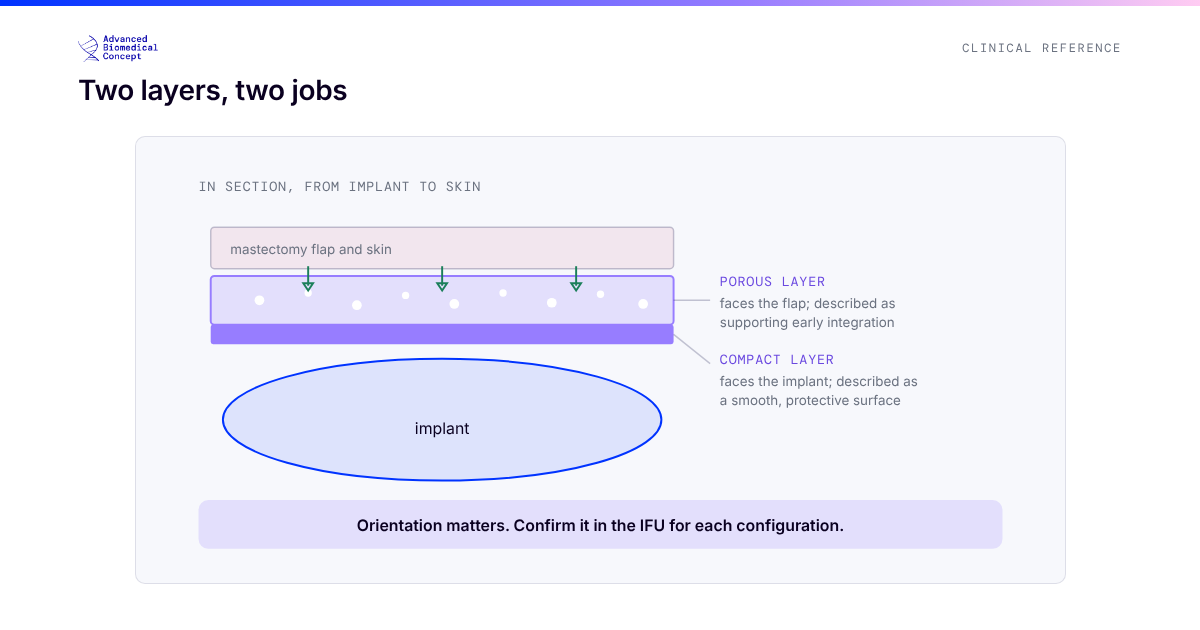
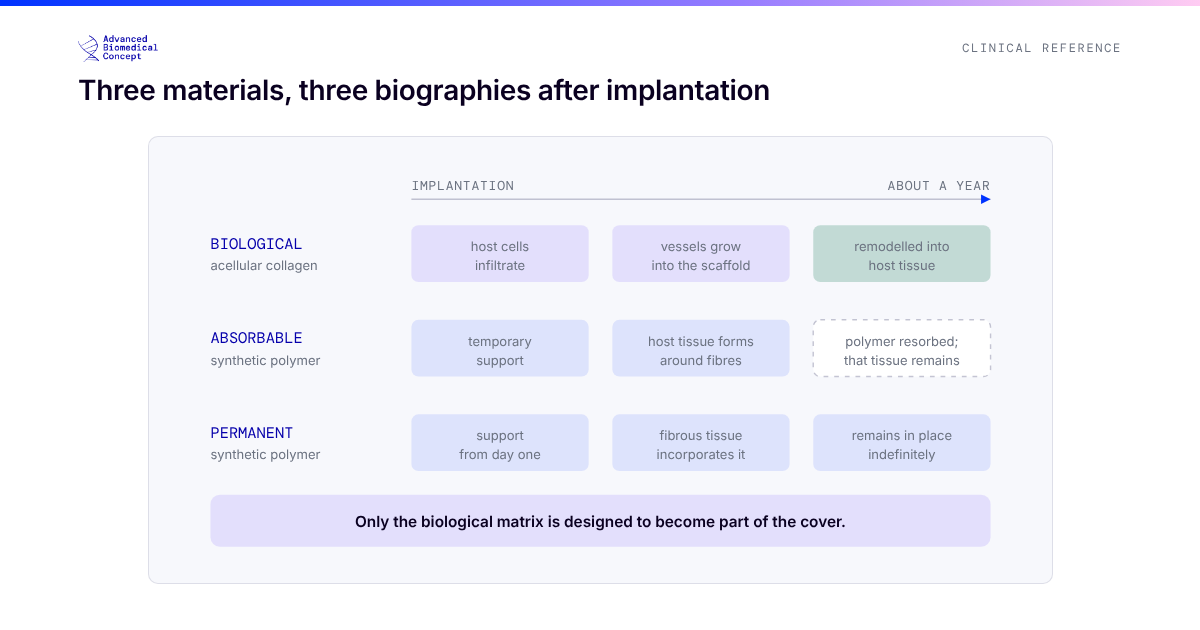
Most modern DTI is performed in the prepectoral plane, and the implant therefore depends on a soft-tissue support layer rather than muscle. A biological matrix or ADM stabilises the pocket, defines the inframammary fold and supports the implant’s weight while integration proceeds. Published DTI series span the material families: ADM-based cohorts dominate the historical literature, and bovine pericardium DTI data now include the De Vita 2024 multicentre prepectoral series (65 breasts, 9.2% major complications, no significant capsular contracture at mean 21.3 months). How the material families compare is covered in our matrix versus ADM guide, and the published brand-level data in our bovine pericardium matrices comparison.
Technique notes from the literature
- Assess flaps after mastectomy, decide then. Consensus guidance keeps DTI, staged expander and delayed pathways all on the table until flap quality is known.
- Respect the envelope. Implant volume should restore, not stress, the skin; sizing to the mastectomy specimen and footprint beats maximising volume.
- Plan the refinement stage. Contour touch-ups with fat grafting are common and expected; building them into the patient conversation from the start avoids disappointment later.
The bottom line
DTI offers a single-operation reconstruction for the well-selected patient: good flaps, a proportionate envelope, favourable biology and a properly supported pocket. The published series agree on the fundamentals while differing in detail, and the safest units are those that treat DTI as a decision made in theatre, not in clinic. For the wider prepectoral pathway, see our prepectoral reconstruction pillar guide.
Key published sources
- Colwell AS. Direct-to-implant breast reconstruction. Gland Surgery. 2015.
- Margulies IG, Salzberg CA. Direct to implant breast reconstruction: visualized technique. Gland Surgery. 2019.
- Highton L, et al. Prepectoral implant-based breast reconstruction: a joint consensus guide. ecancermedicalscience. 2019.
- De Vita R, et al. Prepectoral direct-to-implant reconstruction with acellular bovine pericardium matrix, multicentre series. Clinical Breast Cancer. 2024.
Important information This article is general education, not medical advice. Tap to read the full medical, regulatory & legal notice.
This article is provided by Advanced Biomedical Concept for general informational and educational purposes only. It does not constitute medical, surgical, diagnostic, or other professional healthcare advice, and it is not a substitute for consultation with a suitably qualified healthcare professional. Reading it creates no doctor–patient or other professional relationship. Nothing here should be used to diagnose, treat, cure, or prevent any disease or condition, or to make decisions about medical care. Always seek the advice of a physician or other qualified provider with any questions about a medical condition or treatment, and never disregard or delay professional advice because of something you have read here.
Any reference to Advanced Biomedical Concept products (including ExaShape and ExaFat) is provided for general information only. These are medical devices intended to be used by appropriately trained healthcare professionals strictly in accordance with their applicable, current Instructions for Use (IFU). Regulatory status (including CE marking and classification under the EU Medical Device Regulation), market availability, and approved indications differ between countries and may change over time; a device referred to here may not be available or approved in your country. This content is not intended as, and must not be relied upon as, a statement or claim of safety, clinical performance, or efficacy beyond what is set out in the applicable IFU and current regulatory approvals. Product-specific information is directed at healthcare professionals and is not intended to promote, advertise, or offer any medical device to the general public where such promotion is restricted or prohibited by law.
Statements reflect information believed to be accurate at the date of publication and may be updated or corrected without notice. Any statements regarding the future are expectations or general views, not guarantees. Clinical outcomes depend on many individual factors, results vary from person to person, and no particular result is promised or implied. Where third-party studies, sources, or external links are referenced, they are provided for convenience and information only and do not imply endorsement, and Advanced Biomedical Concept is not responsible for their content.
To the fullest extent permitted by applicable law, Advanced Biomedical Concept and its officers, employees, contributors, and representatives (each acting in that capacity and on behalf of Advanced Biomedical Concept) accept no liability for any loss, injury, or damage of any kind arising directly or indirectly from use of, or reliance on, this content. Nothing in this notice excludes or limits any liability that cannot lawfully be excluded or limited.
Questions about this material can be directed to us via our contact page.
Last reviewed: August 24, 2026.