Advanced Biomedical Concept
Request a Demo For Surgeons For Distributors
🇬🇧 English EN 🇮🇹 Italiano IT 🇫🇷 Français FR 🇩🇪 Deutsch DE 🇪🇸 Español ES 🇵🇹 Português PT 🇹🇷 Türkçe TR 🇸🇦 العربية AR 🇯🇵 日本語 JA

MENU

Request a Demo For Surgeons For Distributors
Category

Clinical Insights

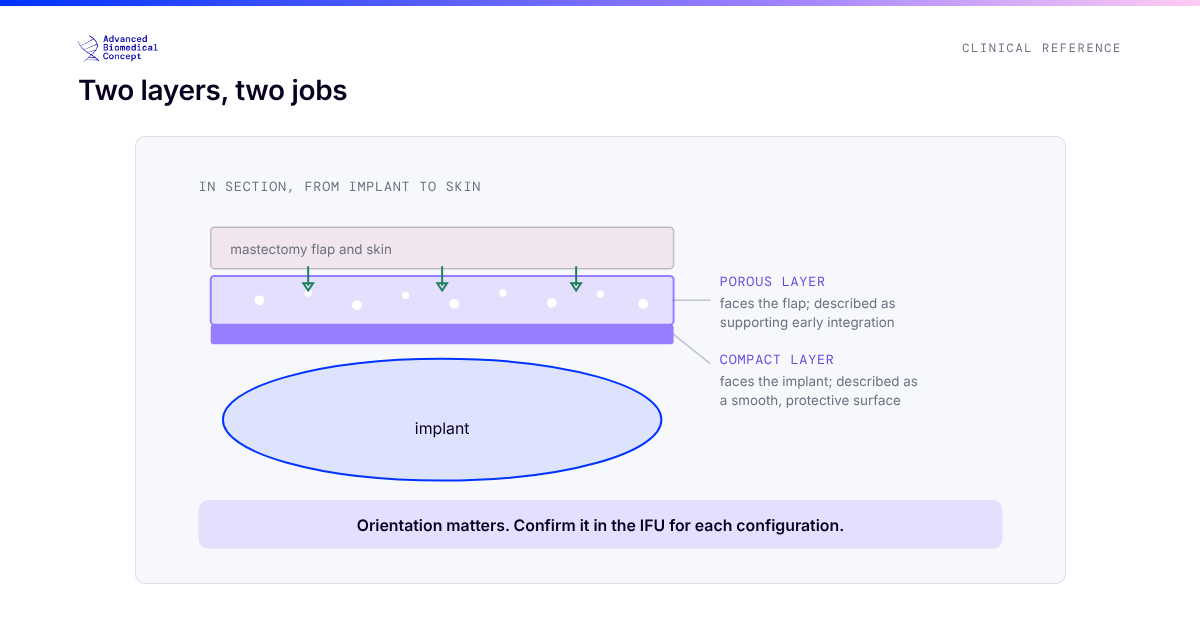
A cross-section from the implant outwards to the skin. Closest to the implant, the compact layer of the membrane, described by the manufacturer as providing a smooth surface towards the device. Above it, the porous layer, described as the side that supports early tissue integration, with small arrows showing cells and vessels entering it from the flap. Above that, the mastectomy flap and skin. A note reminds the reader to confirm orientation in the Instructions for Use for each configuration.
Clinical Insights — 12 October 2026

ExaShape in Practice: Which Configuration, Which Patient, and How to Use It

Why ExaShape, in which cases, which configuration, and how it is used in theatre, from the flap decision to the refinement stage.

Read article →
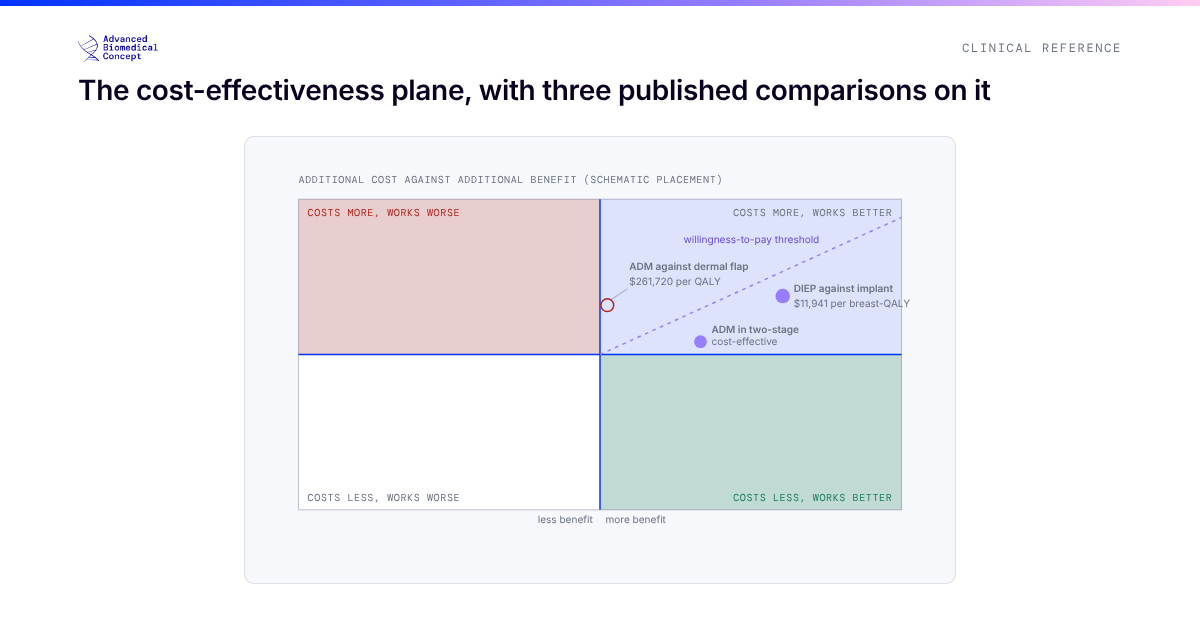
A two-axis diagram. The horizontal axis is additional benefit, the vertical axis additional cost, with the comparator at the centre. The top-right quadrant is more costly and more effective, where the question is whether the extra benefit is worth the extra cost. The bottom-right is cheaper and better, dominant. The top-left is costlier and worse, dominated. Three comparisons are placed schematically. DIEP flap against implant, top right, about 11,941 US dollars per breast-related QALY, judged cost-effective. Dermal matrix in two-stage expander reconstruction against none, just above the origin to the right, judged cost-effective. Dermal matrix against an autologous dermal flap in single-stage reconstruction, slightly above the origin with almost no extra benefit, 261,720 dollars per QALY, judged not cost-effective.
Clinical Insights — 09 October 2026

The Cost-Effectiveness of Breast Reconstruction: What Actually Drives the Numbers

Unit price is the least informative number in reconstruction economics. Complications, theatre time and the number of operations drive cost; the unit…

Read article →
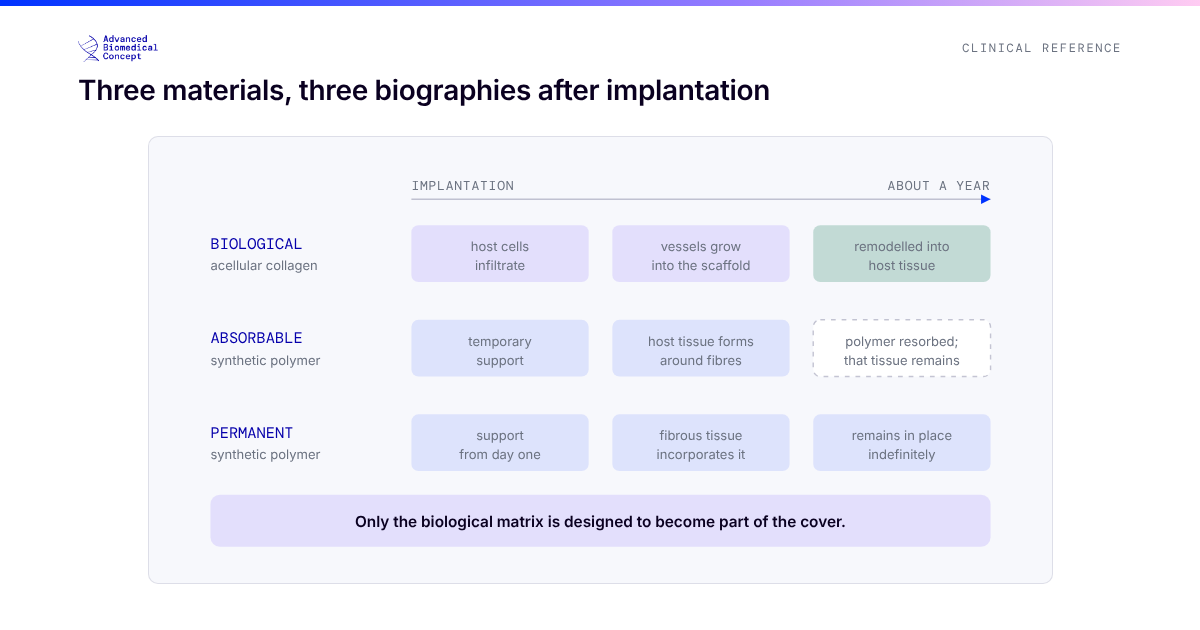
Three horizontal timelines running from implantation to about a year. Biological matrix: host cells infiltrate the collagen scaffold, new vessels grow into it, and it is gradually remodelled into host tissue that becomes part of the soft-tissue cover. Absorbable synthetic mesh: the polymer provides temporary support while it is surrounded by host tissue, then is resorbed over months, leaving the tissue that formed around it. Permanent synthetic mesh: the polymer is surrounded and incorporated by fibrous tissue and remains in place indefinitely. A note states that only the first adds to the cover by becoming tissue, and that the timing varies by product.
Clinical Insights — 06 October 2026

Biologic or Synthetic Mesh in Breast Reconstruction: The Evidence and the Trade-Offs

The randomised head-to-heads favour synthetic mesh on seroma; biological matrices offer integration into thin cover. The choice is made patient by patient.

Read article →
A grid of seven questions. One, what was the design: randomised, prospective cohort or retrospective series. Two, which plane: prepectoral, subpectoral or dual plane. Three, one stage or two: direct-to-implant or expander. Four, who was included: flap thickness, smoking, BMI, radiotherapy, prior surgery. Five, how long was follow-up, since late complications such as capsular contracture need years. Six, how were complications defined and counted: per patient or per breast, minor and major, and whether rippling counts. Seven, who did it and who paid: learning curve, number of surgeons, and conflicts of interest. A closing line states that two numbers are only comparable if the answers match.
Clinical Insights — 03 October 2026

How to Compare Mesh Studies in Breast Reconstruction (and Why 9% and 38% Can Both Be Right)

Headline complication rates for the same material range from under 10% to nearly 40%. Seven questions explain why, and show how to…

Read article →
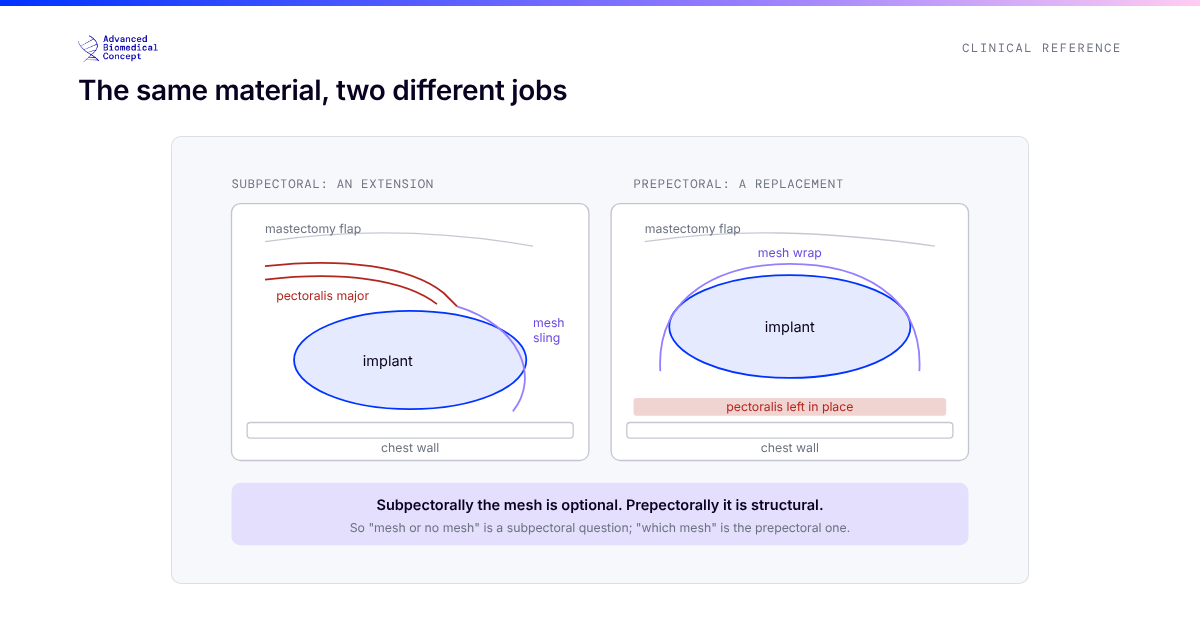
Two cross-sections of a reconstructed breast. On the left, subpectoral placement with a mesh sling: the pectoralis major covers the upper part of the implant and a mesh extends from the lower edge of the muscle to the inframammary fold, covering the lower pole. The mesh here is an extension of the muscle. On the right, prepectoral placement: the muscle is left on the chest wall and the mesh wraps the front of the implant, with the mastectomy flap directly over it. The mesh here replaces the muscle and defines the whole pocket. A note states that in the prepectoral plane the support material is structural rather than optional.
Clinical Insights — 30 September 2026

Meshes and Matrices in Breast Reconstruction: What They Do and What the Evidence Says

"Mesh" is a family, not a product. Subpectorally the question is whether to use one; prepectorally it is which one, configured how.

Read article →
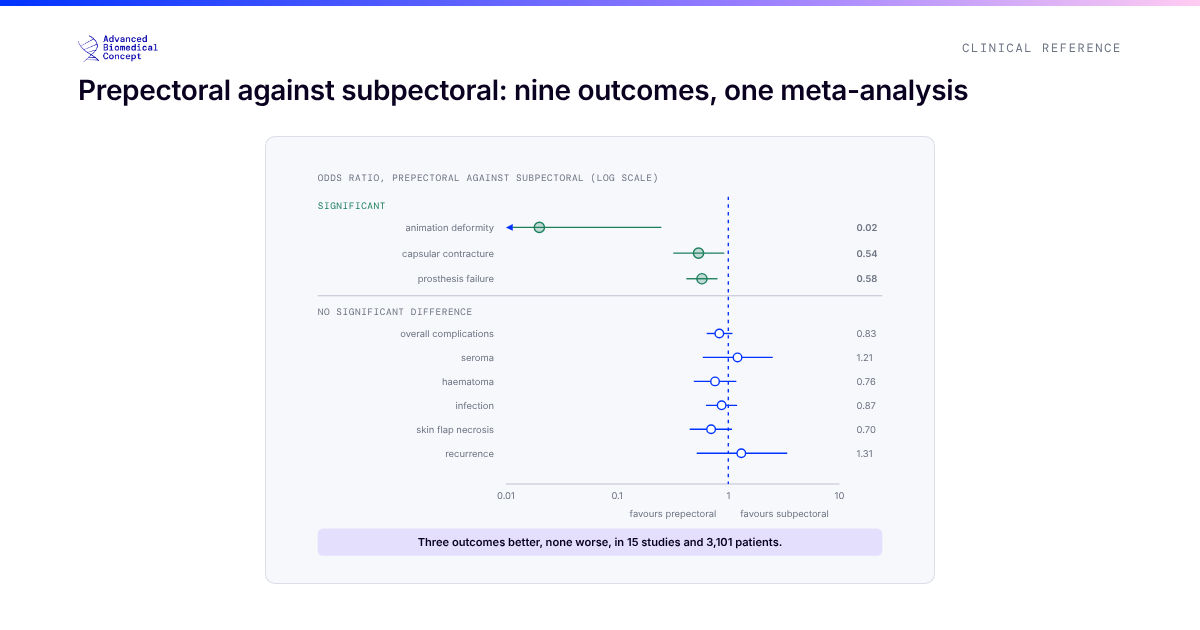
A forest plot on a logarithmic scale from 0.01 to 10, with a vertical line at 1 meaning no difference and values to the left favouring prepectoral placement. Three outcomes have intervals entirely left of 1: animation deformity, odds ratio 0.02 with interval 0.00 to 0.25; capsular contracture, 0.54 with interval 0.32 to 0.92; prosthesis failure, 0.58 with interval 0.42 to 0.80. Six outcomes have intervals crossing 1, meaning no significant difference: overall complications 0.83, seroma 1.21, haematoma 0.76, infection 0.87, skin flap necrosis 0.70, and recurrence 1.31.
Clinical Insights — 27 September 2026

Prepectoral or Subpectoral: What the Evidence Now Shows

Pooled data favour prepectoral placement on three outcomes and disfavour it on none. The evidence is consistent but observational, and the first…

Read article →
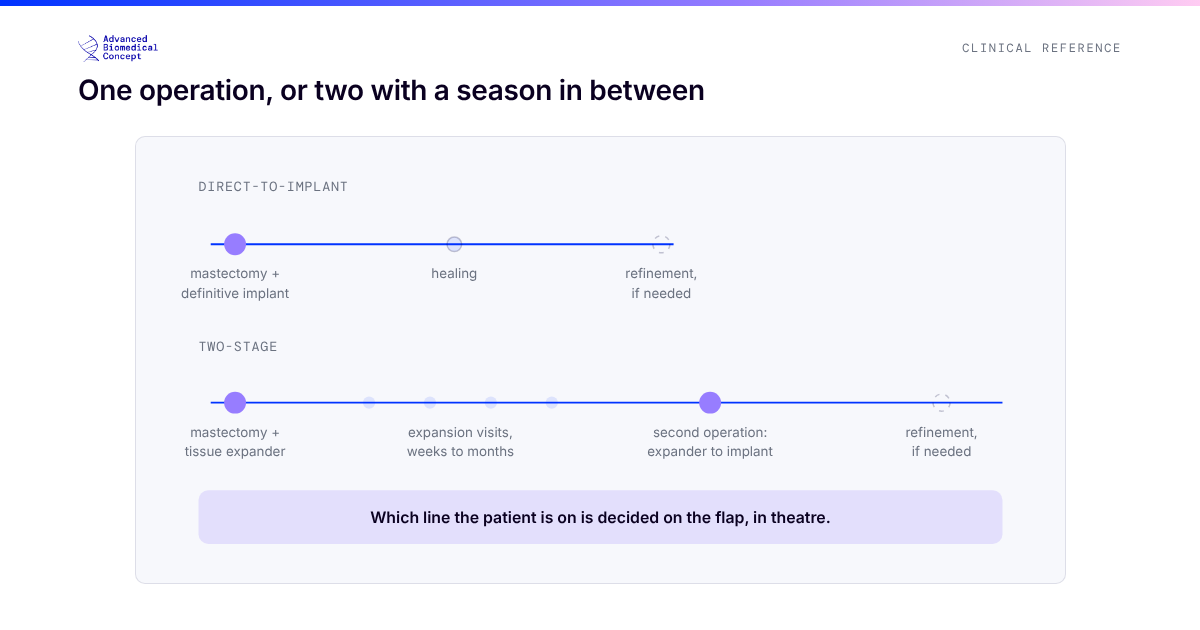
Two timelines running left to right. Direct-to-implant: mastectomy and definitive implant in one operation, then healing, then optional refinement such as fat grafting. Two-stage: mastectomy with a tissue expander, then a series of expansion visits over several weeks to months, then a second operation to exchange the expander for the definitive implant, then optional refinement. A note states that the first operation decides which line the patient is on, and that the decision rests on the mastectomy flap.
Clinical Insights — 24 September 2026

Direct-to-Implant or Two-Stage: Reading a Meta-Analysis, a Trial and a Cohort Together

A meta-analysis, a randomised trial and a prospective cohort give three different answers. Selection on the mastectomy flap explains all three.

Read article →
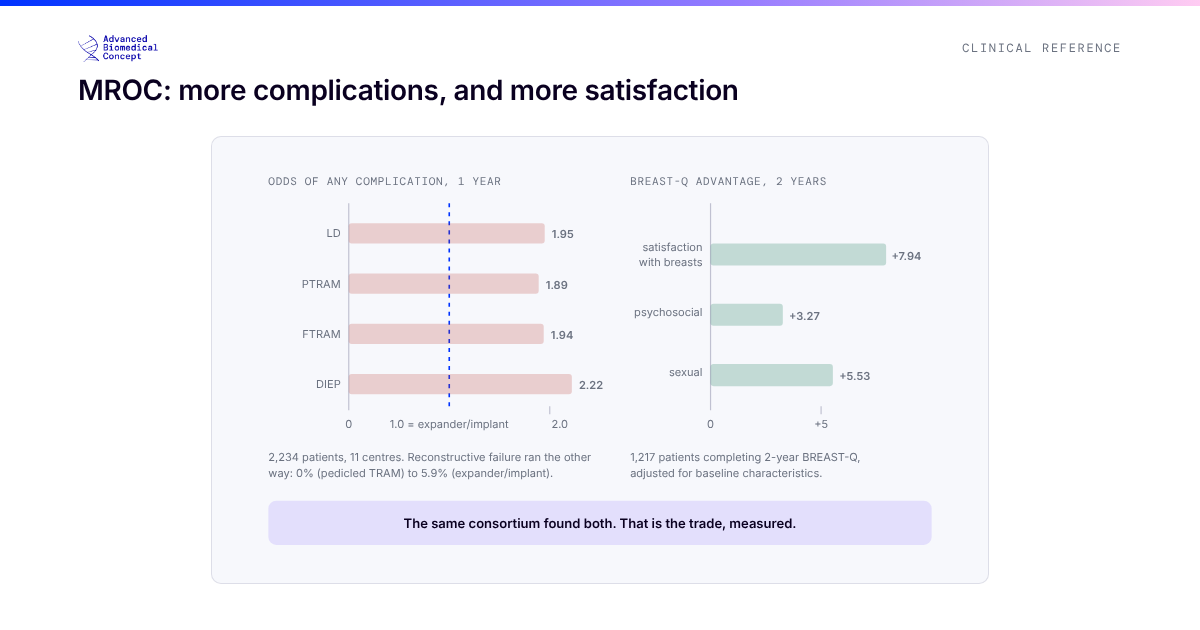
Two panels from the Mastectomy Reconstruction Outcomes Consortium. Left panel: adjusted odds of any complication at one year for each autologous technique relative to expander and implant reconstruction, which is set at 1.0. Latissimus dorsi 1.95, pedicled TRAM 1.89, free TRAM 1.94, DIEP 2.22. Right panel: the adjusted BREAST-Q advantage for autologous reconstruction at two years. Satisfaction with breasts plus 7.94 points, psychosocial well-being plus 3.27, sexual well-being plus 5.53. A closing line states that the same study found autologous techniques carry more complications and deliver more satisfaction.
Clinical Insights — 21 September 2026

Implant-Based or Autologous Reconstruction: What the Comparative Evidence Shows

The best comparative study measured both trades at once: autologous tissue scores higher on satisfaction, implants carry fewer complications. The choice is…

Read article →
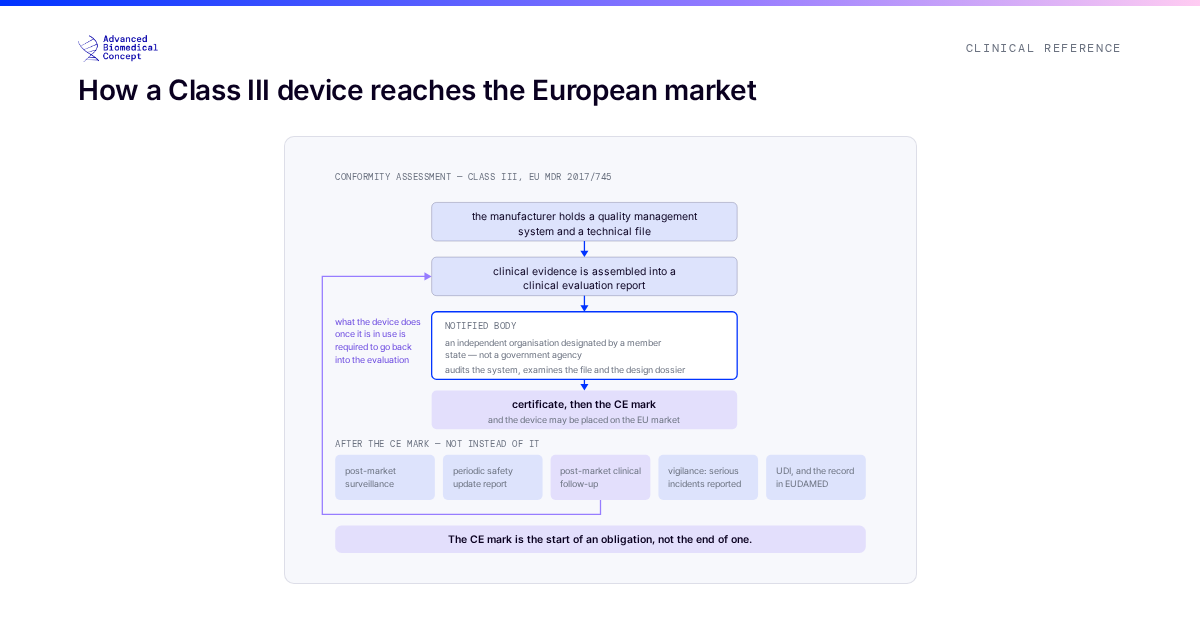
The conformity assessment route for a high-risk implantable device under EU Regulation 2017/745. A manufacturer holds a quality management system and a technical file, assembles clinical evidence into a clinical evaluation report, and submits both to a notified body, which is an independent organisation designated by a member state rather than a government agency. The notified body audits the system and examines the file and, for this class, the design dossier. A certificate allows the CE mark and market access. After launch the obligations continue: post-market surveillance, a periodic safety update report, post-market clinical follow-up feeding back into the clinical evaluation, and vigilance reporting of serious incidents. The device carries a unique device identifier and its data are registered in the European database, EUDAMED. The loop is drawn as continuing rather than ending at approval.
Clinical Insights — 19 September 2026

What the CE Mark Tells You, and the Six Questions It Does Not Answer

The CE mark answers whether a device meets the regulation for its intended purpose. It does not answer whether it is the…

Read article →
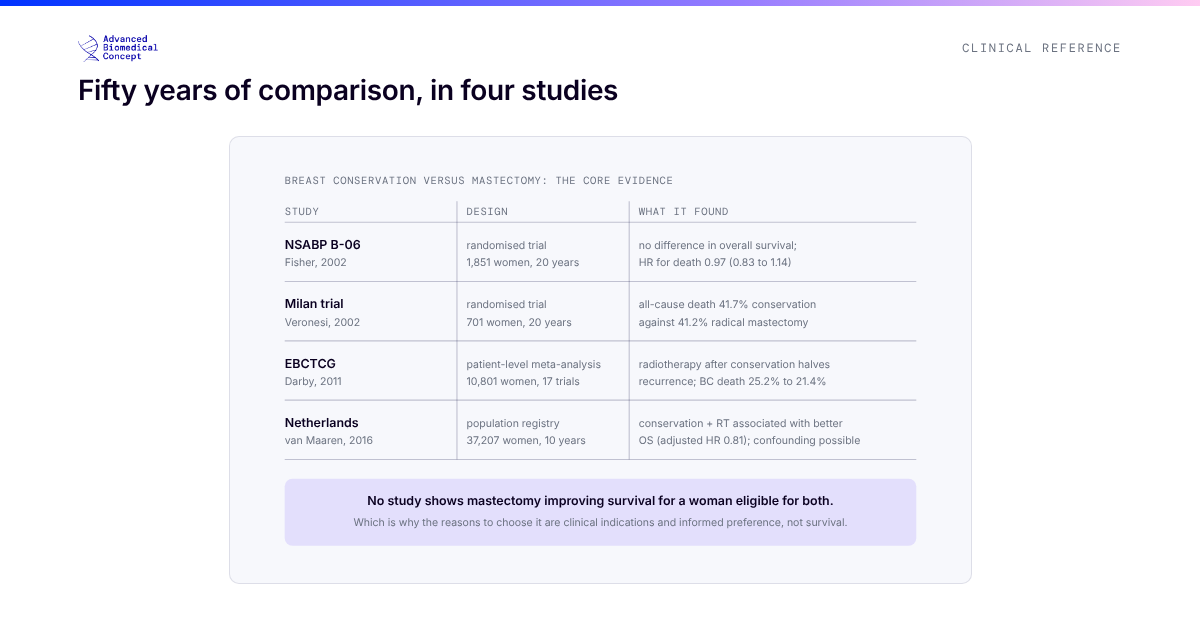
A four-row evidence table comparing breast-conserving surgery with mastectomy. Row one, NSABP B-06, a randomised trial of 1,851 women: no survival difference at twenty years, hazard ratio for death 0.97 for lumpectomy with radiotherapy against mastectomy. Row two, the Milan trial, randomised, 701 women: all-cause death 41.7 percent against 41.2 percent at twenty years. Row three, the EBCTCG meta-analysis of 10,801 women: radiotherapy after conservation halves recurrence and reduces breast cancer death. Row four, a Dutch registry of 37,207 women: conservation with radiotherapy associated with better ten-year overall survival, with confounding by severity possible. A closing line notes that no study shows mastectomy improving survival for a woman eligible for both.
Clinical Insights — 18 September 2026

When Mastectomy Is Chosen: What the Evidence Says, and What Reconstruction Owes the Patient

Fifty years of trials say conservation is at least as safe as mastectomy for eligible women. When mastectomy is the plan, the…

Read article →

Posts navigation

1 2 … 7 Older →
Advanced Biomedical Concept

Innovators in breast reconstruction surgery. CE-marked biological membranes and surgical support devices. Founded 2020, Rome, Italy.

info@advancedbioconcept.it

Company

  • Our Story
  • Meet the Team
  • Testimonials & Quotes
  • Events
  • Certifications
  • Products

  • Exashape Line
  • Exafat Kit
  • Clinical Guides

    Biological Matrix for Breast Reconstruction Prepectoral Breast Reconstruction Rigottomia (Rigottomy): The Technique Explained Biological Matrix, ADM & Synthetic Mesh: A Clinical Comparison View all clinical guides →

    For Professionals

    Clinical StudiesE-LearningContact

    Tools

  • Decision Simulator
  • Media Kit
  • Exashape Evidence Library
  • Cost-Per-Case Calculator
  • Breast Reconstruction Options ExplorerDRAFT Libra

    © 2026 Advanced Biomedical Concept Srl. All rights reserved. — P.IVA: 15657681001

    Privacy PolicyCookie settings For Healthcare Professionals Only. CE marked per EU MDR 2017/745.
    Advanced Biomedical Concept
    Discover what we make

    From the ExaShape® biological matrix for breast reconstruction to the EXAFAT® fat-grafting system — explore the full range of ABC devices.

    Explore our products →

    We value your privacy We use essential cookies to make our site work. With your consent we may also use cookies to analyse traffic and improve your experience. See our Privacy Policy and Cookie Policy.

    How can we help?

    Send us a message and our team will get back to you within 1–2 business days.
    We typically reply within 1–2 business days.