Implant-based and autologous reconstruction are usually presented to patients as two options on a menu. The evidence suggests a more useful framing: they trade different things, they trade them on different timescales, and the best-designed study of the question so far finds that neither wins on every axis. Autologous reconstruction tends to deliver higher long-term satisfaction. Implant-based reconstruction tends to deliver fewer complications, a shorter operation and a faster recovery. Which of those matters more is a question about the patient, not the technique.
This article sets out what the comparative evidence actually shows, where it is strongest, and where modern implant-based technique is trying to narrow the gap.
How the balance shifted
Implant reconstruction became the dominant technique in the United States in the early 2000s. Using the Nationwide Inpatient Sample, Albornoz and colleagues found that immediate reconstruction rose from 20.8% to 37.8% of mastectomies between 1998 and 2008, almost entirely because implant use grew by an average of 11% per year while autologous rates stayed flat. Implants overtook autologous techniques as the leading method after 2002, and the rise tracked the growth in bilateral mastectomy.1
The reason is not mysterious. Bilateral reconstruction with flaps is a long, demanding operation that needs microsurgical capacity; bilateral reconstruction with implants is shorter, reproducible, and leaves no donor site. As bilateral and risk-reducing mastectomy became more common, implants were the technique that scaled.
The best comparative evidence: MROC
Most early comparisons were single-centre and retrospective. The Mastectomy Reconstruction Outcomes Consortium (MROC) changed that: a prospective study across 11 North American centres and 57 surgeons, collecting complications and BREAST-Q scores before surgery and at fixed intervals afterwards.
Complications. In 2,234 patients at one year, every autologous technique carried higher odds of a complication than expander/implant reconstruction, after adjusting for site, demographic and clinical variables: latissimus dorsi OR 1.95, pedicled TRAM 1.89, free TRAM 1.94, DIEP 2.22. For major complications needing readmission or reoperation, pedicled TRAM and DIEP remained significantly higher. Reconstructive failure, however, ran the other way: from 0% for pedicled TRAM to 5.9% for expander/implant.2
Patient-reported outcomes. In the same consortium, at two years, autologous patients reported greater satisfaction with their breasts (adjusted difference 7.94 points), psychosocial well-being (3.27) and sexual well-being (5.53) than implant patients.3
The longer view comes from Memorial Sloan Kettering, where Nelson and colleagues followed BREAST-Q in 3,268 patients over eight years. Autologous patients reported higher satisfaction with their breasts at every time point. But the implant group’s scores were stable over the whole period: implant patients did not, on average, become progressively less satisfied as the years passed.4 That stability is often lost in summaries of the study, and it matters for counselling.
Reading the comparison properly
Three caveats keep these findings honest.
Selection runs both ways. Patients are not randomised between implants and flaps. Those offered autologous reconstruction may have more donor tissue, larger and more ptotic breasts, or a history of radiotherapy; those offered implants are more often bilateral and prophylactic. Adjustment helps, but it cannot remove the effect of a surgeon’s judgement about who suits which operation.
The implant techniques studied are mostly older. The MROC cohorts were recruited between 2012 and 2015, and the implant arm was predominantly two-stage expander/implant reconstruction, much of it subpectoral. Prepectoral placement, direct-to-implant reconstruction and contemporary matrices were a small share or absent. Whether modern implant technique narrows the satisfaction gap is a reasonable hypothesis, not yet a demonstrated result.
Complications are not all equal. A donor-site wound problem after a DIEP flap and a periprosthetic infection leading to explantation are both “complications”, with very different consequences. The odds ratios above count events; they do not weigh them.
What decides it for a given patient
With the evidence read that way, the choice becomes a matching exercise.
Radiotherapy is the factor that moves the balance most consistently. Irradiated tissue tolerates an implant less well, and contracture and failure rates rise; many surgeons will favour autologous tissue when radiotherapy is certain, or plan an implant reconstruction knowing that fat grafting or conversion may follow. The wider interaction is covered in radiotherapy and implant-based reconstruction.
Laterality and indication push the other way. A young carrier having bilateral risk-reducing mastectomy, with a good envelope and limited abdominal tissue, is the patient for whom implant reconstruction was made.
The patient’s priorities are a legitimate input. A patient who wants to be back at work in weeks and has no wish for a second scar is weighing the evidence correctly when she chooses an implant, even knowing the average satisfaction scores.
Cost-effectiveness: the counterintuitive finding
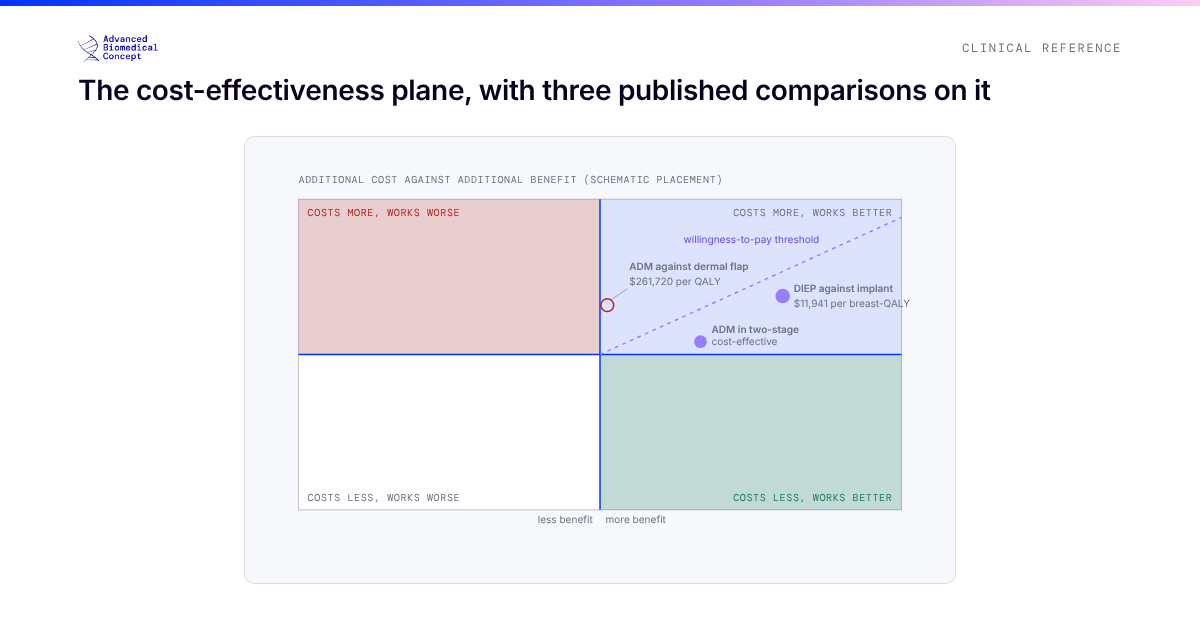
Autologous reconstruction costs more up front. Matros and colleagues asked whether it is worth it, using BREAST-Q scores to estimate breast-related quality of life. The extra cost of a unilateral DIEP flap over an implant was $11,941 per breast-related quality-adjusted life year, and $28,017 for bilateral reconstruction; the value was greatest in younger patients with earlier-stage disease, who live longest with the result.5 By the thresholds commonly used in health economics, that makes DIEP cost-effective, especially unilaterally. The broader economics, including where matrices fit, are discussed in the cost-effectiveness of reconstruction.
Where implant-based reconstruction is trying to close the gap
If autologous tissue wins on satisfaction, the reasons are not hard to identify: it is warm, soft, ages with the patient, and has no device-related complications such as contracture, rippling or animation. Contemporary implant technique targets each of those deliberately.
Animation and pain are addressed by placing the implant in front of the muscle. A meta-analysis of 3,101 patients found prepectoral placement associated with markedly less animation deformity and less capsular contracture than subpectoral placement.6
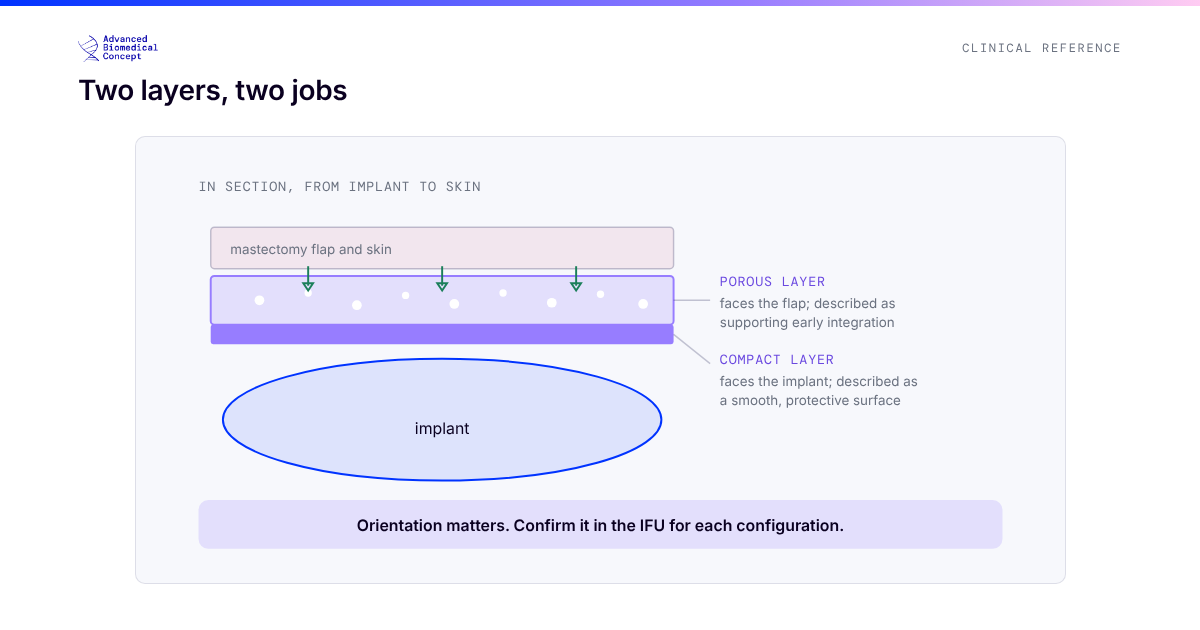
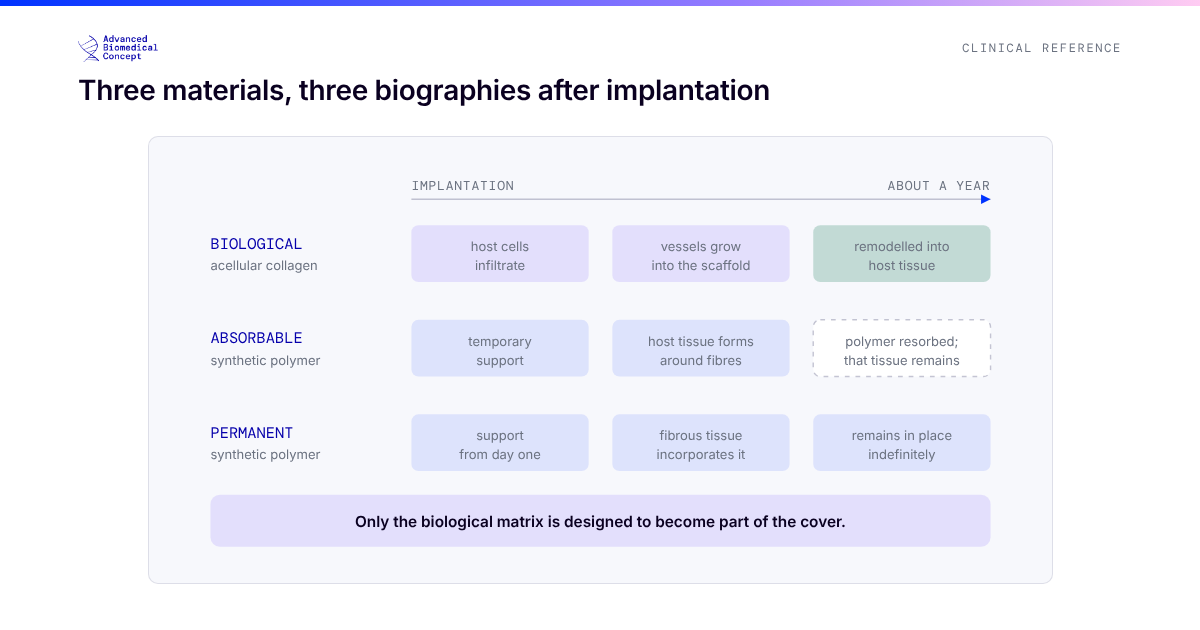
Implant position and the lower pole are addressed by a matrix that defines the pocket. ExaShape®, a bilayer bovine pericardium membrane, is designed for this role, with pocket configurations that wrap the implant before placement; the published multicentre experience with a bovine pericardium pocket in direct-to-implant prepectoral reconstruction reported low major complication rates over a mean of 21 months.7
Thin cover and rippling are addressed by staged fat grafting, which turns an implant reconstruction into a hybrid. Here the quality of the graft matters as much as the volume; closed-loop processing such as EXAFAT® is intended to deliver a cleaner, more consistent graft for exactly this refinement stage. The mechanics of retention are covered in what determines fat graft retention.
None of this has yet been shown, in a study the size of MROC, to equalise patient-reported outcomes between implant and autologous reconstruction. It is the direction the field is moving, and it is the question the next generation of comparative studies needs to answer.
The short version
Autologous reconstruction delivers higher average satisfaction and costs more; implant reconstruction delivers fewer complications, a quicker recovery and stable long-term satisfaction. The best evidence measured both at once and did not pick a winner. For a patient whose features and priorities point to an implant, the job is to make that implant reconstruction as close to autologous as technique allows, with the muscle spared, the pocket supported and the cover refined.
References
- Albornoz CR, Bach PB, Mehrara BJ, et al. A paradigm shift in U.S. breast reconstruction: increasing implant rates. Plast Reconstr Surg. 2013;131(1):15-23. doi:10.1097/PRS.0b013e3182729cde
- Wilkins EG, Hamill JB, Kim HM, et al. Complications in postmastectomy breast reconstruction: one-year outcomes of the Mastectomy Reconstruction Outcomes Consortium (MROC) study. Ann Surg. 2018;267(1):164-170. doi:10.1097/SLA.0000000000002033
- Santosa KB, Qi J, Kim HM, Hamill JB, Wilkins EG, Pusic AL. Long-term patient-reported outcomes in postmastectomy breast reconstruction. JAMA Surg. 2018;153(10):891-899. doi:10.1001/jamasurg.2018.1677
- Nelson JA, Allen RJ, Polanco T, et al. Long-term patient-reported outcomes following postmastectomy breast reconstruction: an 8-year examination of 3268 patients. Ann Surg. 2019;270(3):473-483. doi:10.1097/SLA.0000000000003467
- Matros E, Albornoz CR, Razdan SN, et al. Cost-effectiveness analysis of implants versus autologous perforator flaps using the BREAST-Q. Plast Reconstr Surg. 2015;135(4):937-946. doi:10.1097/PRS.0000000000001134
- Ostapenko E, Nixdorf L, Devyatko Y, Exner R, Wimmer K, Fitzal F. Prepectoral versus subpectoral implant-based breast reconstruction: a systemic review and meta-analysis. Ann Surg Oncol. 2023;30(1):126-136. doi:10.1245/s10434-022-12567-0
- De Vita R, Mangialardi ML, Pozzi M, et al. A pericardium bovine matrix pocket in DTI prepectoral breast reconstruction. Clin Breast Cancer. 2024;24(7):e613-e621. doi:10.1016/j.clbc.2024.06.004. Disclosure: the first author is a consultant for ExaShape.
This article is educational material for healthcare professionals. The choice of reconstructive technique is an individual decision made by the surgeon and patient; nothing here is a recommendation for a specific patient. ExaShape® and EXAFAT® are CE marked per EU MDR 2017/745 and are for professional use only.
Important information This article is general education, not medical advice. Tap to read the full medical, regulatory & legal notice.
This article is provided by Advanced Biomedical Concept for general informational and educational purposes only. It does not constitute medical, surgical, diagnostic, or other professional healthcare advice, and it is not a substitute for consultation with a suitably qualified healthcare professional. Reading it creates no doctor–patient or other professional relationship. Nothing here should be used to diagnose, treat, cure, or prevent any disease or condition, or to make decisions about medical care. Always seek the advice of a physician or other qualified provider with any questions about a medical condition or treatment, and never disregard or delay professional advice because of something you have read here.
Any reference to Advanced Biomedical Concept products (including ExaShape and ExaFat) is provided for general information only. These are medical devices intended to be used by appropriately trained healthcare professionals strictly in accordance with their applicable, current Instructions for Use (IFU). Regulatory status (including CE marking and classification under the EU Medical Device Regulation), market availability, and approved indications differ between countries and may change over time; a device referred to here may not be available or approved in your country. This content is not intended as, and must not be relied upon as, a statement or claim of safety, clinical performance, or efficacy beyond what is set out in the applicable IFU and current regulatory approvals. Product-specific information is directed at healthcare professionals and is not intended to promote, advertise, or offer any medical device to the general public where such promotion is restricted or prohibited by law.
Statements reflect information believed to be accurate at the date of publication and may be updated or corrected without notice. Any statements regarding the future are expectations or general views, not guarantees. Clinical outcomes depend on many individual factors, results vary from person to person, and no particular result is promised or implied. Where third-party studies, sources, or external links are referenced, they are provided for convenience and information only and do not imply endorsement, and Advanced Biomedical Concept is not responsible for their content.
To the fullest extent permitted by applicable law, Advanced Biomedical Concept and its officers, employees, contributors, and representatives (each acting in that capacity and on behalf of Advanced Biomedical Concept) accept no liability for any loss, injury, or damage of any kind arising directly or indirectly from use of, or reliance on, this content. Nothing in this notice excludes or limits any liability that cannot lawfully be excluded or limited.
Questions about this material can be directed to us via our contact page.
Last reviewed: October 15, 2026.