Hospitals buy devices at a unit price. Patients and payers experience reconstruction as a whole pathway: operations, nights in hospital, clinic visits, complications, revisions, and years of living with the result. Most arguments about the cost of breast reconstruction confuse the two. A matrix that costs more per sheet can make a case cheaper if it removes an operation, and a cheaper pathway can be the more expensive one if it fails more often. This article sets out how cost-effectiveness is measured in reconstruction, what the published analyses actually found, and what drives the numbers.
Three different questions that all get called “cost”
A cost analysis asks which pathway costs less, assuming the outcomes are the same. A cost-effectiveness analysis asks how much extra it costs to gain an extra unit of benefit. A cost-utility analysis measures that benefit in quality-adjusted life years (QALYs), a unit that combines length and quality of life, and reports an incremental cost-effectiveness ratio: the extra cost per QALY gained. In breast reconstruction, the quality component is often derived from BREAST-Q scores or expert utility estimates.
The perspective matters too. A payer counts reimbursements; a hospital counts its own resource use; a societal analysis adds patients’ lost work and travel. Two analyses of the same operations can reach different conclusions simply by standing in different places.
What the published analyses found
Autologous against implant. Using BREAST-Q scores from 526 patients, Matros and colleagues found a unilateral DIEP flap cost an additional $11,941 per breast-related QALY compared with implant reconstruction, and a bilateral DIEP $28,017. Both fall within conventional thresholds, and value was greatest in younger women with earlier-stage disease, who live longest with the benefit.1 Autologous reconstruction costs more and, on this measure, is worth it. That is a useful corrective to the assumption that the cheapest pathway is the most cost-effective.
A matrix in expander reconstruction. A decision model of two-stage expander reconstruction found that adding a human dermal matrix increased cost by $361.96 per case, with overall complication rates of 30% with the matrix and 34.5% without, and concluded that it was cost-effective even at retail prices.2
A matrix against an alternative. The same group compared a dermal matrix with an autologous dermal flap in single-stage reconstruction, in patients with breasts large and ptotic enough to provide one. The matrix added cost for almost no measurable gain, an incremental ratio of $261,720 per QALY, and was not cost-effective unless the dermal flap’s complication rate exceeded about 20%.3 The lesson is not that matrices are poor value; it is that value depends on the alternative.
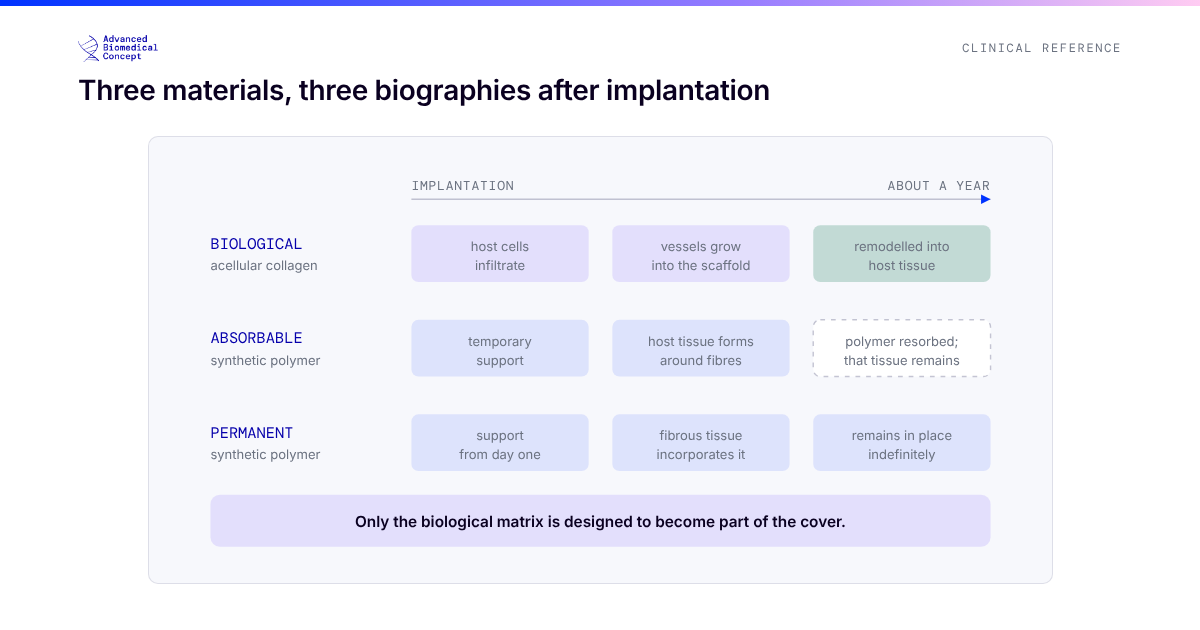
DTI against two-stage. Removing an operation should make direct-to-implant reconstruction cheaper, and the second operation the patient avoids can pay for the support material, provided the single stage goes well. Published single-institution data suggest the difference is smaller than that logic implies.
Two single-institution analyses show why. At Massachusetts General Hospital, total costs did not differ significantly between DTI with a matrix and expander reconstruction.4 In 548 patients at the same institution, subpectoral reconstruction appeared more costly than prepectoral overall, but the difference disappeared after accounting for laterality and staging; the apparent prepectoral advantage came from its association with single-stage reconstruction.5 In a smaller Chinese comparison, bovine pericardium-assisted reconstruction, latissimus dorsi-assisted reconstruction and two-stage reconstruction had similar hospitalisation costs.6
Complications are the real cost driver
Every model above is most sensitive to the same variable: what goes wrong. An implant loss means readmission, often antibiotics, an explantation, and a delayed reconstruction months later. It costs more than any matrix, and it erases the saving of an avoided second stage several times over. At national scale those events are not rare.8
This is why the most useful economic unit in reconstruction is not the price of a sheet but the cost per completed reconstruction: everything spent, divided by the number of patients who end the pathway with the reconstruction they were promised. A material that adds a few hundred to the case but prevents one implant loss in fifty is cheap. A material that saves a few hundred but adds seromas that need drainage and readmission is not. The site’s cost-per-case calculator is built around that unit, and the procurement view is covered in the cost of biological matrices.
Where ExaShape and EXAFAT sit in the arithmetic
Three levers from the analyses above are under the surgical team’s control, and the ABC devices were designed around them.
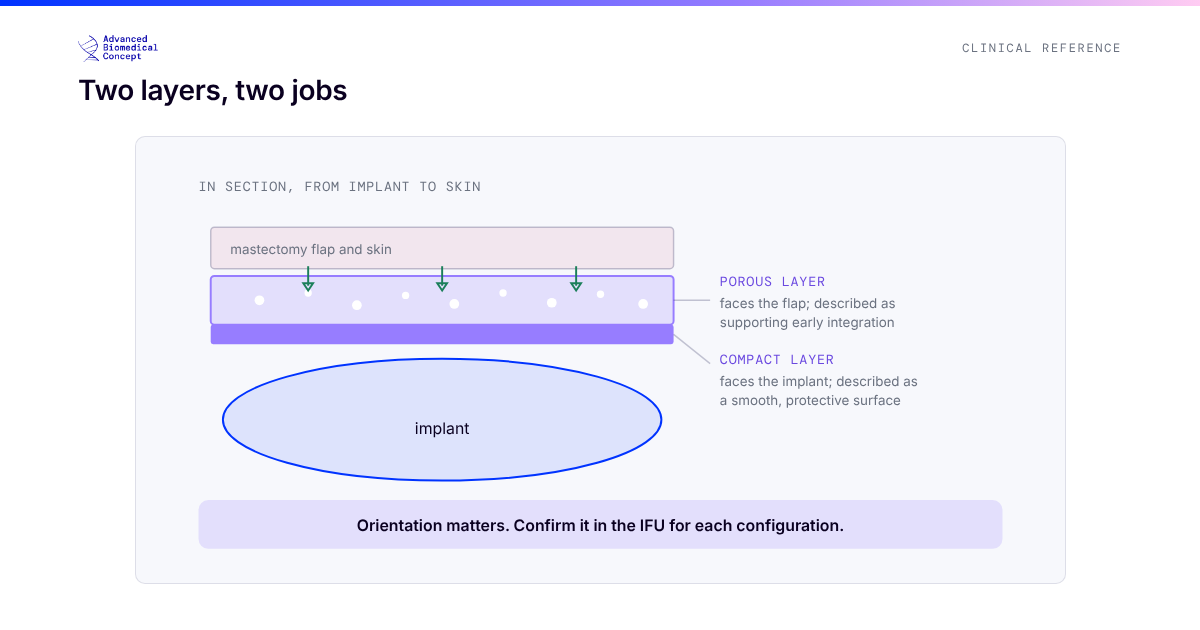
Removing a stage. The strongest economic case for a support material is that it allows a selected patient to complete reconstruction in one operation. ExaShape® BioShield Pockets are designed for prepectoral direct-to-implant reconstruction, where that saving is realised.
Theatre time. Operating time is one of the largest direct costs of any reconstruction, and a long single stage can absorb the saving of the stage it replaced. Pre-shaped pockets that are wrapped around the implant on a back table, in parallel with haemostasis and drain placement, are intended to keep the reconstructive step short; in the published pericardium pocket series, mean total operative time was 1.42 hours.7
Refinement sessions. Fat grafting after prepectoral reconstruction is common, and every additional session is an additional operation. Graft quality affects how much volume each session retains, which is the rationale for closed-loop processing such as EXAFAT®. Formal economic evaluation of processing systems in breast reconstruction has not yet been published, and this is an area where good data would be valuable.
None of these is a cost-effectiveness claim for a specific device; that would need a formal analysis with device-specific outcome data. They are the variables any such analysis would turn on.
The short version
Unit price is the least informative number in reconstruction economics. Published analyses find autologous reconstruction cost-effective against implants, matrices cost-effective in some comparisons and not others, and DTI at least cost-neutral against two-stage when it goes well. The common thread is that complications, theatre time and the number of operations drive cost far more than the device. The right unit to manage is the cost per completed reconstruction.
References
- Matros E, Albornoz CR, Razdan SN, et al. Cost-effectiveness analysis of implants versus autologous perforator flaps using the BREAST-Q. Plast Reconstr Surg. 2015;135(4):937-946. doi:10.1097/PRS.0000000000001134
- Krishnan NM, Chatterjee A, Rosenkranz KM, et al. The cost effectiveness of acellular dermal matrix in expander-implant immediate breast reconstruction. J Plast Reconstr Aesthet Surg. 2014;67(4):468-476. doi:10.1016/j.bjps.2013.12.035
- Krishnan NM, Chatterjee A, Van Vliet MM, et al. A comparison of acellular dermal matrix to autologous dermal flaps in single-stage, implant-based immediate breast reconstruction: a cost-effectiveness analysis. Plast Reconstr Surg. 2013;131(5):953-961. doi:10.1097/PRS.0b013e3182865a24
- Colwell AS, Damjanovic B, Zahedi B, Medford-Davis L, Hertl C, Austen WG. Retrospective review of 331 consecutive immediate single-stage implant reconstructions with acellular dermal matrix: indications, complications, trends, and costs. Plast Reconstr Surg. 2011;128(6):1170-1178. doi:10.1097/PRS.0b013e318230c2f6
- Chinta S, Koh DJ, Sobti N, et al. Cost analysis of pre-pectoral implant-based breast reconstruction. Sci Rep. 2022;12(1):17512. doi:10.1038/s41598-022-21675-6
- Wang S, He S, Zhang X, et al. Acellular bovine pericardium matrix in immediate breast reconstruction compared with conventional implant-based breast reconstruction. JPRAS Open. 2021;29:1-9. doi:10.1016/j.jpra.2021.03.005
- De Vita R, Mangialardi ML, Pozzi M, et al. A pericardium bovine matrix pocket in DTI prepectoral breast reconstruction. Clin Breast Cancer. 2024;24(7):e613-e621. doi:10.1016/j.clbc.2024.06.004. Disclosure: the first author is a consultant for ExaShape.
- Potter S, Conroy EJ, Cutress RI, et al. Short-term safety outcomes of mastectomy and immediate implant-based breast reconstruction with and without mesh (iBRA): a multicentre, prospective cohort study. Lancet Oncol. 2019;20(2):254-266. doi:10.1016/S1470-2045(18)30781-2
This article is educational material for healthcare professionals and procurement teams. Costs are reported in the currency and year of each study and are not directly comparable. No cost-effectiveness claim is made for any specific product. ExaShape® and EXAFAT® are CE marked per EU MDR 2017/745 and are for professional use only.
Important information This article is general education, not medical advice. Tap to read the full medical, regulatory & legal notice.
This article is provided by Advanced Biomedical Concept for general informational and educational purposes only. It does not constitute medical, surgical, diagnostic, or other professional healthcare advice, and it is not a substitute for consultation with a suitably qualified healthcare professional. Reading it creates no doctor–patient or other professional relationship. Nothing here should be used to diagnose, treat, cure, or prevent any disease or condition, or to make decisions about medical care. Always seek the advice of a physician or other qualified provider with any questions about a medical condition or treatment, and never disregard or delay professional advice because of something you have read here.
Any reference to Advanced Biomedical Concept products (including ExaShape and ExaFat) is provided for general information only. These are medical devices intended to be used by appropriately trained healthcare professionals strictly in accordance with their applicable, current Instructions for Use (IFU). Regulatory status (including CE marking and classification under the EU Medical Device Regulation), market availability, and approved indications differ between countries and may change over time; a device referred to here may not be available or approved in your country. This content is not intended as, and must not be relied upon as, a statement or claim of safety, clinical performance, or efficacy beyond what is set out in the applicable IFU and current regulatory approvals. Product-specific information is directed at healthcare professionals and is not intended to promote, advertise, or offer any medical device to the general public where such promotion is restricted or prohibited by law.
Statements reflect information believed to be accurate at the date of publication and may be updated or corrected without notice. Any statements regarding the future are expectations or general views, not guarantees. Clinical outcomes depend on many individual factors, results vary from person to person, and no particular result is promised or implied. Where third-party studies, sources, or external links are referenced, they are provided for convenience and information only and do not imply endorsement, and Advanced Biomedical Concept is not responsible for their content.
To the fullest extent permitted by applicable law, Advanced Biomedical Concept and its officers, employees, contributors, and representatives (each acting in that capacity and on behalf of Advanced Biomedical Concept) accept no liability for any loss, injury, or damage of any kind arising directly or indirectly from use of, or reliance on, this content. Nothing in this notice excludes or limits any liability that cannot lawfully be excluded or limited.
Questions about this material can be directed to us via our contact page.
Last reviewed: October 15, 2026.