Advanced Biomedical Concept
Request a Demo For Surgeons For Distributors
🇬🇧 English EN 🇮🇹 Italiano IT 🇫🇷 Français FR 🇩🇪 Deutsch DE 🇪🇸 Español ES 🇵🇹 Português PT 🇹🇷 Türkçe TR 🇸🇦 العربية AR 🇯🇵 日本語 JA

MENU

Request a Demo For Surgeons For Distributors
Tag

biological matrix

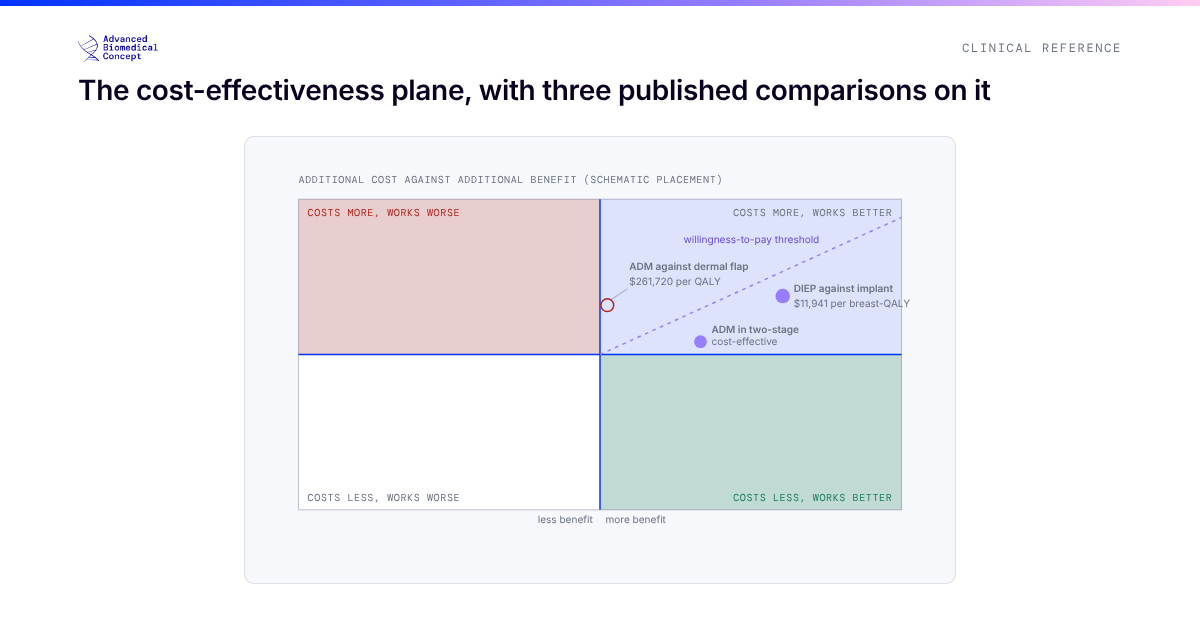
A two-axis diagram. The horizontal axis is additional benefit, the vertical axis additional cost, with the comparator at the centre. The top-right quadrant is more costly and more effective, where the question is whether the extra benefit is worth the extra cost. The bottom-right is cheaper and better, dominant. The top-left is costlier and worse, dominated. Three comparisons are placed schematically. DIEP flap against implant, top right, about 11,941 US dollars per breast-related QALY, judged cost-effective. Dermal matrix in two-stage expander reconstruction against none, just above the origin to the right, judged cost-effective. Dermal matrix against an autologous dermal flap in single-stage reconstruction, slightly above the origin with almost no extra benefit, 261,720 dollars per QALY, judged not cost-effective.
Clinical Insights — 09 October 2026

The Cost-Effectiveness of Breast Reconstruction: What Actually Drives the Numbers

Unit price is the least informative number in reconstruction economics. Complications, theatre time and the number of operations drive cost; the unit…

Read article →
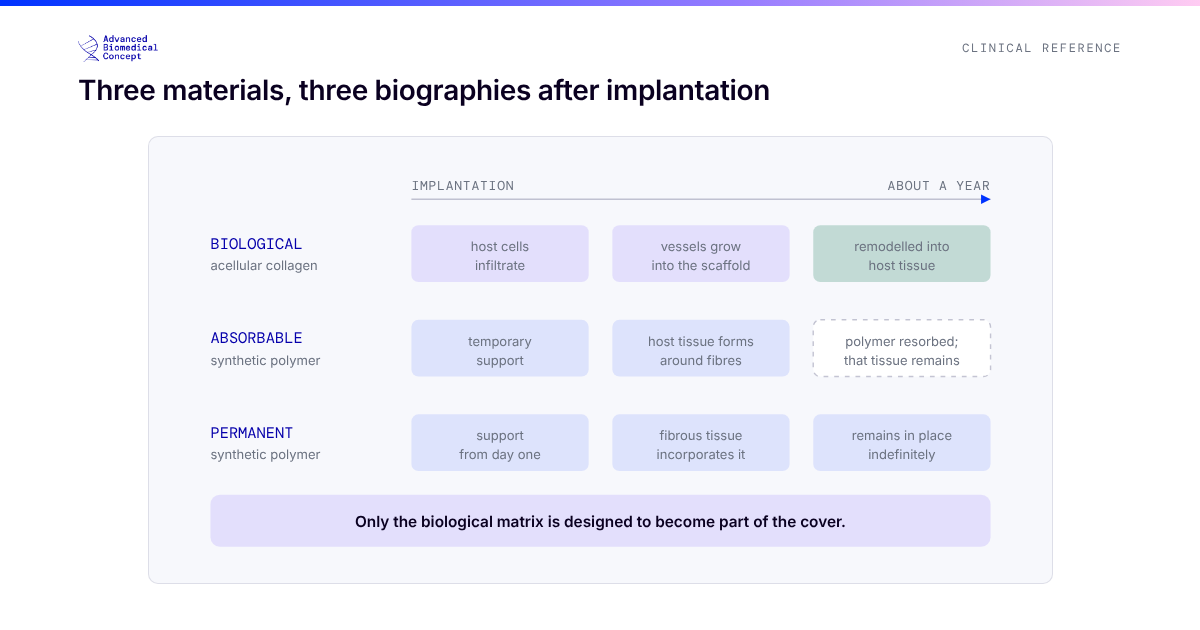
Three horizontal timelines running from implantation to about a year. Biological matrix: host cells infiltrate the collagen scaffold, new vessels grow into it, and it is gradually remodelled into host tissue that becomes part of the soft-tissue cover. Absorbable synthetic mesh: the polymer provides temporary support while it is surrounded by host tissue, then is resorbed over months, leaving the tissue that formed around it. Permanent synthetic mesh: the polymer is surrounded and incorporated by fibrous tissue and remains in place indefinitely. A note states that only the first adds to the cover by becoming tissue, and that the timing varies by product.
Clinical Insights — 06 October 2026

Biologic or Synthetic Mesh in Breast Reconstruction: The Evidence and the Trade-Offs

The randomised head-to-heads favour synthetic mesh on seroma; biological matrices offer integration into thin cover. The choice is made patient by patient.

Read article →
A grid of seven questions. One, what was the design: randomised, prospective cohort or retrospective series. Two, which plane: prepectoral, subpectoral or dual plane. Three, one stage or two: direct-to-implant or expander. Four, who was included: flap thickness, smoking, BMI, radiotherapy, prior surgery. Five, how long was follow-up, since late complications such as capsular contracture need years. Six, how were complications defined and counted: per patient or per breast, minor and major, and whether rippling counts. Seven, who did it and who paid: learning curve, number of surgeons, and conflicts of interest. A closing line states that two numbers are only comparable if the answers match.
Clinical Insights — 03 October 2026

How to Compare Mesh Studies in Breast Reconstruction (and Why 9% and 38% Can Both Be Right)

Headline complication rates for the same material range from under 10% to nearly 40%. Seven questions explain why, and show how to…

Read article →
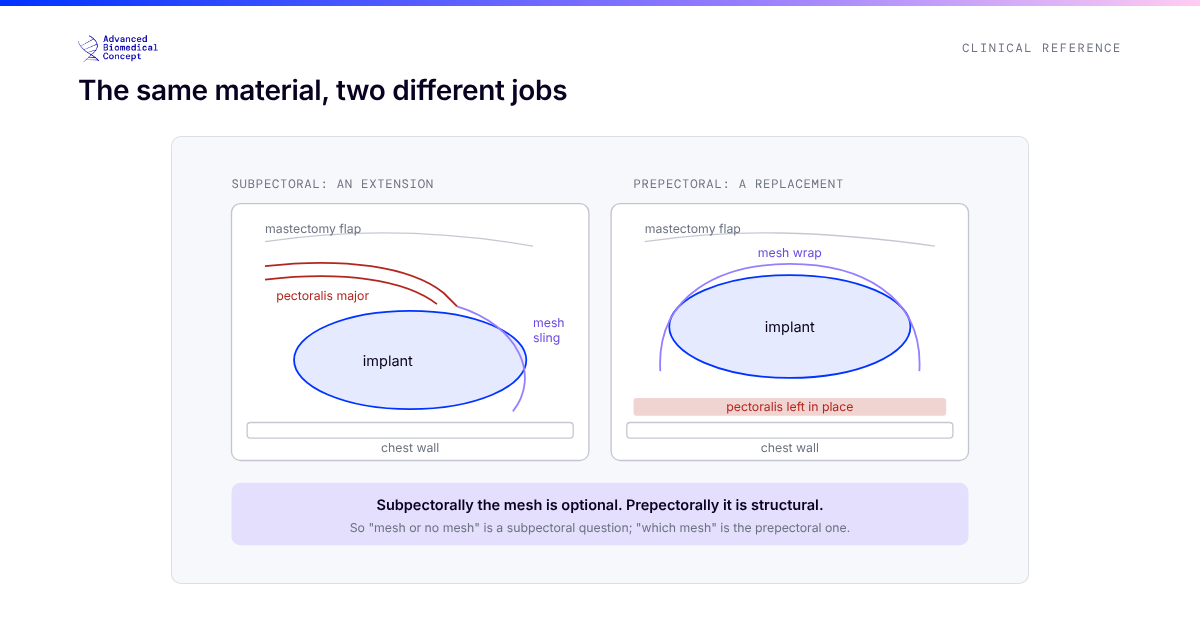
Two cross-sections of a reconstructed breast. On the left, subpectoral placement with a mesh sling: the pectoralis major covers the upper part of the implant and a mesh extends from the lower edge of the muscle to the inframammary fold, covering the lower pole. The mesh here is an extension of the muscle. On the right, prepectoral placement: the muscle is left on the chest wall and the mesh wraps the front of the implant, with the mastectomy flap directly over it. The mesh here replaces the muscle and defines the whole pocket. A note states that in the prepectoral plane the support material is structural rather than optional.
Clinical Insights — 30 September 2026

Meshes and Matrices in Breast Reconstruction: What They Do and What the Evidence Says

"Mesh" is a family, not a product. Subpectorally the question is whether to use one; prepectorally it is which one, configured how.

Read article →
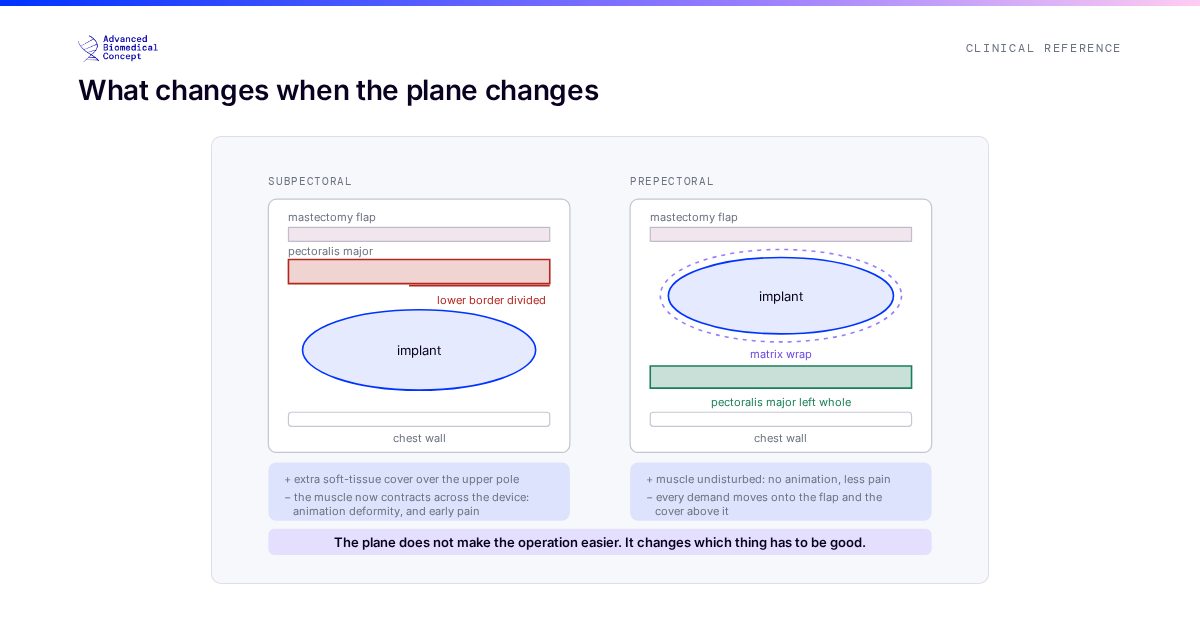
The same implant drawn in two planes. Subpectoral, it sits under the pectoralis major, which has been divided along its lower border: the muscle gives extra soft-tissue cover over the upper pole, but it now contracts across the device, which is the mechanism of animation deformity and of post-operative pain. Prepectoral, the implant sits on the muscle, wrapped in a matrix and covered by the mastectomy flap alone: the muscle is left whole and undisturbed, so there is no animation and less early pain, and in exchange every demand shifts onto the quality of the flap and the soft-tissue cover above it.
Clinical Insights — 10 September 2026

Prepectoral or Subpectoral: What Changes When the Plane Changes

Prepectoral placement moves the burden from the muscle to the mastectomy flap. An improvement where the flap can carry it, a mistake…

Read article →
hybrid-breast-reconstruction-implant-plus-fat-grafting-01
Clinical Insights — 18 August 2026

Hybrid Breast Reconstruction: Combining an Implant, Matrix Support and Fat Grafting

Implant for structure, fat for the living envelope, matrix for support: the rationale, technique and published outcomes of hybrid reconstruction.

Read article →
11901-capsular-contracture
Clinical Insights — 09 August 2026

Capsular Contracture in Implant-Based Reconstruction: Risk Factors, Prevention and the Role of Matrices

What drives capsular contracture, how radiotherapy and implant plane change the risk, and what matrix-assisted series report.

Read article →
Surgeon_explaining_breast_implan…_2K_202607240939
Clinical Insights — 21 July 2026

Questions to Ask Your Surgeon About Breast Reconstruction

The questions worth asking to make an informed, confident decision about your reconstruction.

Read article →
Doctors_looking_at_tablet_2K_202607231626
Clinical Insights — 20 July 2026

Choosing a Biological Matrix: A Practical Framework for Reconstructive Surgeons

A structured, six-dimension framework for comparing biological matrices on the properties that actually matter — rather than on branding.

Read article →
Medical_visualization_biological…_2K_202607231553
Clinical Insights — 20 July 2026

Prepectoral Breast Reconstruction: The Role of Biological Matrix and Fat Grafting

What prepectoral breast reconstruction is, why it spares the chest muscle, and how a biological matrix and fat grafting enable the technique.

Read article →

Posts navigation

1 2 … 5 Older →
Advanced Biomedical Concept

Innovators in breast reconstruction surgery. CE-marked biological membranes and surgical support devices. Founded 2020, Rome, Italy.

info@advancedbioconcept.it

Company

  • Our Story
  • Meet the Team
  • Testimonials & Quotes
  • Events
  • Certifications
  • Products

  • Exashape Line
  • Exafat Kit
  • Clinical Guides

    Biological Matrix for Breast Reconstruction Prepectoral Breast Reconstruction Rigottomia (Rigottomy): The Technique Explained Biological Matrix, ADM & Synthetic Mesh: A Clinical Comparison View all clinical guides →

    For Professionals

    Clinical StudiesE-LearningContact

    Tools

  • Decision Simulator
  • Media Kit
  • Exashape Evidence Library
  • Cost-Per-Case Calculator
  • Breast Reconstruction Options ExplorerDRAFT Libra

    © 2026 Advanced Biomedical Concept Srl. All rights reserved. — P.IVA: 15657681001

    Privacy PolicyCookie settings For Healthcare Professionals Only. CE marked per EU MDR 2017/745.
    Advanced Biomedical Concept
    Discover what we make

    From the ExaShape® biological matrix for breast reconstruction to the EXAFAT® fat-grafting system — explore the full range of ABC devices.

    Explore our products →

    We value your privacy We use essential cookies to make our site work. With your consent we may also use cookies to analyse traffic and improve your experience. See our Privacy Policy and Cookie Policy.

    How can we help?

    Send us a message and our team will get back to you within 1–2 business days.
    We typically reply within 1–2 business days.