Few questions in breast surgery have been studied for as long, or as rigorously, as whether a woman with early breast cancer should keep her breast. The randomised trials began in the 1970s, their twenty-year results were published in 2002, and the registries that followed now cover hundreds of thousands of patients. The answer they give is clear, and it is worth stating plainly before anything else in this article: for a woman who is a candidate for both, breast-conserving surgery followed by radiotherapy is at least as safe as mastectomy in terms of survival.
And yet mastectomy rates rose through the 2000s, bilateral mastectomy for unilateral disease rose faster still, and immediate reconstruction became routine rather than exceptional. This article sets out what the evidence says on both sides, where mastectomy is the right plan or the patient’s informed choice, and what that choice asks of the reconstructive surgeon. That last part is where the reconstruction literature has most to say, and it is the part a reconstructive team controls.
What the randomised trials established
Two trials define the field. In the United States, NSABP B-06 randomised 1,851 women to total mastectomy, lumpectomy alone or lumpectomy with breast irradiation. At twenty years there were no significant differences in disease-free, distant-disease-free or overall survival between the three arms. The hazard ratio for death after lumpectomy with radiotherapy, compared with mastectomy, was 0.97 (95% CI 0.83 to 1.14).1 What radiotherapy changed was local control: ipsilateral breast recurrence was 14.3% with irradiation against 39.2% without it.
In Milan, Veronesi and colleagues randomised 701 women with tumours of 2 cm or less to radical mastectomy or quadrantectomy with radiotherapy. After a median of twenty years, death from any cause was 41.7% in the conservation arm and 41.2% in the mastectomy arm; death from breast cancer was 26.1% and 24.3%. Local recurrence was higher after conservation, 8.8% against 2.3%, without any effect on survival.2
The individual-patient meta-analysis of 17 trials by the Early Breast Cancer Trialists’ Collaborative Group then quantified what radiotherapy contributes after conservation: it roughly halved the ten-year risk of any recurrence (35.0% to 19.3%) and reduced fifteen-year breast cancer mortality from 25.2% to 21.4%.3 Conservation, in other words, is not “less surgery”. It is a different treatment in which radiotherapy does part of the work.
Registry data have since pushed in the same direction. In 37,207 Dutch women with T1 to T2, N0 to N1 disease, conservation with radiotherapy was associated with better ten-year overall survival than mastectomy, with an adjusted hazard ratio of 0.81.4 The authors were careful about what this means: distant metastasis-free survival differed only in the T1N0 subgroup, which suggests that some of the gap reflects who was offered which operation rather than what the operation did. Their own conclusion was the conservative one, that conservation is at least equivalent. A reconstructive audience should hold it at the same level.
Why mastectomy rates rose anyway
Across more than 1.2 million women treated at accredited US centres, the adjusted odds of mastectomy in patients eligible for conservation rose by 34% between 2003 and 2011. Over the same period, reconstruction after mastectomy rose from 11.6% to 36.4%, and bilateral mastectomy for unilateral disease from 1.9% to 11.2%.5 In California the shift was sharpest in young women: among those under 40, bilateral mastectomy rose from 3.6% in 1998 to 33% in 2011, without being associated with lower mortality than conservation with radiotherapy.6
The reasons are documented in the decision literature rather than the oncology literature: fear of recurrence, wish to avoid radiotherapy or repeated surveillance imaging, genetic testing results, symmetry, and the availability of a good reconstruction. That last factor is the one that concerns this site. The quality of what reconstruction can offer is part of what patients weigh, which places an obligation on the reconstructive team to be honest about what it delivers.
Where mastectomy is the plan
Mastectomy is not a second-best operation in every context. There are well-established situations in which it is the indicated treatment, and one in which it is the patient’s to choose.
The risk-reduction evidence is strong. In a prospective multicentre cohort of 2,482 BRCA1 and BRCA2 carriers, no breast cancers were diagnosed in the 247 women who underwent risk-reducing mastectomy, against 98 cancers among 1,372 women who did not.7 Earlier, the Mayo Clinic series of 639 women with a family history reported a reduction in breast cancer incidence of at least 90% after bilateral prophylactic mastectomy.8 This is a population that is often young, often healthy, and often having surgery on breasts with no cancer in them. They are also, frequently, ideal candidates for nipple-sparing mastectomy with immediate implant reconstruction.
The fact the reconstructive surgeon has to sit with
One finding deserves to be read carefully by anyone who reconstructs breasts. At Memorial Sloan Kettering, Flanagan and colleagues compared BREAST-Q scores in 3,233 women with stage I or II cancer treated by conservation or by mastectomy with implant reconstruction. Conservation was associated with higher scores across every subscale, and radiotherapy lowered scores in both groups.9
This is not an argument against mastectomy. It is the benchmark a reconstruction is being measured against. When mastectomy is chosen, the patient has accepted an operation that, on average, leaves her less satisfied than conservation would have. The reconstructive team’s job is to close as much of that gap as technique allows. And technique allows more than it did when those patients were treated.
What closing the gap looks like
The levers are known, and each has its own literature on this site.
Preserve what can be preserved. Nipple-sparing and skin-sparing mastectomy keep the envelope, and with it the shape the patient started with. In well-selected patients this is the foundation everything else rests on; see nipple-sparing mastectomy and reconstruction.
Reconstruct immediately where it is safe. The patient wakes with a breast rather than a scar, and the envelope is used while it is still supple.
Spare the muscle where the flap allows. Prepectoral placement avoids animation deformity and the pain of muscle division. The meta-analytic evidence for this is discussed in prepectoral versus subpectoral: the evidence.
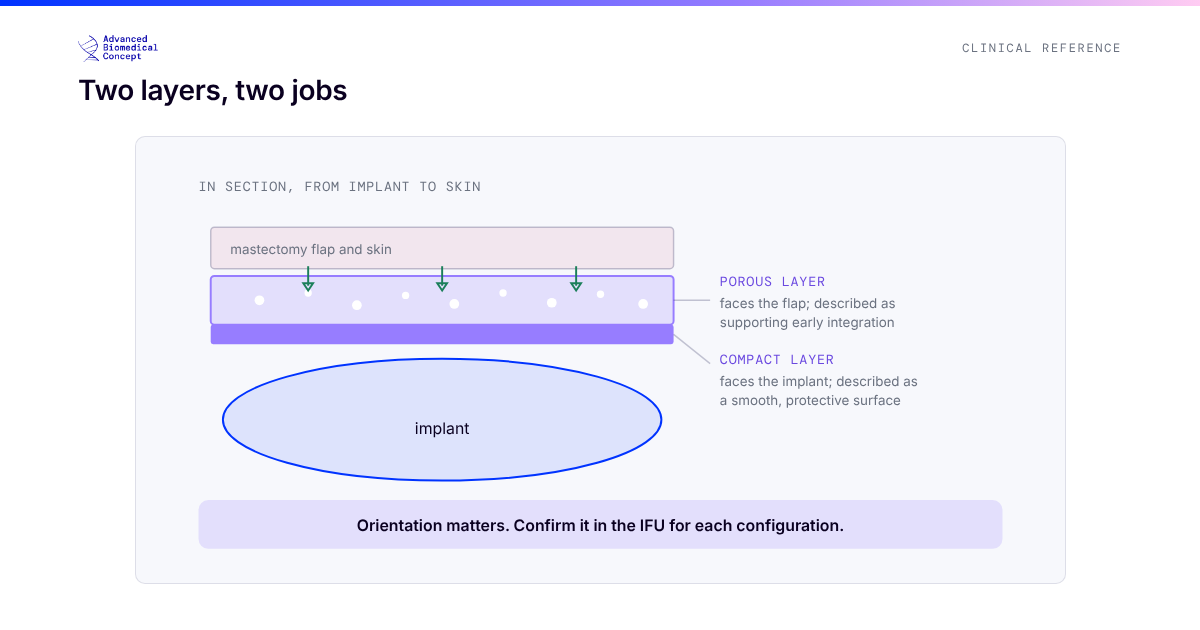
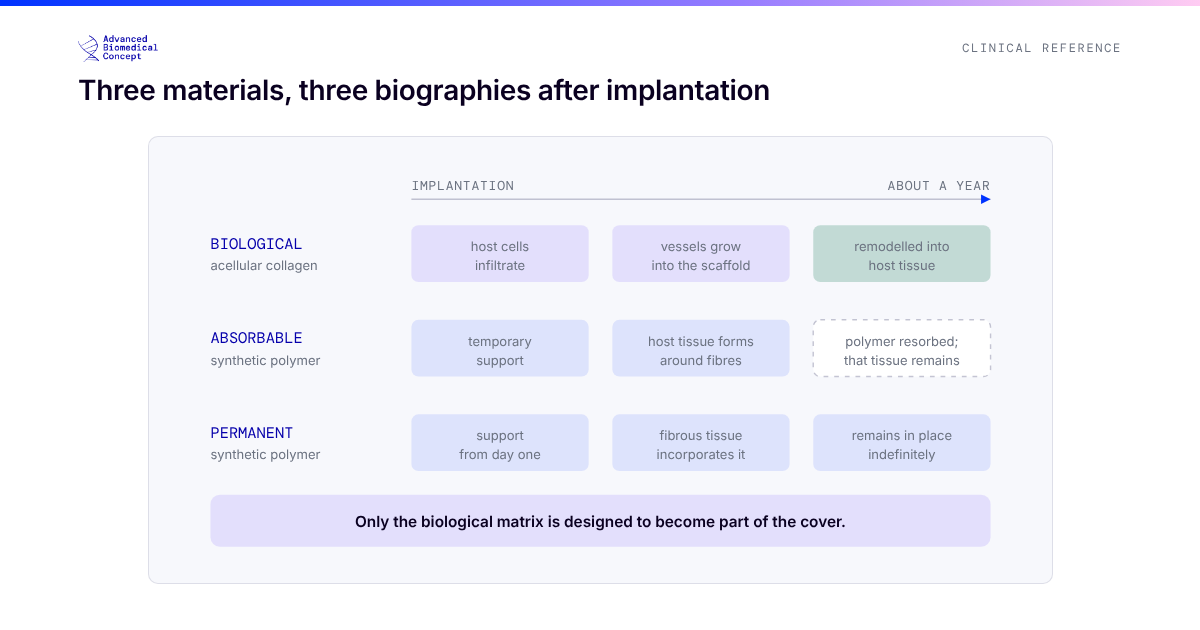
Support the implant with a material designed for the job. In the prepectoral plane, the matrix defines the pocket. ExaShape®, a CE-marked bilayer bovine pericardium membrane, is one option built specifically for that role, with pre-shaped pocket configurations that wrap the implant before it goes in.
Refine with the patient’s own tissue. Rippling and contour irregularities over a prepectoral implant are among the main reasons patients are less satisfied after mastectomy than after conservation. Staged fat grafting addresses exactly that, and processing quality matters to how much of it stays; the EXAFAT® closed-loop system was designed for breast-specific grafting.
The underlying principle is the same in all five. If a patient has chosen mastectomy, she has chosen it partly on the strength of what reconstruction can offer. That is a promise the reconstruction then has to keep.
Counselling, in practice
Three things belong in every conversation where mastectomy is on the table, and the evidence above supports all of them.
First, that survival after conservation with radiotherapy is equivalent for eligible women, and that bilateral surgery for unilateral disease has not been shown to reduce mortality.1,6 Second, that the trade is real in both directions: conservation carries radiotherapy, surveillance and a small risk of local recurrence; mastectomy carries reconstruction, its complications and its revisions. Third, what the reconstruction will realistically look and feel like in this patient’s hands, including the likelihood of a second stage, of refinement by fat grafting, and of the difference radiotherapy makes if it is needed after all.
A patient who chooses mastectomy after that conversation has made an informed decision, and it deserves the best reconstruction available. A patient who chooses it without that conversation has not.
The short version
For a woman eligible for both, breast conservation with radiotherapy is at least as safe as mastectomy. Mastectomy is indicated in defined situations, and is a legitimate informed choice in others. When it is chosen, the reconstruction becomes the measure of whether the choice was a good one, and the tools to make it a good one, preserved envelopes, prepectoral planes, purpose-built matrices and refined fat grafting, are now better than at any point in the history of the comparison.
References
- Fisher B, Anderson S, Bryant J, et al. Twenty-year follow-up of a randomized trial comparing total mastectomy, lumpectomy, and lumpectomy plus irradiation for the treatment of invasive breast cancer. N Engl J Med. 2002;347(16):1233-1241. doi:10.1056/NEJMoa022152
- Veronesi U, Cascinelli N, Mariani L, et al. Twenty-year follow-up of a randomized study comparing breast-conserving surgery with radical mastectomy for early breast cancer. N Engl J Med. 2002;347(16):1227-1232. doi:10.1056/NEJMoa020989
- Early Breast Cancer Trialists’ Collaborative Group (Darby S, McGale P, Correa C, et al). Effect of radiotherapy after breast-conserving surgery on 10-year recurrence and 15-year breast cancer death: meta-analysis of individual patient data for 10,801 women in 17 randomised trials. Lancet. 2011;378(9804):1707-1716. doi:10.1016/S0140-6736(11)61629-2
- van Maaren MC, de Munck L, de Bock GH, et al. 10 year survival after breast-conserving surgery plus radiotherapy compared with mastectomy in early breast cancer in the Netherlands: a population-based study. Lancet Oncol. 2016;17(8):1158-1170. doi:10.1016/S1470-2045(16)30067-5
- Kummerow KL, Du L, Penson DF, Shyr Y, Hooks MA. Nationwide trends in mastectomy for early-stage breast cancer. JAMA Surg. 2015;150(1):9-16. doi:10.1001/jamasurg.2014.2895
- Kurian AW, Lichtensztajn DY, Keegan THM, et al. Use of and mortality after bilateral mastectomy compared with other surgical treatments for breast cancer in California, 1998-2011. JAMA. 2014;312(9):902-914. doi:10.1001/jama.2014.10707
- Domchek SM, Friebel TM, Singer CF, et al. Association of risk-reducing surgery in BRCA1 or BRCA2 mutation carriers with cancer risk and mortality. JAMA. 2010;304(9):967-975. doi:10.1001/jama.2010.1237
- Hartmann LC, Schaid DJ, Woods JE, et al. Efficacy of bilateral prophylactic mastectomy in women with a family history of breast cancer. N Engl J Med. 1999;340(2):77-84. doi:10.1056/NEJM199901143400201
- Flanagan MR, Zabor EC, Romanoff A, et al. A comparison of patient-reported outcomes after breast-conserving surgery and mastectomy with implant breast reconstruction. Ann Surg Oncol. 2019;26(10):3133-3140. doi:10.1245/s10434-019-07548-9
This article is educational material for healthcare professionals. The choice between breast conservation and mastectomy is an oncological decision made with the patient by the multidisciplinary team; nothing here is a recommendation for any individual patient. ExaShape® and EXAFAT® are CE marked per EU MDR 2017/745 and are for professional use only.
Important information This article is general education, not medical advice. Tap to read the full medical, regulatory & legal notice.
This article is provided by Advanced Biomedical Concept for general informational and educational purposes only. It does not constitute medical, surgical, diagnostic, or other professional healthcare advice, and it is not a substitute for consultation with a suitably qualified healthcare professional. Reading it creates no doctor–patient or other professional relationship. Nothing here should be used to diagnose, treat, cure, or prevent any disease or condition, or to make decisions about medical care. Always seek the advice of a physician or other qualified provider with any questions about a medical condition or treatment, and never disregard or delay professional advice because of something you have read here.
Any reference to Advanced Biomedical Concept products (including ExaShape and ExaFat) is provided for general information only. These are medical devices intended to be used by appropriately trained healthcare professionals strictly in accordance with their applicable, current Instructions for Use (IFU). Regulatory status (including CE marking and classification under the EU Medical Device Regulation), market availability, and approved indications differ between countries and may change over time; a device referred to here may not be available or approved in your country. This content is not intended as, and must not be relied upon as, a statement or claim of safety, clinical performance, or efficacy beyond what is set out in the applicable IFU and current regulatory approvals. Product-specific information is directed at healthcare professionals and is not intended to promote, advertise, or offer any medical device to the general public where such promotion is restricted or prohibited by law.
Statements reflect information believed to be accurate at the date of publication and may be updated or corrected without notice. Any statements regarding the future are expectations or general views, not guarantees. Clinical outcomes depend on many individual factors, results vary from person to person, and no particular result is promised or implied. Where third-party studies, sources, or external links are referenced, they are provided for convenience and information only and do not imply endorsement, and Advanced Biomedical Concept is not responsible for their content.
To the fullest extent permitted by applicable law, Advanced Biomedical Concept and its officers, employees, contributors, and representatives (each acting in that capacity and on behalf of Advanced Biomedical Concept) accept no liability for any loss, injury, or damage of any kind arising directly or indirectly from use of, or reliance on, this content. Nothing in this notice excludes or limits any liability that cannot lawfully be excluded or limited.
Questions about this material can be directed to us via our contact page.
Last reviewed: October 15, 2026.