Direct-to-implant (DTI) reconstruction places the definitive implant at the time of mastectomy. Two-stage reconstruction places a tissue expander, inflates it over weeks, and exchanges it for an implant in a second operation. The appeal of DTI is obvious: one operation instead of two, no expansion visits, and a patient who wakes with a breast close to its final shape. The question is what that costs in safety, and the honest answer is that it depends almost entirely on who it is offered to.
The evidence on this comparison is unusually instructive because it contains a large meta-analysis, a prospective multicentre cohort and a randomised trial, and they do not all agree. Reading them together explains why.
What each pathway asks of the patient
The extra time in a two-stage pathway is not dead time. The expander holds the envelope while the mastectomy flap recovers its blood supply, lets the surgeon control volume gradually, and the exchange operation offers a second look: pocket adjustment, implant choice, and often a first round of fat grafting. DTI gives all of that up in exchange for a single anaesthetic and a shorter journey.
The meta-analysis: higher risk, as a population
Basta and colleagues pooled 13 studies covering 5,216 reconstructions. Infection, seroma and capsular contracture were similar between pathways. But DTI was associated with more mastectomy flap necrosis (OR 1.43), more reoperation (OR 1.25) and nearly twice the risk of implant loss (OR 1.87).1 The authors drew the conclusion that matters most: the critical component of DTI patient selection is the surgeon’s judgement of mastectomy flap quality.
The randomised trial: a warning about the specific technique
The Dutch BRIOS trial randomised 142 women undergoing skin-sparing mastectomy to one-stage reconstruction with an acellular dermal matrix or to two-stage reconstruction. Its result was striking: one-stage reconstruction carried higher odds of surgical complications (OR 3.81), reoperation (OR 3.38) and removal of the implant, matrix or both (OR 8.80). Severe adverse events occurred in 29% of one-stage breasts and 5% of two-stage breasts.2
It is important to read what was tested. BRIOS studied a specific technique, one-stage subpectoral reconstruction with a particular porcine dermal matrix, across eight hospitals, many of them early in their experience of it. The authors’ own conclusion was that patient selection, risk factors and surgical technique needed to be better understood. It is the strongest evidence that DTI performed broadly, without strict selection, can go badly. It is not evidence about prepectoral DTI with a different matrix in selected patients, which was not studied.
The prospective cohort: no difference, when selected
MROC tells a different story. Among 1,427 patients across 11 centres, 99 had DTI and 1,328 had two-stage reconstruction. At two years, after adjusting for demographic and clinical characteristics, there were no statistically significant differences in any complication, including infection. Patient-reported outcomes were similar, with one exception: sexual well-being was better after DTI.3
The obvious caveat is the imbalance: 99 against 1,328. Those 99 patients were chosen by their surgeons for DTI, which is precisely the point. When the selection is done well, the excess risk seen in pooled data can disappear.
The learning curve is part of the data
A single-institution series from Massachusetts General Hospital adds a detail every unit adopting DTI should know. Across 331 consecutive DTI reconstructions with a dermal matrix, implant loss was 1.5%, compared with 7.0% in tissue expander reconstructions without a matrix at the same centre. But complications were 21.4% in the surgeons’ combined first year of DTI and 10.9% in subsequent years.4 DTI rewards experience, and the first year of a programme is where the numbers are made or lost.
Where the decision is actually made
Every source above converges on the same point: the decision is made on the mastectomy flap, after the mastectomy, by the surgeon looking at it. A thick, well-perfused flap in a non-smoker with moderate breast volume is a DTI candidate. A thin, equivocal flap, especially under a large implant, is not, and converting the plan to an expander on the day is the correct decision rather than a failure. The practicalities of that assessment are set out in reading the mastectomy flap. Perfusion imaging can help: in one Danish series of prepectoral DTI with bovine pericardium, the authors concluded that indocyanine green angiography helped reduce complication risk, and that skin necrosis was associated with previous breast surgery.5
Prepectoral DTI and the role of the matrix
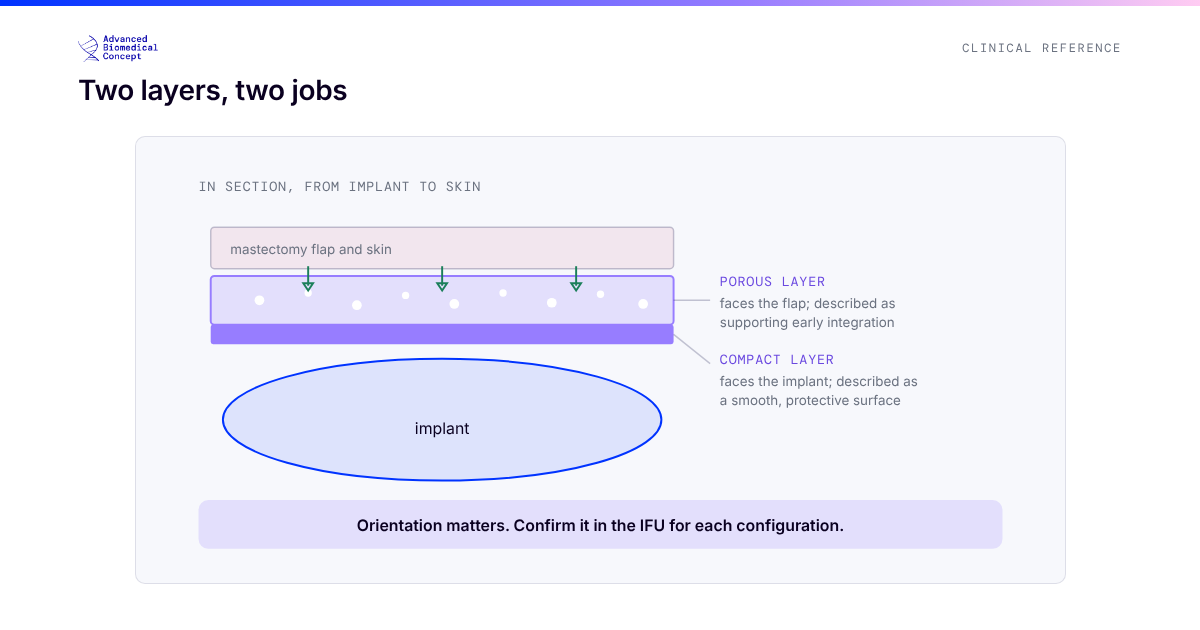
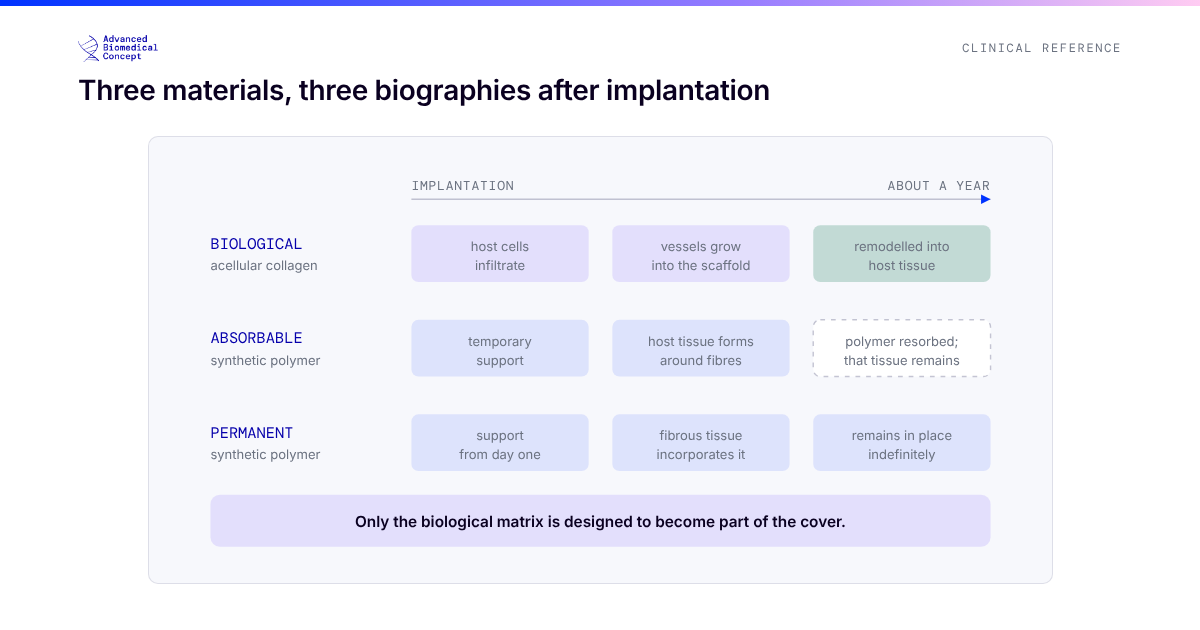
Much of the DTI evidence above comes from subpectoral or dual-plane reconstruction. In contemporary practice DTI is increasingly prepectoral, which changes the mechanics: there is no muscle to provide cover, and the matrix becomes the structure that defines the pocket and holds the implant in position from the first day.
The ExaShape® BioShield Pocket was designed for exactly this situation: a pre-shaped bovine pericardium pocket that wraps the anterior implant before insertion, so the implant goes into the pocket already supported. The largest published multicentre series of DTI prepectoral reconstruction with a bovine pericardium pocket, 65 reconstructions with a mean follow-up of 21.3 months, reported minor complications in four breasts and major complications in two, a mean operative time of 1.42 hours, and no significant capsular contracture.6 Seven patients had fat grafting at six months to correct rippling or wrinkling, which is the expected refinement stage for prepectoral reconstruction in thinner patients and where a consistent graft, such as one processed with EXAFAT®, earns its place. This is a retrospective series, not a comparison; it describes what DTI looks like when the selection and the support are designed together.
Cost and time
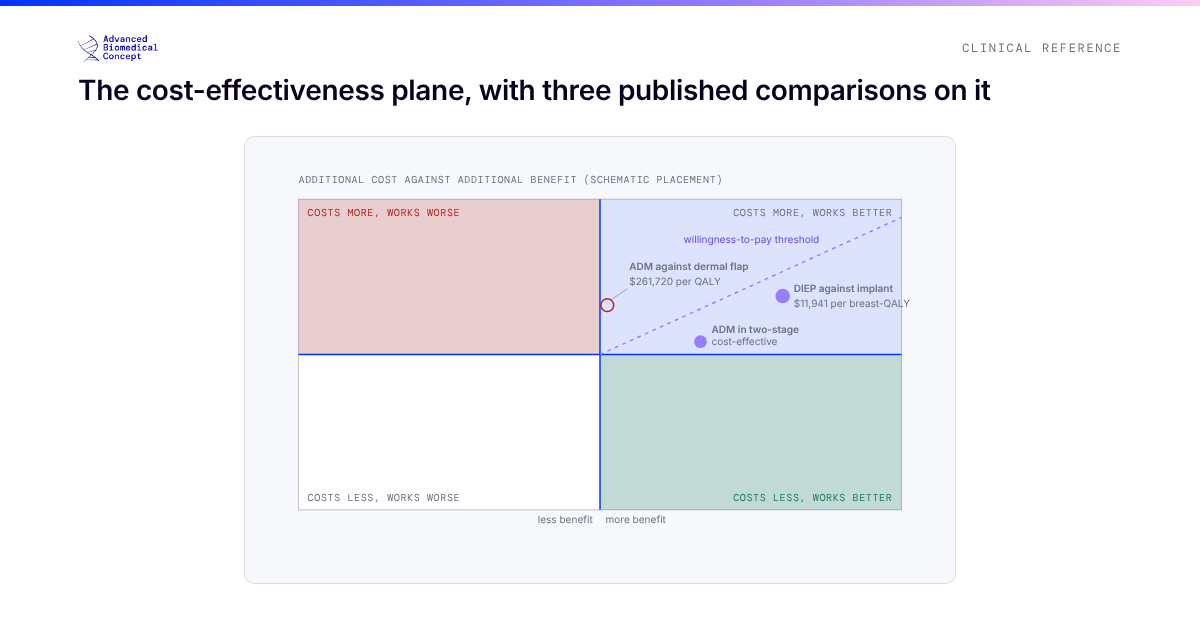
DTI removes an operation, which should make it cheaper, but the published difference is smaller than that logic suggests. At MGH, total costs did not differ significantly between DTI and expander reconstruction.4 At the same institution, the lower cost seen with prepectoral reconstruction disappeared once staging was accounted for: the saving came from single-stage reconstruction, not from the plane.7 The economic case for DTI, like the clinical case, depends on keeping complications low; a single implant loss erases the saving of the avoided second stage. The wider economics are discussed in the cost-effectiveness of reconstruction.
The short version
DTI is not riskier by nature. It is less forgiving of the wrong patient. Pooled data and an unselected randomised trial show what happens when it is offered broadly; a prospective cohort of selected patients shows that, chosen well, it matches two-stage reconstruction while sparing the patient an operation. The decision belongs to the flap on the day, and the prepectoral version of it depends on a matrix designed to hold the implant from the start.
References
- Basta MN, Gerety PA, Serletti JM, Kovach SJ, Fischer JP. A systematic review and head-to-head meta-analysis of outcomes following direct-to-implant versus conventional two-stage implant reconstruction. Plast Reconstr Surg. 2015;136(6):1135-1144. doi:10.1097/PRS.0000000000001749
- Dikmans REG, Negenborn VL, Bouman MB, et al. Two-stage implant-based breast reconstruction compared with immediate one-stage implant-based breast reconstruction augmented with an acellular dermal matrix: an open-label, phase 4, multicentre, randomised, controlled trial. Lancet Oncol. 2017;18(2):251-258. doi:10.1016/S1470-2045(16)30668-4
- Srinivasa DR, Garvey PB, Qi J, et al. Direct-to-implant versus two-stage tissue expander/implant reconstruction: 2-year risks and patient-reported outcomes from a prospective, multicenter study. Plast Reconstr Surg. 2017;140(5):869-877. doi:10.1097/PRS.0000000000003748
- Colwell AS, Damjanovic B, Zahedi B, Medford-Davis L, Hertl C, Austen WG. Retrospective review of 331 consecutive immediate single-stage implant reconstructions with acellular dermal matrix: indications, complications, trends, and costs. Plast Reconstr Surg. 2011;128(6):1170-1178. doi:10.1097/PRS.0b013e318230c2f6
- Bentzon TT, Abu-Khalil M, Venzo A, Matzen DR, Damsgaard TE. Immediate prepectoral breast reconstruction using bovine pericardium matrix. Dan Med J. 2025;72(2). doi:10.61409/A08240522
- De Vita R, Mangialardi ML, Pozzi M, et al. A pericardium bovine matrix pocket in DTI prepectoral breast reconstruction. Clin Breast Cancer. 2024;24(7):e613-e621. doi:10.1016/j.clbc.2024.06.004. Disclosure: the first author is a consultant for ExaShape.
- Chinta S, Koh DJ, Sobti N, et al. Cost analysis of pre-pectoral implant-based breast reconstruction. Sci Rep. 2022;12(1):17512. doi:10.1038/s41598-022-21675-6
This article is educational material for healthcare professionals. The choice between direct-to-implant and two-stage reconstruction is an intraoperative judgement about an individual patient; nothing here is a recommendation for a specific case. ExaShape® and EXAFAT® are CE marked per EU MDR 2017/745 and are for professional use only.
Important information This article is general education, not medical advice. Tap to read the full medical, regulatory & legal notice.
This article is provided by Advanced Biomedical Concept for general informational and educational purposes only. It does not constitute medical, surgical, diagnostic, or other professional healthcare advice, and it is not a substitute for consultation with a suitably qualified healthcare professional. Reading it creates no doctor–patient or other professional relationship. Nothing here should be used to diagnose, treat, cure, or prevent any disease or condition, or to make decisions about medical care. Always seek the advice of a physician or other qualified provider with any questions about a medical condition or treatment, and never disregard or delay professional advice because of something you have read here.
Any reference to Advanced Biomedical Concept products (including ExaShape and ExaFat) is provided for general information only. These are medical devices intended to be used by appropriately trained healthcare professionals strictly in accordance with their applicable, current Instructions for Use (IFU). Regulatory status (including CE marking and classification under the EU Medical Device Regulation), market availability, and approved indications differ between countries and may change over time; a device referred to here may not be available or approved in your country. This content is not intended as, and must not be relied upon as, a statement or claim of safety, clinical performance, or efficacy beyond what is set out in the applicable IFU and current regulatory approvals. Product-specific information is directed at healthcare professionals and is not intended to promote, advertise, or offer any medical device to the general public where such promotion is restricted or prohibited by law.
Statements reflect information believed to be accurate at the date of publication and may be updated or corrected without notice. Any statements regarding the future are expectations or general views, not guarantees. Clinical outcomes depend on many individual factors, results vary from person to person, and no particular result is promised or implied. Where third-party studies, sources, or external links are referenced, they are provided for convenience and information only and do not imply endorsement, and Advanced Biomedical Concept is not responsible for their content.
To the fullest extent permitted by applicable law, Advanced Biomedical Concept and its officers, employees, contributors, and representatives (each acting in that capacity and on behalf of Advanced Biomedical Concept) accept no liability for any loss, injury, or damage of any kind arising directly or indirectly from use of, or reliance on, this content. Nothing in this notice excludes or limits any liability that cannot lawfully be excluded or limited.
Questions about this material can be directed to us via our contact page.
Last reviewed: October 15, 2026.