Radiotherapy saves lives, and it complicates reconstruction; both statements are true, and modern breast teams plan around them together. For patients who need or may need post-mastectomy radiotherapy (PMRT), the questions multiply: reconstruct now or later? Expander or implant? Above or below the muscle? This article summarises what the published evidence says about combining radiotherapy with implant-based reconstruction, for healthcare professionals and for patients who want to understand the reasoning behind their team’s advice.

What radiation does to reconstructed tissue
Radiotherapy causes progressive fibrosis and microvascular damage in the treated field. Around an implant this shows up as higher rates of capsular contracture, delayed wound problems, implant malposition and reconstructive failure in essentially every comparative series; a large systematic review of implant-based reconstruction with PMRT (Ricci et al., Journal of Surgical Research 2017) puts reconstructive failure in irradiated implant reconstructions substantially above non-irradiated ones. Radiated tissue also heals less forgivingly at revision, which shapes every downstream choice.
Timing: radiate the expander or the implant?
When two-stage reconstruction meets PMRT, the sequencing question is whether radiation hits the temporary expander or the definitive implant. The literature is genuinely divided: meta-analytic work (Lee and Mun, 2017, among others) suggests each sequence trades one set of risks against another, with expander irradiation associated in some series with more failure of the reconstruction and implant irradiation with more contracture of the final device. Units reasonably differ, and multidisciplinary planning before mastectomy matters more than any universal rule.
Does the implant plane change the equation?
The prepectoral question is newer. Short-term comparative data (Sinnott et al., Annals of Surgical Oncology 2018; subsequent systematic reviews of prepectoral reconstruction before PMRT) suggest that prepectoral placement does not increase complications in the irradiated setting and is associated in some cohorts with less severe capsular contracture, perhaps because the capsule and muscle are not fused into one irradiated unit. Follow-up is still short relative to the decades a reconstruction must last, so the fair summary is: prepectoral reconstruction is a reasonable option in the PMRT setting in experienced hands, with the evidence base growing rather than settled. Background on the plane itself is in our prepectoral guide and the plane comparison.
The soft-tissue environment
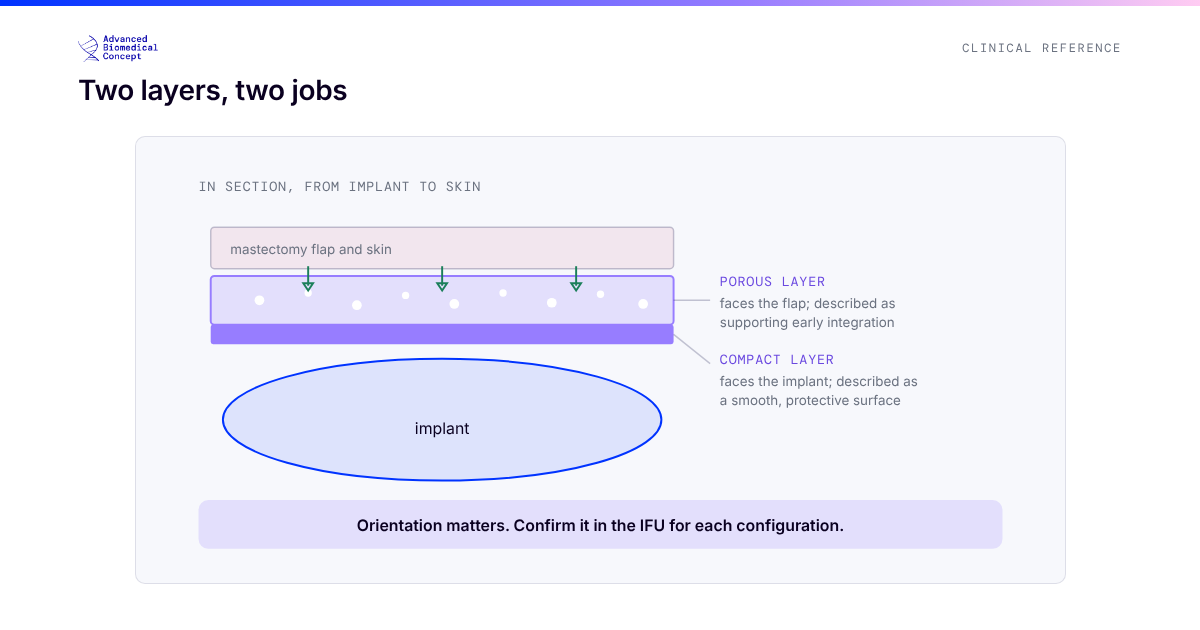
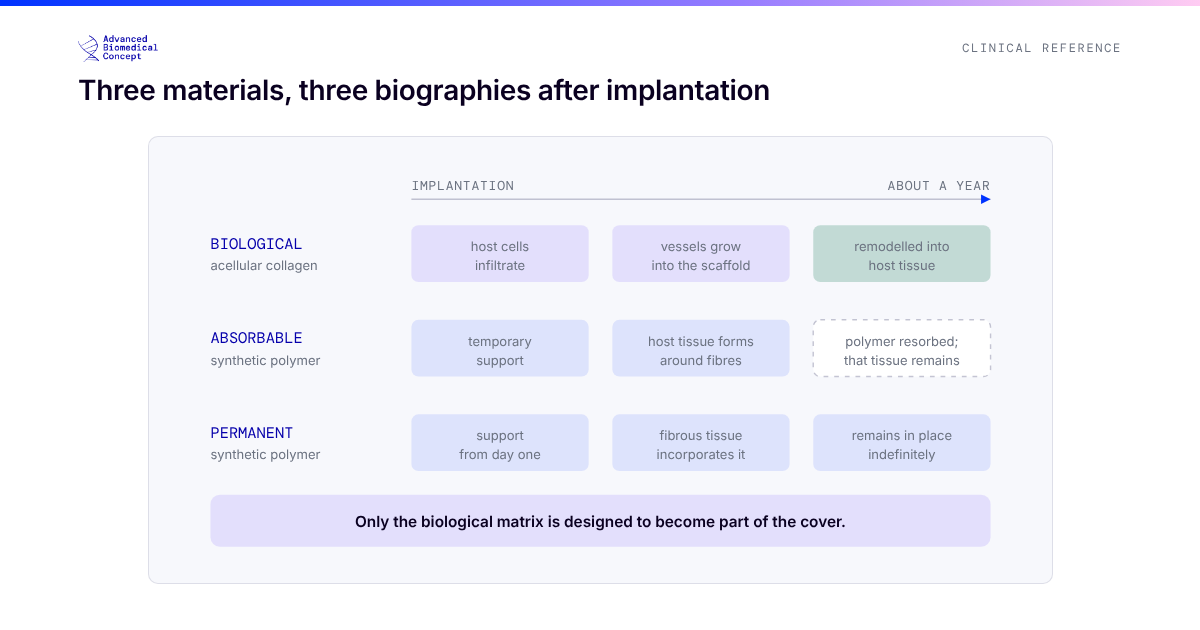
Two adjuncts recur in the literature on reconstructing in an irradiated field. The first is soft-tissue support: a biological matrix stabilises the pocket and supports the implant where irradiated tissue is less compliant; matrix-assisted cohorts in the PMRT setting report acceptable outcomes in published series, though data specific to any single material remain limited. The second is autologous fat grafting, whose regenerative effect on irradiated tissue has been reported since Rigotti’s landmark 2007 work: grafted fat can soften radiodamaged skin and thicken the envelope, and staged grafting has become a standard refinement in irradiated reconstructions, sometimes prepared with rigottomia where the tissue is tethered and fibrotic.
When implant-based reconstruction is not the right tool
Every honest discussion of PMRT ends here: in heavily irradiated, thin or repeatedly complicated chests, autologous flap reconstruction has better-documented durability, and hybrid approaches sit between. Our patient-facing reconstruction options guide and interactive options explorer lay out the full landscape so the trade-offs can be discussed rather than assumed.
The bottom line
Radiotherapy raises the stakes of every reconstructive choice, but it rules out very little by itself. Sequencing, plane, matrix support and staged fat grafting are the levers teams use to make implant-based reconstruction work in the irradiated setting, and the published evidence, while still maturing, supports planning these choices deliberately and jointly with the radiation oncology team from the outset.
Key published sources
- Ricci JA, et al. A meta-analysis of implant-based breast reconstruction and timing of postmastectomy radiotherapy. Journal of Surgical Research. 2017.
- Lee KT, Mun GH. Optimal sequencing of postmastectomy radiotherapy and two-stage prosthetic reconstruction: a meta-analysis. Annals of Surgical Oncology. 2017.
- Sinnott CJ, et al. Impact of postmastectomy radiation therapy in prepectoral versus subpectoral implant-based breast reconstruction. Annals of Surgical Oncology. 2018.
- Rigotti G, et al. Clinical treatment of radiotherapy tissue damage by lipoaspirate transplant. Plastic and Reconstructive Surgery. 2007.
Important information This article is general education, not medical advice. Tap to read the full medical, regulatory & legal notice.
This article is provided by Advanced Biomedical Concept for general informational and educational purposes only. It does not constitute medical, surgical, diagnostic, or other professional healthcare advice, and it is not a substitute for consultation with a suitably qualified healthcare professional. Reading it creates no doctor–patient or other professional relationship. Nothing here should be used to diagnose, treat, cure, or prevent any disease or condition, or to make decisions about medical care. Always seek the advice of a physician or other qualified provider with any questions about a medical condition or treatment, and never disregard or delay professional advice because of something you have read here.
Any reference to Advanced Biomedical Concept products (including ExaShape and ExaFat) is provided for general information only. These are medical devices intended to be used by appropriately trained healthcare professionals strictly in accordance with their applicable, current Instructions for Use (IFU). Regulatory status (including CE marking and classification under the EU Medical Device Regulation), market availability, and approved indications differ between countries and may change over time; a device referred to here may not be available or approved in your country. This content is not intended as, and must not be relied upon as, a statement or claim of safety, clinical performance, or efficacy beyond what is set out in the applicable IFU and current regulatory approvals. Product-specific information is directed at healthcare professionals and is not intended to promote, advertise, or offer any medical device to the general public where such promotion is restricted or prohibited by law.
Statements reflect information believed to be accurate at the date of publication and may be updated or corrected without notice. Any statements regarding the future are expectations or general views, not guarantees. Clinical outcomes depend on many individual factors, results vary from person to person, and no particular result is promised or implied. Where third-party studies, sources, or external links are referenced, they are provided for convenience and information only and do not imply endorsement, and Advanced Biomedical Concept is not responsible for their content.
To the fullest extent permitted by applicable law, Advanced Biomedical Concept and its officers, employees, contributors, and representatives (each acting in that capacity and on behalf of Advanced Biomedical Concept) accept no liability for any loss, injury, or damage of any kind arising directly or indirectly from use of, or reliance on, this content. Nothing in this notice excludes or limits any liability that cannot lawfully be excluded or limited.
Questions about this material can be directed to us via our contact page.
Last reviewed: August 24, 2026.