A reconstruction is rarely a single operation, and it is never permanent in the way patients first imagine. Implants age, tissue changes, radiotherapy keeps working for years, and results that were excellent at six months can need attention at six years. Revision breast reconstruction is the surgery that maintains, corrects and improves an existing reconstruction. This article covers why revisions happen, what the main procedures achieve, and how the reconstructive plan should account for them from the beginning.

>
Why revisions happen
- Capsular contracture. The leading cause of reoperation in implant-based reconstruction, covered in depth in our capsular contracture article.
- Animation deformity. Movement of a submuscular implant with chest muscle contraction, correctable by pocket conversion; see animation deformity.
- Rippling and thin soft-tissue cover. The characteristic aesthetic issue of thin envelopes, particularly in the prepectoral plane.
- Malposition. Implants that ride high, bottom out, or lateralise as the pocket stretches or the fold releases.
- Asymmetry. Between reconstructed and natural breast, or between two reconstructions that have aged differently.
- Implant events. Rupture, deflation and elective exchange as devices reach the end of their expected service life.
- Radiotherapy sequelae. Progressive fibrosis, contracture and volume loss in an irradiated field.
The main revision procedures
Capsule surgery and implant exchange
Capsulotomy releases the contracted capsule; capsulectomy removes it. Either may be combined with implant exchange, and the essential question at revision is what will be different this time: a new plane, added soft-tissue support, or a different device. Simply replacing like with like into the same pocket invites the same outcome.
Pocket conversion and fold reconstruction
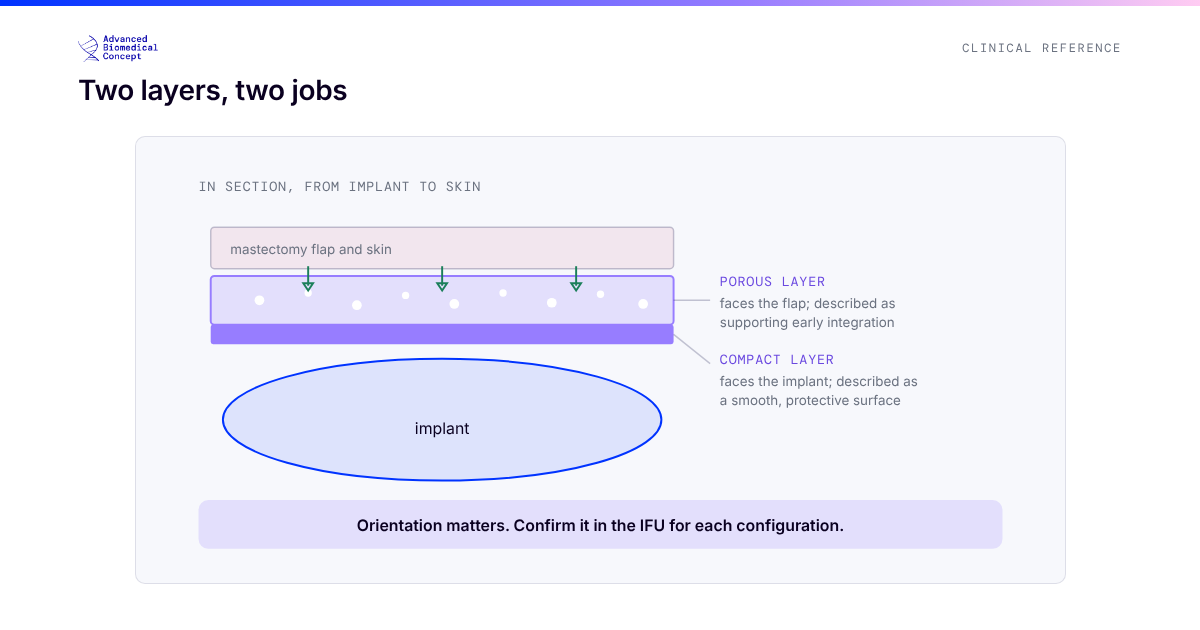
Converting a subpectoral pocket to prepectoral corrects animation and, in published series, is well tolerated when the envelope can take it (Lentz et al., Gland Surgery 2019). Capsulorrhaphy and inframammary fold reconstruction, often reinforced with a biological matrix, address malposition by rebuilding the boundaries that failed.
Fat grafting
The most versatile revision tool. Autologous fat grafting thickens thin envelopes, camouflages rippling and step-offs, softens irradiated skin and corrects contour asymmetry, usually across staged sessions. Where the recipient bed is scarred and tethered, rigottomia releases it so the graft can take. This is hybrid thinking applied after the fact.
Conversion to autologous or hybrid reconstruction
For repeatedly failing implant reconstructions, particularly in irradiated tissue, changing category rather than device is often the durable answer. Our options explorer lays out where each route sits.
Revision in irradiated tissue
Every revision is harder in a radiated field: healing is slower, tissue is less compliant, and complication rates are higher across the board. Staging becomes more important, fat grafting is used earlier and more liberally for its regenerative effect on radiodamaged tissue, and the threshold for converting to autologous tissue is lower. The reasoning is set out in our radiotherapy article.
Planning for revision from day one
The single most useful thing a reconstructive team can do about revision is to name it early. Patients who are told at the outset that reconstruction is a process, that touch-ups are design rather than failure, and that devices have a service life, experience later surgery as maintenance rather than disappointment. In the De Vita 2024 prepectoral series, roughly one breast in nine had fat-graft rippling correction at six months, an ordinary and expected part of the pathway. Our list of questions to ask before reconstruction puts this conversation on the table before the first operation.
The bottom line
Revision is not the failure of reconstruction; it is part of its lifecycle. The specific procedures are well described and mostly effective, the tools are capsule surgery, pocket conversion, matrix reinforcement and fat grafting, and the outcomes are best when revision is anticipated, discussed honestly and planned rather than improvised.
Key published sources
- Lentz R, et al. Correction of animation deformity with subpectoral to prepectoral implant exchange. Gland Surgery. 2019.
- Advances on capsular contracture: prevention and management. Plastic and Reconstructive Surgery Global Open. 2023.
- De Vita R, et al. Prepectoral direct-to-implant reconstruction with acellular bovine pericardium matrix, multicentre series. Clinical Breast Cancer. 2024.
- Rigotti G, et al. Clinical treatment of radiotherapy tissue damage by lipoaspirate transplant. Plastic and Reconstructive Surgery. 2007.
Important information This article is general education, not medical advice. Tap to read the full medical, regulatory & legal notice.
This article is provided by Advanced Biomedical Concept for general informational and educational purposes only. It does not constitute medical, surgical, diagnostic, or other professional healthcare advice, and it is not a substitute for consultation with a suitably qualified healthcare professional. Reading it creates no doctor–patient or other professional relationship. Nothing here should be used to diagnose, treat, cure, or prevent any disease or condition, or to make decisions about medical care. Always seek the advice of a physician or other qualified provider with any questions about a medical condition or treatment, and never disregard or delay professional advice because of something you have read here.
Any reference to Advanced Biomedical Concept products (including ExaShape and ExaFat) is provided for general information only. These are medical devices intended to be used by appropriately trained healthcare professionals strictly in accordance with their applicable, current Instructions for Use (IFU). Regulatory status (including CE marking and classification under the EU Medical Device Regulation), market availability, and approved indications differ between countries and may change over time; a device referred to here may not be available or approved in your country. This content is not intended as, and must not be relied upon as, a statement or claim of safety, clinical performance, or efficacy beyond what is set out in the applicable IFU and current regulatory approvals. Product-specific information is directed at healthcare professionals and is not intended to promote, advertise, or offer any medical device to the general public where such promotion is restricted or prohibited by law.
Statements reflect information believed to be accurate at the date of publication and may be updated or corrected without notice. Any statements regarding the future are expectations or general views, not guarantees. Clinical outcomes depend on many individual factors, results vary from person to person, and no particular result is promised or implied. Where third-party studies, sources, or external links are referenced, they are provided for convenience and information only and do not imply endorsement, and Advanced Biomedical Concept is not responsible for their content.
To the fullest extent permitted by applicable law, Advanced Biomedical Concept and its officers, employees, contributors, and representatives (each acting in that capacity and on behalf of Advanced Biomedical Concept) accept no liability for any loss, injury, or damage of any kind arising directly or indirectly from use of, or reliance on, this content. Nothing in this notice excludes or limits any liability that cannot lawfully be excluded or limited.
Questions about this material can be directed to us via our contact page.
Last reviewed: August 24, 2026.