For years, breast reconstruction was described as a choice between two families: implants, or the patient’s own tissue. Hybrid reconstruction quietly dissolves that boundary. It combines an implant for core volume and projection with autologous fat grafting for the soft-tissue envelope, frequently over a matrix-supported prepectoral pocket, so the final breast is part device and part patient. This article explains the rationale, the technique and the published outcomes.


Why combine implant and fat?
Each component covers the other’s weakness. An implant delivers reliable volume and shape but sits close under mastectomy skin, where edges show and ripples telegraph, particularly in the prepectoral plane and in slim patients. Grafted fat is living tissue that thickens and softens the envelope, blends the transitions at the breast borders and improves the quality of overlying skin, but cannot reliably build a whole breast alone in most reconstructive settings. The hybrid concept, articulated for the prepectoral era in reports such as Maruccia et al. (Plastic and Reconstructive Surgery Global Open 2020) on the synergy of lipofilling and implants, uses each for what it does best.
The anatomy of a modern hybrid reconstruction
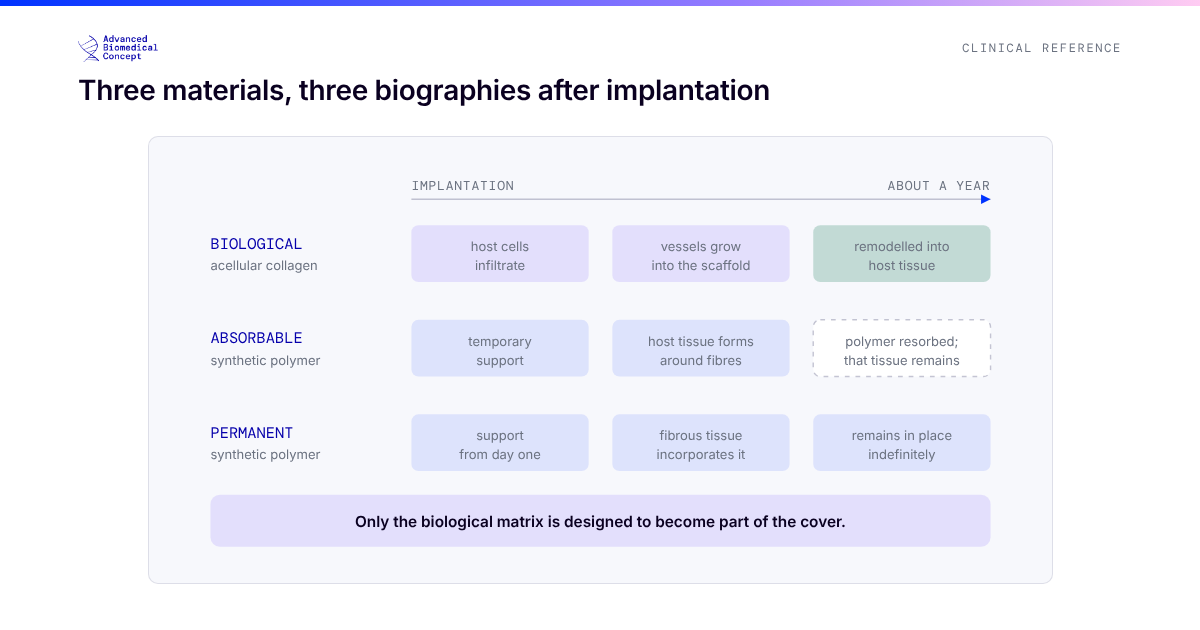
- The pocket. Typically prepectoral: the implant sits above an intact pectoralis major, avoiding animation deformity, supported by a biological matrix such as a bovine pericardium scaffold (ABC’s ExaShape line is one CE-marked example under the EU MDR) or an ADM, which stabilises implant position while integration proceeds.
- The implant. Sized to restore core volume without stressing the envelope; in hybrid planning the implant does not have to do everything, which often means a more conservative device.
- The fat. Harvested by liposuction, processed, and grafted in fine parcels into the subcutaneous layer over and around the implant, at the primary operation, as a staged refinement, or both. Graft survival depends on processing quality and recipient-site technique; closed-system processing approaches such as fat dialysis (the principle behind the EXAFAT system) aim to deliver washed, concentrated fat with its stromal vascular fraction preserved, and tight or scarred beds can be prepared with rigottomia.
What the published outcomes show
A systematic review of hybrid breast reconstruction (Stein et al., Medicina 2022) and subsequent patient-reported outcome studies describe good aesthetic results and high patient satisfaction, with complication profiles driven mainly by the implant component rather than the grafting. Series of simultaneous prepectoral DTI with fat grafting (Zhu et al., Plastic and Reconstructive Surgery 2022) report the approach is feasible at the primary operation in selected patients. Fat-specific events, oil cysts, fat necrosis and partial resorption, occur at rates comparable to fat grafting generally and are usually managed conservatively. As throughout this series, cohorts are heterogeneous and figures belong to their studies rather than to the technique in the abstract.
Fat grafting after any implant reconstruction
Hybrid thinking also applies retrospectively: rippling, step-offs and thin upper poles after a previous implant reconstruction are routinely improved with staged fat grafting. In the De Vita 2024 prepectoral bovine pericardium DTI series, roughly one breast in nine received fat-graft rippling correction at six months, a realistic picture of how often refinement is part of the journey. Patients sometimes read a planned second stage as failure; in hybrid reconstruction it is design.
Safety context
Because hybrid reconstruction grafts fat into a post-oncological field, patients reasonably ask whether that is safe. The oncological evidence on fat grafting after breast cancer is reassuring and is reviewed in full, with sources, in our companion article on the oncological safety of fat grafting.
The bottom line
Hybrid reconstruction treats the implant and the patient’s own fat as partners: device for structure, fat for the living envelope, matrix for support, most naturally in the muscle-sparing prepectoral plane. The published experience reports high satisfaction with a manageable complication profile, and the approach has become a defining pattern of modern implant-based reconstruction. For the grafting fundamentals, start with our fat grafting guide and the fat dialysis pillar.
Key published sources
- Maruccia M, et al. The prepectoral hybrid breast reconstruction: the synergy of lipofilling and breast implants. Plastic and Reconstructive Surgery Global Open. 2020.
- Stein MJ, et al. Outcomes in hybrid breast reconstruction: a systematic review. Medicina. 2022.
- Zhu L, et al. Hybrid prepectoral direct-to-implant and autologous fat graft in immediate reconstruction. Plastic and Reconstructive Surgery. 2022.
- De Vita R, et al. Prepectoral direct-to-implant reconstruction with acellular bovine pericardium matrix, multicentre series. Clinical Breast Cancer. 2024.
Important information This article is general education, not medical advice. Tap to read the full medical, regulatory & legal notice.
This article is provided by Advanced Biomedical Concept for general informational and educational purposes only. It does not constitute medical, surgical, diagnostic, or other professional healthcare advice, and it is not a substitute for consultation with a suitably qualified healthcare professional. Reading it creates no doctor–patient or other professional relationship. Nothing here should be used to diagnose, treat, cure, or prevent any disease or condition, or to make decisions about medical care. Always seek the advice of a physician or other qualified provider with any questions about a medical condition or treatment, and never disregard or delay professional advice because of something you have read here.
Any reference to Advanced Biomedical Concept products (including ExaShape and ExaFat) is provided for general information only. These are medical devices intended to be used by appropriately trained healthcare professionals strictly in accordance with their applicable, current Instructions for Use (IFU). Regulatory status (including CE marking and classification under the EU Medical Device Regulation), market availability, and approved indications differ between countries and may change over time; a device referred to here may not be available or approved in your country. This content is not intended as, and must not be relied upon as, a statement or claim of safety, clinical performance, or efficacy beyond what is set out in the applicable IFU and current regulatory approvals. Product-specific information is directed at healthcare professionals and is not intended to promote, advertise, or offer any medical device to the general public where such promotion is restricted or prohibited by law.
Statements reflect information believed to be accurate at the date of publication and may be updated or corrected without notice. Any statements regarding the future are expectations or general views, not guarantees. Clinical outcomes depend on many individual factors, results vary from person to person, and no particular result is promised or implied. Where third-party studies, sources, or external links are referenced, they are provided for convenience and information only and do not imply endorsement, and Advanced Biomedical Concept is not responsible for their content.
To the fullest extent permitted by applicable law, Advanced Biomedical Concept and its officers, employees, contributors, and representatives (each acting in that capacity and on behalf of Advanced Biomedical Concept) accept no liability for any loss, injury, or damage of any kind arising directly or indirectly from use of, or reliance on, this content. Nothing in this notice excludes or limits any liability that cannot lawfully be excluded or limited.
Questions about this material can be directed to us via our contact page.
Last reviewed: August 24, 2026.