Every implanted device is walled off by the body in a thin capsule of scar tissue; that is normal healing. Capsular contracture is what happens when that capsule thickens and tightens around a breast implant, distorting its shape, hardening the breast and sometimes causing pain. It remains one of the leading causes of reoperation after implant-based reconstruction. This article reviews what drives it, how it is graded, and what the evidence says about reducing the risk, including the role of implant plane and soft-tissue matrices.
Grading and burden
Contracture is conventionally graded with the Baker scale, from grade I (soft, natural) to grade IV (hard, painful, visibly distorted); grades III and IV are considered clinically significant and often prompt revision. Reported rates after reconstruction vary enormously with follow-up length, radiotherapy exposure and technique, from low single digits in favourable cohorts to far higher figures in irradiated submuscular reconstructions followed long-term. That heterogeneity is why single headline numbers deserve suspicion, and why our evidence at a glance page presents figures with their sources and cohort context.
What drives it
The dominant modern theory is inflammatory: a low-grade stimulus keeps the capsule’s fibroblasts activated, and the capsule contracts as myofibroblasts do what myofibroblasts do. Recurring contributors in the literature include subclinical infection and biofilm on the implant surface, blood and fluid around the device, radiotherapy, and implant surface and pocket factors. Hence the familiar preventive bundle: meticulous haemostasis, pocket irrigation, minimal implant handling with insertion aids, and drain and antibiotic protocols that vary by unit.
Radiotherapy, plane and the capsule
Radiotherapy is the single strongest risk multiplier; irradiated reconstructions contract more often and more severely in essentially every comparative series (see our dedicated article on radiotherapy and implant-based reconstruction). Implant plane also appears to matter: several prepectoral cohorts report notably low contracture rates at short to medium follow-up, and an analysis of postmastectomy radiotherapy by plane (Sinnott et al., Annals of Surgical Oncology 2018) found less severe contracture with prepectoral placement. Longer follow-up is still accumulating, so these findings are encouraging rather than final.
What matrices add
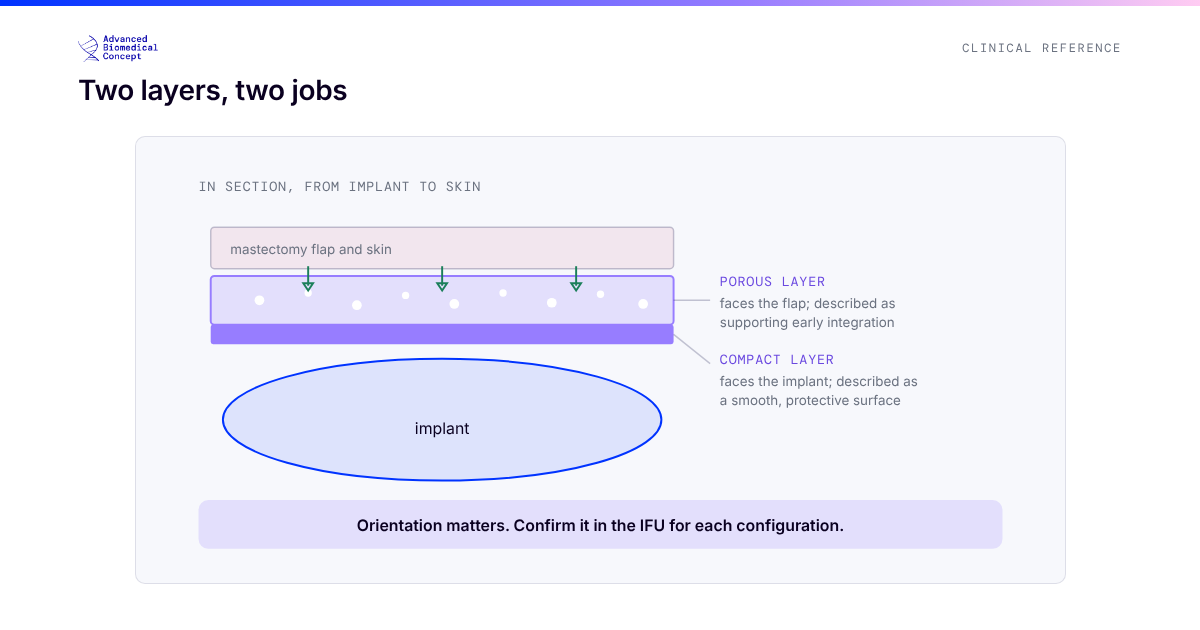
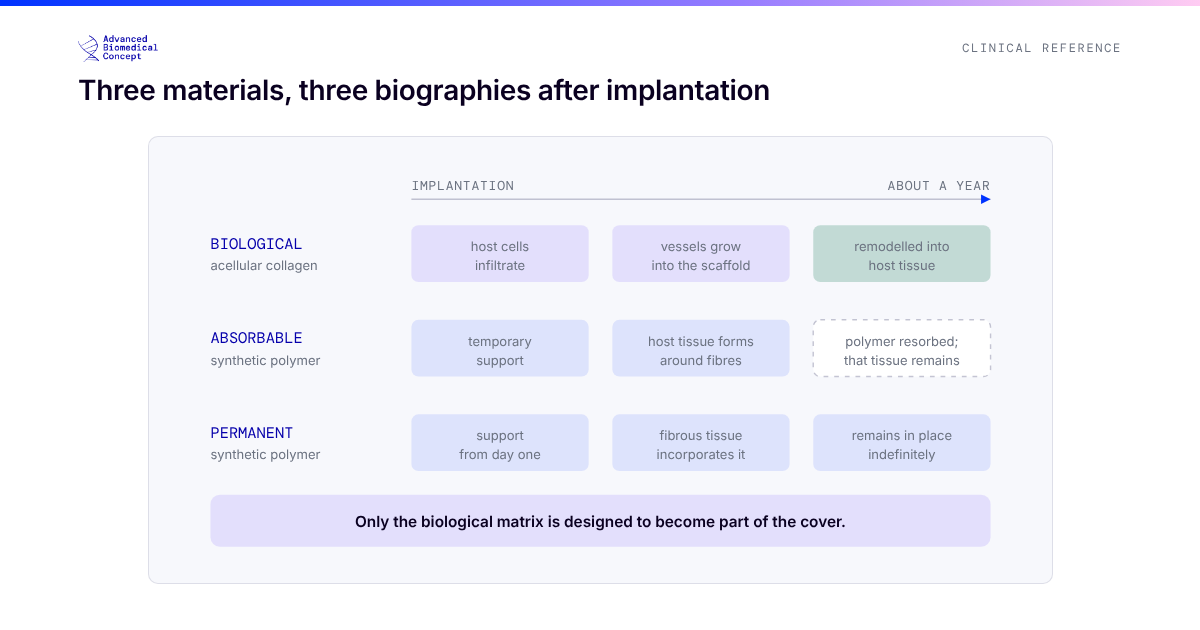
A consistent observation across the acellular dermal matrix literature, summarised in a single-arm meta-analysis of ADM use in reconstruction (Salibian et al. 2019 among others), is a low reported rate of capsular contracture where the implant is wrapped or covered by matrix, with histological work showing reduced capsule formation at the matrix-implant interface. The same rationale extends to other biological scaffolds: in the De Vita 2024 multicentre prepectoral direct-to-implant series using an acellular bovine pericardium matrix (65 breasts), no significant capsular contracture was observed at a mean 21.3 months of follow-up. These are single-arm data, not randomised comparisons, and cohorts differ; but the direction is consistent enough that capsule behaviour is now a standard part of the matrix versus ADM discussion.
Managing established contracture
Established Baker III-IV contracture is a surgical problem: capsulectomy or capsulotomy, implant exchange, and a decision about changing something so the problem does not simply recur. Options with published support include moving the implant to a fresh plane (including prepectoral conversion), adding matrix coverage at revision, and in irradiated or repeatedly contracting patients, converting to autologous or hybrid reconstruction with fat grafting to improve the soft-tissue environment. The right choice is individual, and the evidence for each pathway is observational.
The bottom line
Capsular contracture is multifactorial, but its levers are increasingly well mapped: control contamination and bleeding, respect the effects of radiotherapy in planning, and consider plane and soft-tissue support, where modern prepectoral and matrix-assisted series report low contracture rates at the follow-up published so far. Attribution matters; every figure here comes from the named cohorts, and none of them is a head-to-head trial.
Key published sources
- Sinnott CJ, et al. Impact of postmastectomy radiation therapy in prepectoral versus subpectoral implant-based breast reconstruction. Annals of Surgical Oncology. 2018.
- Salibian AA, et al. Efficacy of acellular dermal matrix in capsular contracture of implant-based breast reconstruction: a single-arm meta-analysis. Aesthetic Plastic Surgery. 2020.
- De Vita R, et al. Prepectoral direct-to-implant reconstruction with acellular bovine pericardium matrix, multicentre series. Clinical Breast Cancer. 2024.
- Advances on capsular contracture: prevention and management. Plastic and Reconstructive Surgery Global Open. 2023.
Important information This article is general education, not medical advice. Tap to read the full medical, regulatory & legal notice.
This article is provided by Advanced Biomedical Concept for general informational and educational purposes only. It does not constitute medical, surgical, diagnostic, or other professional healthcare advice, and it is not a substitute for consultation with a suitably qualified healthcare professional. Reading it creates no doctor–patient or other professional relationship. Nothing here should be used to diagnose, treat, cure, or prevent any disease or condition, or to make decisions about medical care. Always seek the advice of a physician or other qualified provider with any questions about a medical condition or treatment, and never disregard or delay professional advice because of something you have read here.
Any reference to Advanced Biomedical Concept products (including ExaShape and ExaFat) is provided for general information only. These are medical devices intended to be used by appropriately trained healthcare professionals strictly in accordance with their applicable, current Instructions for Use (IFU). Regulatory status (including CE marking and classification under the EU Medical Device Regulation), market availability, and approved indications differ between countries and may change over time; a device referred to here may not be available or approved in your country. This content is not intended as, and must not be relied upon as, a statement or claim of safety, clinical performance, or efficacy beyond what is set out in the applicable IFU and current regulatory approvals. Product-specific information is directed at healthcare professionals and is not intended to promote, advertise, or offer any medical device to the general public where such promotion is restricted or prohibited by law.
Statements reflect information believed to be accurate at the date of publication and may be updated or corrected without notice. Any statements regarding the future are expectations or general views, not guarantees. Clinical outcomes depend on many individual factors, results vary from person to person, and no particular result is promised or implied. Where third-party studies, sources, or external links are referenced, they are provided for convenience and information only and do not imply endorsement, and Advanced Biomedical Concept is not responsible for their content.
To the fullest extent permitted by applicable law, Advanced Biomedical Concept and its officers, employees, contributors, and representatives (each acting in that capacity and on behalf of Advanced Biomedical Concept) accept no liability for any loss, injury, or damage of any kind arising directly or indirectly from use of, or reliance on, this content. Nothing in this notice excludes or limits any liability that cannot lawfully be excluded or limited.
Questions about this material can be directed to us via our contact page.
Last reviewed: August 24, 2026.