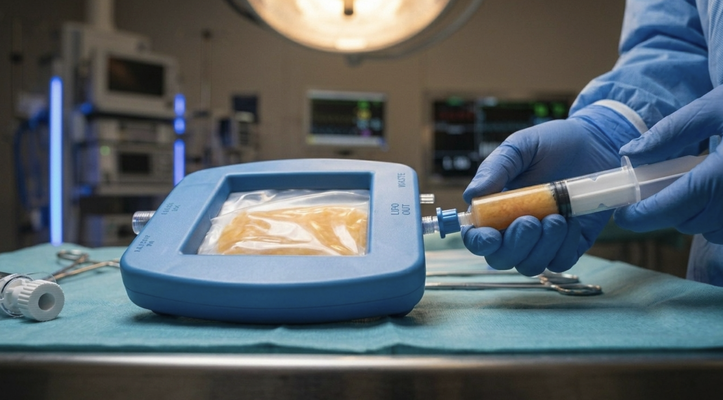
Fat grafting has become one of the most useful tools in breast reconstruction. By transferring a patient’s own fat to add natural soft tissue, it can refine contour, soften edges and improve the way a reconstruction looks and feels. But the results depend heavily on one thing that patients rarely hear about: how the fat is processed before it is re-injected. This article explains how fat grafting works and why processing quality matters.
What is fat grafting?
Fat grafting (also called lipofilling or autologous fat transfer) is a procedure in which fat is gently harvested from one area of the body — often the abdomen or thighs — processed, and then injected into the breast area to add volume and soft-tissue coverage. Because it uses the patient’s own tissue, it integrates naturally when it survives, and it avoids introducing any foreign material.
Why fat grafting matters in reconstruction
In implant-based reconstruction, especially prepectoral techniques where the implant sits closer to the skin, soft-tissue coverage is critical for a natural result. Thin coverage can make implant edges or rippling more visible. Fat grafting adds a layer of the patient’s own tissue that:
- Softens the transition between the reconstruction and the surrounding chest;
- Improves contour and helps camouflage implant edges;
- Can improve the quality and pliability of the overlying tissue over time.
It works hand in hand with a biological matrix: the matrix provides structural support, the fat provides natural coverage.
The central challenge: graft survival
Transferred fat only helps if it survives. The persistent challenge of fat grafting is that a portion of the grafted fat can be reabsorbed by the body, sometimes requiring repeat sessions. Graft survival depends on the fat being handled gently and, crucially, on how clean the fat is when it is re-injected.
Freshly harvested fat is mixed with unwanted components — blood, oil, local anaesthetic fluid and cellular debris. If these contaminants are not adequately removed, they can compromise the quality of the graft and its chances of surviving. At the same time, aggressive processing can damage the fat and the valuable regenerative cells within it.
Preserving the stromal vascular fraction (SVF)
Fat tissue contains a population of regenerative cells known as the stromal vascular fraction, or SVF. These cells play an important role in helping grafted fat establish a blood supply and survive. Good processing aims to do two things at once: remove contaminants and preserve the delicate SVF and the integrity of the fat itself. Getting that balance right is what separates high-quality fat processing from simple washing.
Fat “dialysis”: a technology approach
This is where processing technology comes in. Advanced Biomedical Concept’s EXAFAT is a closed-loop fat dialysis system designed to efficiently remove contaminants while preserving fat integrity and the SVF niche. The “closed-loop” design keeps the fat protected during processing. The goal is cleaner, better-preserved fat — and therefore more predictable, higher-quality grafting. You can read more in our dedicated fat grafting guide.
What the procedure involves
Fat grafting is usually done under anaesthetic and has two parts: gentle liposuction to harvest fat from a donor area, and re-injection of the processed fat into the breast area in fine layers so it has the best chance of picking up a blood supply. Because it is minimally invasive compared with major flap surgery, recovery is often relatively quick, though there will be some bruising and swelling at both the donor and recipient sites. Where more volume or refinement is needed, grafting may be staged across more than one session. Your surgeon will explain what to expect for your specific plan.
How fat grafting and a biological matrix work together
In modern implant reconstruction, fat grafting rarely works alone. It pairs naturally with a biological matrix: the matrix provides the structural support and defined pocket for the implant, while fat grafting adds the soft, natural coverage on top. This partnership is central to prepectoral reconstruction, where the implant sits above the muscle and both good structural support and good soft-tissue coverage are essential. Thinking of them as a team, rather than competing options, is the clearest way to understand modern technique.
What patients should know
Fat grafting is often performed as a refining step, sometimes across more than one session, because a proportion of grafted fat may not survive and further grafting can build on the result. This is normal and expected, not a sign of failure. Better processing aims to improve survival and reduce how much repeat work is needed, but individual results still vary. As always, your surgical team can give you a realistic picture for your situation.
The bottom line
Fat grafting adds natural, living soft tissue to a reconstruction — but its success hinges on graft survival, which in turn depends on gentle handling and clean, well-preserved fat. Technologies such as fat dialysis are designed to remove contaminants while protecting the fat and its regenerative cells. Combined with a supportive biological matrix, high-quality fat grafting is a cornerstone of modern, natural-looking reconstruction. Explore EXAFAT or the broader story of med tech for breast reconstruction.
This article is for general education and is not medical advice. Fat grafting decisions should be made with a qualified surgeon.
Important information This article is general education, not medical advice. Tap to read the full medical, regulatory & legal notice.
This article is provided by Advanced Biomedical Concept for general informational and educational purposes only. It does not constitute medical, surgical, diagnostic, or other professional healthcare advice, and it is not a substitute for consultation with a suitably qualified healthcare professional. Reading it creates no doctor–patient or other professional relationship. Nothing here should be used to diagnose, treat, cure, or prevent any disease or condition, or to make decisions about medical care. Always seek the advice of a physician or other qualified provider with any questions about a medical condition or treatment, and never disregard or delay professional advice because of something you have read here.
Any reference to Advanced Biomedical Concept products (including ExaShape and ExaFat) is provided for general information only. These are medical devices intended to be used by appropriately trained healthcare professionals strictly in accordance with their applicable, current Instructions for Use (IFU). Regulatory status (including CE marking and classification under the EU Medical Device Regulation), market availability, and approved indications differ between countries and may change over time; a device referred to here may not be available or approved in your country. This content is not intended as, and must not be relied upon as, a statement or claim of safety, clinical performance, or efficacy beyond what is set out in the applicable IFU and current regulatory approvals. Product-specific information is directed at healthcare professionals and is not intended to promote, advertise, or offer any medical device to the general public where such promotion is restricted or prohibited by law.
Statements reflect information believed to be accurate at the date of publication and may be updated or corrected without notice. Any statements regarding the future are expectations or general views, not guarantees. Clinical outcomes depend on many individual factors, results vary from person to person, and no particular result is promised or implied. Where third-party studies, sources, or external links are referenced, they are provided for convenience and information only and do not imply endorsement, and Advanced Biomedical Concept is not responsible for their content.
To the fullest extent permitted by applicable law, Advanced Biomedical Concept and its officers, employees, contributors, and representatives (each acting in that capacity and on behalf of Advanced Biomedical Concept) accept no liability for any loss, injury, or damage of any kind arising directly or indirectly from use of, or reliance on, this content. Nothing in this notice excludes or limits any liability that cannot lawfully be excluded or limited.
Questions about this material can be directed to us via our contact page.
Last reviewed: July 23, 2026.