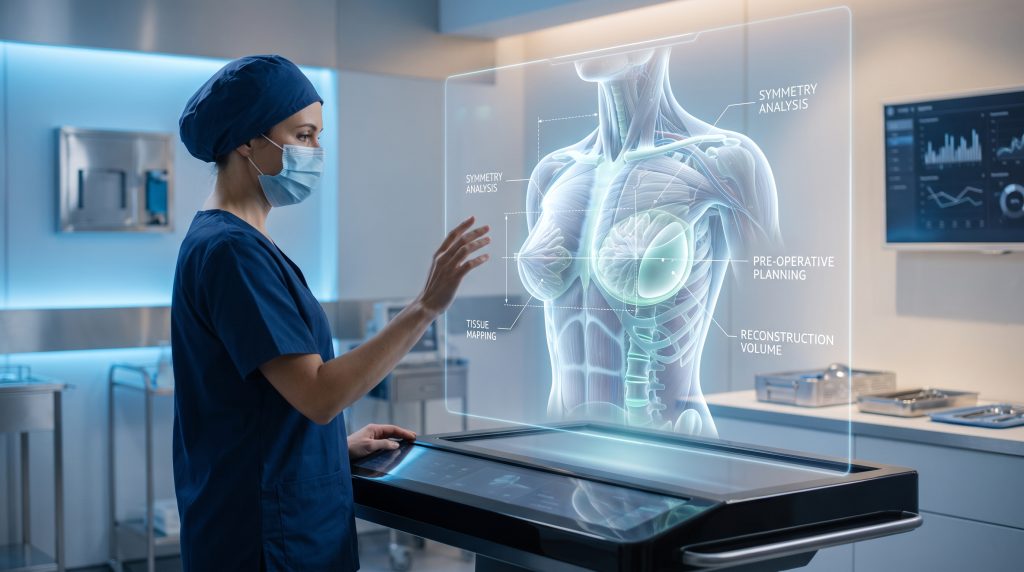
Med tech for breast reconstruction has changed more in the last decade than in the several before it. Reconstruction is no longer just about choosing an implant — it is about the biology and engineering around that implant: the scaffolds that support it, the tissue technologies that improve fat grafting, and the planning tools that help surgeons predict the result. This article looks at how medical technology is reshaping implant-based breast reconstruction and where the field is heading.
From muscle coverage to biology-led reconstruction
For years, implant reconstruction relied on placing the implant beneath the chest (pectoralis) muscle to give it coverage. It worked, but disrupting the muscle can cause discomfort, animation deformity (movement of the implant when the muscle contracts), and a longer recovery.
Modern med tech has enabled a shift to prepectoral reconstruction, where the implant sits above the muscle. The muscle is left intact, but the implant now needs a different form of support — and that is where biological technology comes in. This move from a purely mechanical solution to a biology-led one is the central story of contemporary reconstruction.
The biological matrix: the enabling technology
The single technology that made muscle-sparing reconstruction practical is the biological matrix — a processed collagen scaffold that supports the implant and is designed to be repopulated by the patient’s own cells. Rather than relying on muscle, the surgeon relies on a scaffold the body can integrate.
The newest generation of matrices aims to be biologically active. Advanced Biomedical Concept’s ExaShape, a bovine pericardium-derived bilayer membrane, is engineered not only to support the implant but to encourage regeneration — reactivating fibroblasts, supporting growth-factor release, and initiating new blood-vessel formation as it integrates. That is a meaningful conceptual shift: from a passive support material to a scaffold intended to drive healing.
Fat grafting technology and fat “dialysis”
Fat grafting — transferring a patient’s own fat to add soft-tissue thickness and refine contour — is a second pillar of modern reconstruction. Its long-standing challenge is graft survival: transferred fat can be damaged during harvesting and processing, and contaminants such as blood, oil and cellular debris reduce the quality of the graft.
This is where processing technology matters. Advanced Biomedical Concept’s EXAFAT is a closed-loop fat dialysis system designed to remove contaminants while preserving the integrity of the fat and the stromal vascular fraction (SVF) — the regenerative cell population that helps grafted fat survive and integrate. Cleaner, better-preserved fat is intended to give more predictable, higher-quality grafting. You can read the technical detail in our fat grafting guide.
Two technologies, one reconstruction
The most powerful trend in med tech for breast reconstruction is not any single device — it is the way the pieces work together. A robust biological matrix provides structure and support; high-quality fat grafting adds soft-tissue coverage and natural contour. Combined, they let surgeons perform muscle-sparing reconstructions that would have been difficult with older approaches. ABC’s two product lines, ExaShape and EXAFAT, are built around exactly this pairing.
Planning and decision technology
Technology is also changing the conversation before surgery. Interactive planning tools help patients and surgeons weigh options — implant vs. autologous, prepectoral vs. subpectoral, the role of a matrix and fat grafting — against individual anatomy and goals. Better information up front supports better-matched, more realistic decisions and helps set expectations.
What to look for in modern reconstruction technology
If you are evaluating the technology behind a reconstruction, a few questions help cut through marketing language:
- Does the matrix integrate? Is it designed to be repopulated and revascularised by the body, or simply to sit as a support?
- What is the tissue source? A consistent, well-characterised source such as bovine pericardium supports manufacturing quality.
- How is fat processed? Does the system preserve fat integrity and the SVF niche, or does it risk damaging the graft?
- Is it muscle-sparing? Does the approach let the surgeon avoid disturbing the chest muscle where appropriate?
What this means for the patient experience
Technology tends to be discussed in engineering terms, but its real value is measured in the patient experience. Muscle-sparing techniques enabled by biological matrices can mean avoiding animation deformity — the movement of the implant when the chest muscle flexes — and, for many patients, a recovery less dominated by muscle-related discomfort. Better fat processing aims at more predictable grafting, which can reduce the likelihood of repeat sessions. And better planning tools mean patients arrive at surgery with clearer, more realistic expectations. None of this removes the fact that reconstruction is major surgery with individual risks, but the direction of the technology is toward results that look and feel more natural with less collateral disruption.
How to evaluate the technology behind a reconstruction
For a patient, the sheer number of product names and marketing claims can be overwhelming. A useful way to cut through it is to focus on evidence and reasoning rather than branding. Ask the surgeon why a particular matrix or technique is being recommended for your specific situation, what the alternatives are, and what trade-offs each involves. Look for materials and systems with a clear regulatory status and a manufacturer that is transparent about how the device works. The best technology for any given reconstruction is not necessarily the newest or most heavily promoted — it is the one that fits the patient’s anatomy, goals and clinical circumstances, in the hands of a surgeon experienced with it.
Med tech and regulation in Europe
In Europe, the devices behind modern reconstruction — implants, biological matrices and fat-processing systems — are regulated as medical devices under the EU framework. For patients and surgeons, that regulatory layer is itself part of the “technology” story: it governs how a device is tested, manufactured and labelled. When evaluating any reconstruction technology, its regulatory status and the manufacturer’s quality standards are as relevant as the underlying science.
Where the field is heading
The direction of travel is clear: less disruption to the patient’s own anatomy, more reliance on materials the body can integrate, and better processing of the patient’s own tissue. Med tech for breast reconstruction is increasingly about working with the body’s biology rather than around it. Devices that combine mechanical reliability with genuine biological integration — and that pair structural support with high-quality fat grafting — represent the current leading edge. The next frontier is likely to be even smarter scaffolds and processing systems that further improve how well the body accepts and integrates a reconstruction.
The bottom line
Breast reconstruction has become a technology story as much as a surgical one. The biological matrix made muscle-sparing reconstruction possible; advances in fat processing are making results more predictable; and planning tools are improving the decisions made before surgery. To see how these technologies come together, explore ExaShape and EXAFAT, or start with the biological matrix guide.
This article is for general education and is not medical advice. Individual treatment options should be discussed with a qualified reconstructive surgeon.
Important information This article is general education, not medical advice. Tap to read the full medical, regulatory & legal notice.
This article is provided by Advanced Biomedical Concept for general informational and educational purposes only. It does not constitute medical, surgical, diagnostic, or other professional healthcare advice, and it is not a substitute for consultation with a suitably qualified healthcare professional. Reading it creates no doctor–patient or other professional relationship. Nothing here should be used to diagnose, treat, cure, or prevent any disease or condition, or to make decisions about medical care. Always seek the advice of a physician or other qualified provider with any questions about a medical condition or treatment, and never disregard or delay professional advice because of something you have read here.
Any reference to Advanced Biomedical Concept products (including ExaShape and ExaFat) is provided for general information only. These are medical devices intended to be used by appropriately trained healthcare professionals strictly in accordance with their applicable, current Instructions for Use (IFU). Regulatory status (including CE marking and classification under the EU Medical Device Regulation), market availability, and approved indications differ between countries and may change over time; a device referred to here may not be available or approved in your country. This content is not intended as, and must not be relied upon as, a statement or claim of safety, clinical performance, or efficacy beyond what is set out in the applicable IFU and current regulatory approvals. Product-specific information is directed at healthcare professionals and is not intended to promote, advertise, or offer any medical device to the general public where such promotion is restricted or prohibited by law.
Statements reflect information believed to be accurate at the date of publication and may be updated or corrected without notice. Any statements regarding the future are expectations or general views, not guarantees. Clinical outcomes depend on many individual factors, results vary from person to person, and no particular result is promised or implied. Where third-party studies, sources, or external links are referenced, they are provided for convenience and information only and do not imply endorsement, and Advanced Biomedical Concept is not responsible for their content.
To the fullest extent permitted by applicable law, Advanced Biomedical Concept and its officers, employees, contributors, and representatives (each acting in that capacity and on behalf of Advanced Biomedical Concept) accept no liability for any loss, injury, or damage of any kind arising directly or indirectly from use of, or reliance on, this content. Nothing in this notice excludes or limits any liability that cannot lawfully be excluded or limited.
Questions about this material can be directed to us via our contact page.
Last reviewed: July 23, 2026.