The largest series to date on prepectoral reconstruction assisted by an acellular bovine pericardium pocket. Here is what it recorded.
Material science makes a promise. Real-world clinical data tells you whether the promise holds once the matrix is in a patient and the follow-up clock is running. For ExaShape, the most substantial answer to date comes from a 2024 multicentric study led by De Vita and colleagues, the largest clinical series so far on prepectoral breast reconstruction assisted by an ABPM pocket.
The design is straightforward and the numbers are worth sitting with.
The cohort
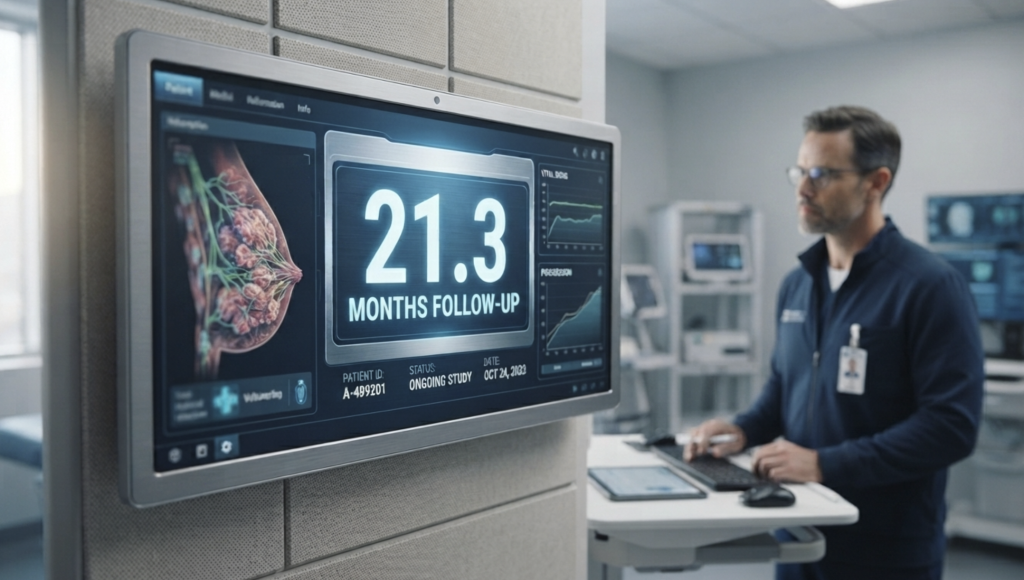
De Vita and colleagues followed 65 reconstructions with a mean follow-up of 21.3 months (De Vita R, et al. Clinical Breast Cancer. 2024). This is not a benchtop model or a short-window snapshot. It is a real-world patient cohort tracked across nearly two years, which is the horizon where capsular and remodelling questions actually surface.
What the data recorded
No significant capsular contracture. Across the series, there were no significant cases of Baker III to IV capsular contracture. In implant-based reconstruction, contracture is the complication that most often undoes an otherwise good result, so its absence across this follow-up window is the headline figure.
A 4.3% major complication rate. In a real-world cohort, a major complication rate of 4.3% describes a predictable safety profile rather than an idealised one.
A mean surgical time of 1.42 hours. Time in the operating room is a patient-safety variable, not only a scheduling one. A mean surgical time of 1.42 hours reflects a workflow that does not depend on prolonged intraoperative shaping of the matrix.
Where the outcome is felt
Safety data answers the surgeon’s question. Patient-reported outcomes answer the patient’s. Using BREAST-Q, the same body of work recorded high mean scores for breast shape (4.18 out of 5) and symmetry (4.15 out of 5), alongside meaningful gains in psychosocial well-being (De Vita R, et al. 2024; Mazzocchi M, et al. PRRS 2022).
That pairing matters. A matrix can produce a clean safety table and still leave patients dissatisfied with the aesthetic result. Here the two move together: a predictable safety profile and outcomes patients rate highly.
Reading the numbers honestly
Real-world clinical data is most useful when it is read for what it is. This is a defined cohort, followed for a defined window, reporting defined endpoints. It does not settle every question, and it is not offered as a comparison against any other device. What it does establish is a documented, reproducible picture of prepectoral reconstruction assisted by an ExaShape pocket across nearly two years of follow-up.
For a surgeon weighing a biological matrix, that is the useful kind of evidence: specific, sourced, and long enough to matter.
65 reconstructions. 21.3 months. A safety profile and a satisfaction profile that hold together.
Explore the full dataset and supporting studies in the ExaShape Evidence Library, or model your own case mix with the Decision Simulator.
Scientific references
- De Vita R, et al. A Pericardium Bovine Matrix Pocket in DTI Prepectoral Breast Reconstruction. Clinical Breast Cancer. 2024.
- Mazzocchi M, et al. PRRS 2022.
Images for illustrative purposes only. For Healthcare Professionals Only. ExaShape is CE marked per EU MDR 2017/745.
Important information This article is general education, not medical advice. Tap to read the full medical, regulatory & legal notice.
This article is provided by Advanced Biomedical Concept for general informational and educational purposes only. It does not constitute medical, surgical, diagnostic, or other professional healthcare advice, and it is not a substitute for consultation with a suitably qualified healthcare professional. Reading it creates no doctor–patient or other professional relationship. Nothing here should be used to diagnose, treat, cure, or prevent any disease or condition, or to make decisions about medical care. Always seek the advice of a physician or other qualified provider with any questions about a medical condition or treatment, and never disregard or delay professional advice because of something you have read here.
Any reference to Advanced Biomedical Concept products (including ExaShape and ExaFat) is provided for general information only. These are medical devices intended to be used by appropriately trained healthcare professionals strictly in accordance with their applicable, current Instructions for Use (IFU). Regulatory status (including CE marking and classification under the EU Medical Device Regulation), market availability, and approved indications differ between countries and may change over time; a device referred to here may not be available or approved in your country. This content is not intended as, and must not be relied upon as, a statement or claim of safety, clinical performance, or efficacy beyond what is set out in the applicable IFU and current regulatory approvals. Product-specific information is directed at healthcare professionals and is not intended to promote, advertise, or offer any medical device to the general public where such promotion is restricted or prohibited by law.
Statements reflect information believed to be accurate at the date of publication and may be updated or corrected without notice. Any statements regarding the future are expectations or general views, not guarantees. Clinical outcomes depend on many individual factors, results vary from person to person, and no particular result is promised or implied. Where third-party studies, sources, or external links are referenced, they are provided for convenience and information only and do not imply endorsement, and Advanced Biomedical Concept is not responsible for their content.
To the fullest extent permitted by applicable law, Advanced Biomedical Concept and its officers, employees, contributors, and representatives (each acting in that capacity and on behalf of Advanced Biomedical Concept) accept no liability for any loss, injury, or damage of any kind arising directly or indirectly from use of, or reliance on, this content. Nothing in this notice excludes or limits any liability that cannot lawfully be excluded or limited.
Questions about this material can be directed to us via our contact page.
Last reviewed: July 1, 2026.