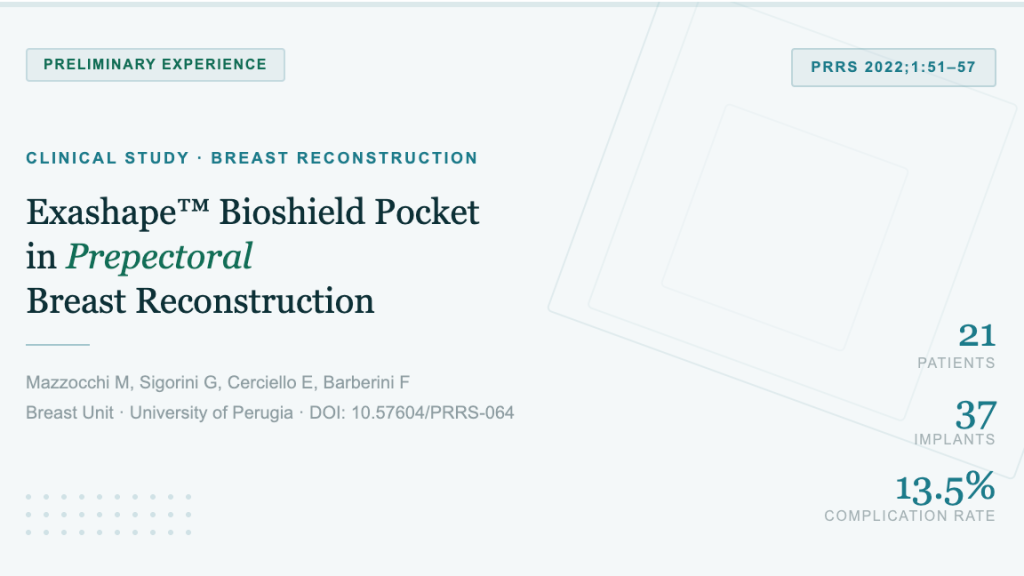
Medical literature is dense by necessity, but that doesn’t mean it has to be inaccessible. We created these animated visualisations to make the study’s key findings easier to absorb at a glance: patient demographics, complication rates, quality-of-life outcomes, and surgical workflow. No data has been altered or embellished. All figures, percentages, and direct quotes are taken verbatim from the published paper.
Our goal is to support awareness of emerging surgical techniques among clinicians, patients, and the wider healthcare community, not to replace the original research. We strongly encourage readers to consult the full study via the DOI above.



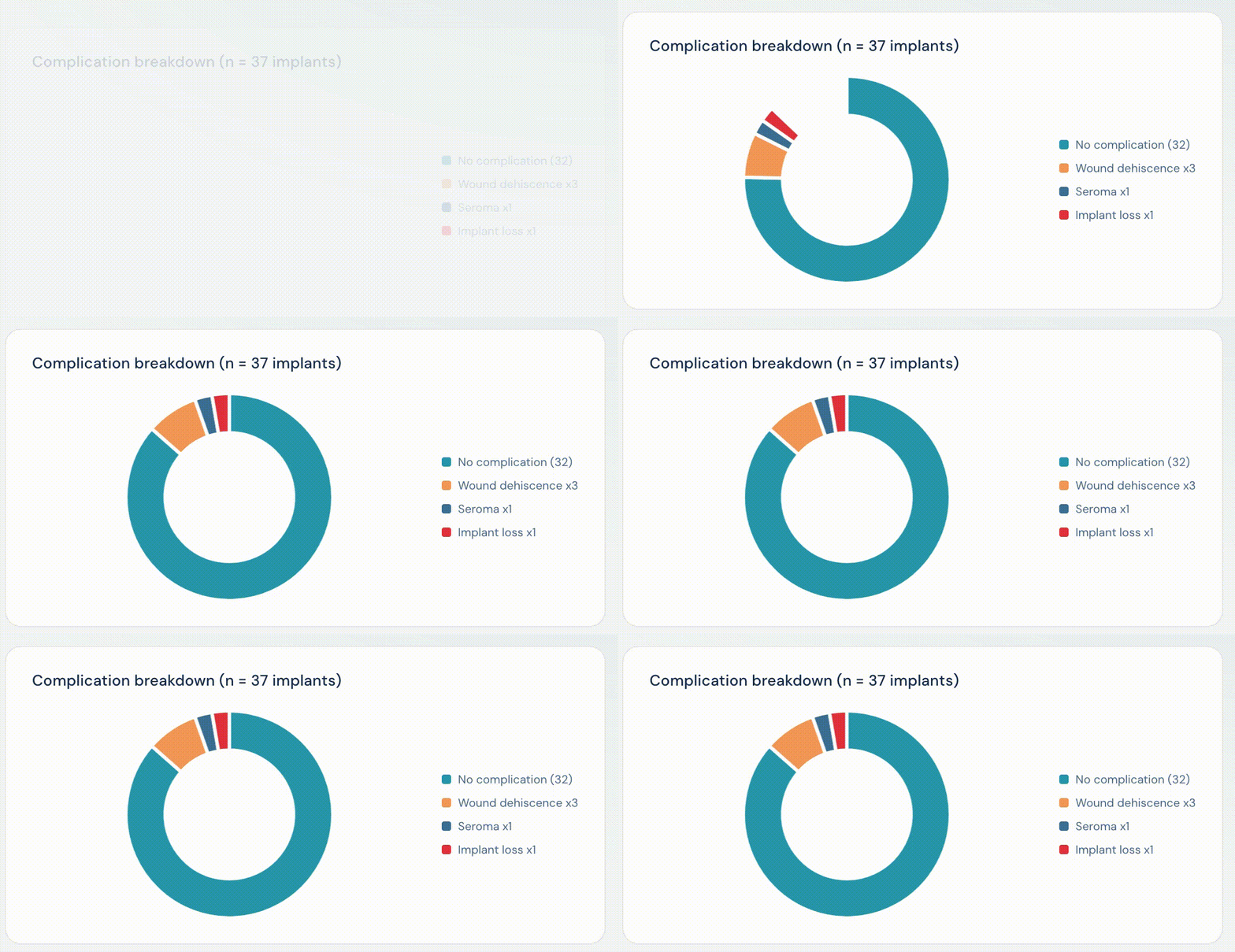
Patients’ age ranged from 38 to 55 (mean age 48 years) and they presented a mean BMI of 22.0 kg/m² (range 18–24.5 kg/m²). None of them presented relevant comorbidities but one was a light smoker. Thirty-seven Exashape™ Bioshield Pocket membranes were used: medium size in 12 cases and large size in all the other cases. Of twenty-one patients enrolled for this study, only five patients had complications: four resolved after surgical revision of scars and one with implant loss.
— Results, p. 53

After surgery, scores for overall satisfaction with breasts, psychosocial well-being, and sexual well-being were all significantly increased (p < 0.05). Health-related quality-of-life was assessed comparing the preoperative and postoperative BREAST-Q scores. As shown by the data collected at BREAST-Q, all patients are satisfied with the type of reconstruction performed and the result obtained. Therefore, with the current results, even if still in the initial phase, we feel we can conclude that the Exashape™ can give a good aesthetic and functional result, allowing the woman to feel comfortable in their daily routine.
— Results & Discussion, p. 54–56

The design of this membrane for DTI Pre-pectoral reconstruction known as Bioshield Pocket™ allows anterior coverage of the implant in less than five minutes creating an additional layer, without the need for adaptation procedures or redundant biological mass, reducing operative time, risk of accidental damage to the silicone implant and limiting protracted handling, with the associated risk of contamination that brings. The implant and mesh assembly can be positioned within the breast skin flap pocket, even without the need for chest wall sutures.
— Introduction, p. 52
Exashape™ Bioshield Pocket allowed a considerable reduction of surgical time in implant positioning, lowering exposure time and risk of infection. It also reduces the risk of implant damage during suturing. Although further studies would be useful to validate our result, we can say that Exashape™ has proved to be useful in breast reconstruction, allowing a good aesthetic and functional result.
— Conclusions, p. 56
The animations in this article are based entirely on data from the following peer-reviewed publication:
Mazzocchi M, Sigorini G, Cerciello E, Barberini F. “The use of Exashape™ Bioshield Pocket in prepectoral breast reconstruction: a preliminary experience.” Plastic, Reconstructive & Regenerative Surgery (PRRS) 2022;1:51–57. DOI: 10.57604/PRRS-064
The study was conducted at the Breast Unit, University of Perugia (Azienda Ospedaliera Perugia, Italy), and approved by the Institutional Ethics Committee (approval no. 325/2021). All patients provided written informed consent.
Copyright & open access
The original study is published under a CC-BY-NC-ND 4.0 International licence (Creative Commons Attribution-NonCommercial-NoDerivatives). This summary is a non-commercial educational use. Quotes reproduced from the paper are attributed and used solely for commentary and informational purposes. All rights to the original work remain with the authors and Pacini Editore Srl.
Medical device notice
Exashape™ Bioshield Pocket is a regulated medical device. Its availability, approved indications, and regulatory status vary by country. References to this product do not imply regulatory approval in any specific jurisdiction. Consult local regulatory guidance and device labelling before clinical use.
Important information This article is general education, not medical advice. Tap to read the full medical, regulatory & legal notice.
This article is provided by Advanced Biomedical Concept for general informational and educational purposes only. It does not constitute medical, surgical, diagnostic, or other professional healthcare advice, and it is not a substitute for consultation with a suitably qualified healthcare professional. Reading it creates no doctor–patient or other professional relationship. Nothing here should be used to diagnose, treat, cure, or prevent any disease or condition, or to make decisions about medical care. Always seek the advice of a physician or other qualified provider with any questions about a medical condition or treatment, and never disregard or delay professional advice because of something you have read here.
Any reference to Advanced Biomedical Concept products (including ExaShape and ExaFat) is provided for general information only. These are medical devices intended to be used by appropriately trained healthcare professionals strictly in accordance with their applicable, current Instructions for Use (IFU). Regulatory status (including CE marking and classification under the EU Medical Device Regulation), market availability, and approved indications differ between countries and may change over time; a device referred to here may not be available or approved in your country. This content is not intended as, and must not be relied upon as, a statement or claim of safety, clinical performance, or efficacy beyond what is set out in the applicable IFU and current regulatory approvals. Product-specific information is directed at healthcare professionals and is not intended to promote, advertise, or offer any medical device to the general public where such promotion is restricted or prohibited by law.
Statements reflect information believed to be accurate at the date of publication and may be updated or corrected without notice. Any statements regarding the future are expectations or general views, not guarantees. Clinical outcomes depend on many individual factors, results vary from person to person, and no particular result is promised or implied. Where third-party studies, sources, or external links are referenced, they are provided for convenience and information only and do not imply endorsement, and Advanced Biomedical Concept is not responsible for their content.
To the fullest extent permitted by applicable law, Advanced Biomedical Concept and its officers, employees, contributors, and representatives (each acting in that capacity and on behalf of Advanced Biomedical Concept) accept no liability for any loss, injury, or damage of any kind arising directly or indirectly from use of, or reliance on, this content. Nothing in this notice excludes or limits any liability that cannot lawfully be excluded or limited.
Questions about this material can be directed to us via our contact page.
Last reviewed: June 16, 2026.