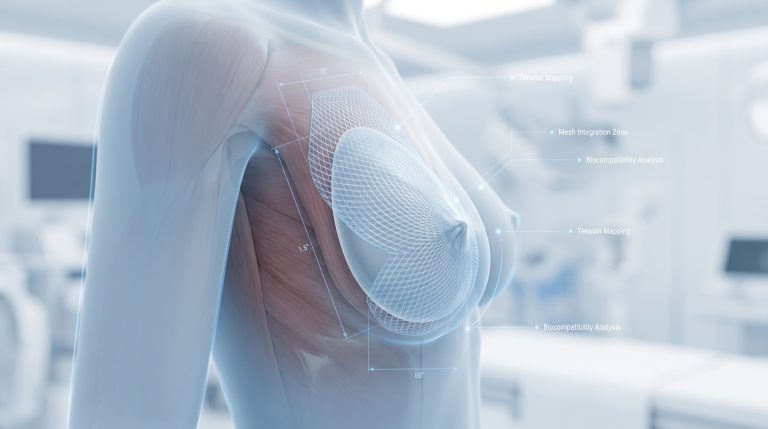
Rigottomia (rigottomy) is best understood through the problems it solves, and few show it off better than the tight, fibrous conditions of the breast and skin. In tuberous breasts, contracted scars and herniated areolae, the underlying issue is the same: a fibrous restriction that pulls tissue into an abnormal shape. Rigottomia releases that restriction and, combined with fat grafting, lets the surgeon reshape and re-volumise the area with minimal scarring. This guide walks through the main applications.
Rigottomia for tuberous (constricted) breast
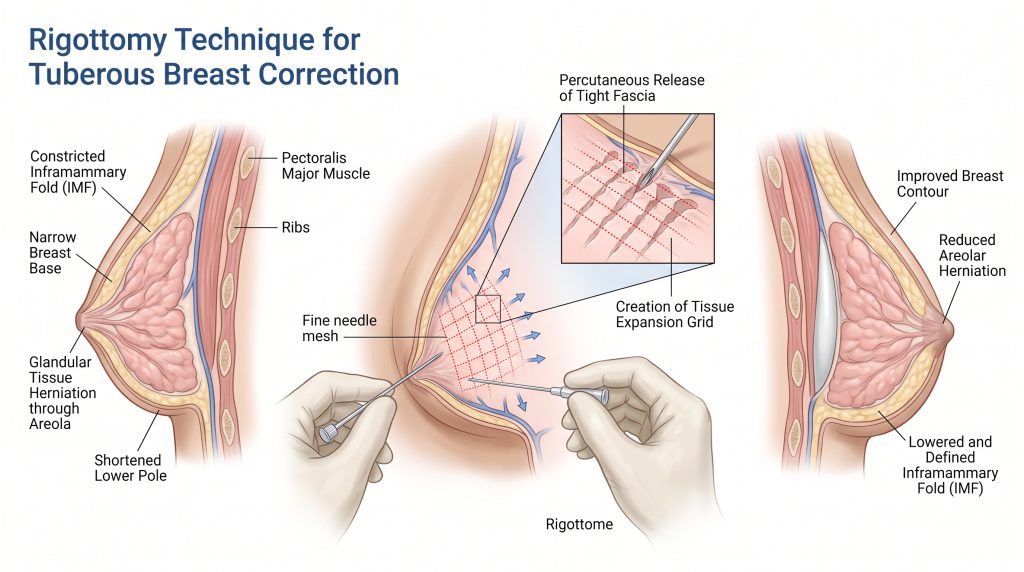
A tuberous or constricted breast is caused by a fibrous ring at the base of the breast that restricts its normal development. The result is a narrow, conical shape, an underdeveloped lower pole, a high inframammary fold and, often, an enlarged or herniated areola. Because the root cause is a fibrous constriction, it responds well to release-and-graft techniques.
Using rigottomia, the surgeon passes a fine needle through tiny periareolar or lower-pole punctures and releases the constricting fibrous bands from beneath the skin, in controlled fan-shaped passes. This frees the lower pole so it can expand. Fat is then grafted into the released tissue to build volume in the deficient lower half and round out the breast — correcting the shape from the inside, without the long scars of traditional flap or implant techniques. Because the correction is gradual and tissue-based, staged sessions are common.
Areola herniation and nipple-areola shape
In tuberous breasts the areola often appears puffy or herniated because tissue is pushed forward through the constricted base. Releasing the underlying fibrous restriction reduces the forces driving that herniation and, combined with volumising the surrounding lower pole, helps the nipple-areola complex sit in better proportion. The aim is to add volume to enlarge the breast’s lower half while avoiding making the areola more prominent — a balance the release-and-graft approach is well suited to.
Rigottomia for scars and burn contractures
Contracted scars and burns are the original home of the technique. A mature scar is a stiff, tethered, poorly vascularised plate that distorts the surrounding tissue. Rigottomia converts it: multiple tiny releases turn the contracted scar into a three-dimensional mesh, expanding its volume and relieving the tension. Seeding that mesh with fat micrografts then softens, expands and regenerates the area. The regenerative effect of grafted fat on scar tissue — improved pliability, colour and quality — is one of the most studied benefits of the approach.
The principle is consistent across every application: release the fibrous restriction into an open matrix, then seed that matrix with fat.
Breast reconstruction and irradiated tissue
After mastectomy — especially where radiotherapy has been given — the chest wall skin is often thin, tight and tethered. Rigottomia helps release and expand that tissue so it can accept fat grafting as part of a wider reconstruction strategy, whether to improve coverage, soften contour or prepare a bed for further reconstruction. It is one reason fat grafting has become such a versatile adjunct in reconstruction after mastectomy.
Beyond the breast
The same release-and-seed logic is applied elsewhere in reconstructive and aesthetic surgery — for example, releasing the tethered scar of a repaired cleft lip before grafting to rebuild philtral contour. Wherever fibrosis restricts shape and volume, rigottomia offers a way to release it through the skin and rebuild with the patient’s own tissue.
What this means for patients
For patients, the appeal is a correction that works with their own tissue and leaves only needle-puncture marks rather than long incisions. The trade-off is that results build gradually and often over more than one session, because there is a limit to how much fat a released bed can support at once. Suitability, expected number of sessions and realistic outcomes are all individual and should be discussed with a qualified surgeon.
The bottom line
From tuberous breasts and herniated areolae to scars, burns and irradiated reconstruction sites, rigottomia works by releasing fibrous restriction into an expandable mesh and seeding it with fat. It reshapes and re-volumises tissue with minimal scarring. To understand the grafting half of the technique, read our fat grafting guide and the pillar article on what rigottomia is.
This article is general educational information, not medical advice. Whether any technique is appropriate depends on your individual situation and should be assessed by a qualified surgeon.
Important information This article is general education, not medical advice. Tap to read the full medical, regulatory & legal notice.
This article is provided by Advanced Biomedical Concept for general informational and educational purposes only. It does not constitute medical, surgical, diagnostic, or other professional healthcare advice, and it is not a substitute for consultation with a suitably qualified healthcare professional. Reading it creates no doctor–patient or other professional relationship. Nothing here should be used to diagnose, treat, cure, or prevent any disease or condition, or to make decisions about medical care. Always seek the advice of a physician or other qualified provider with any questions about a medical condition or treatment, and never disregard or delay professional advice because of something you have read here.
Any reference to Advanced Biomedical Concept products (including ExaShape and ExaFat) is provided for general information only. These are medical devices intended to be used by appropriately trained healthcare professionals strictly in accordance with their applicable, current Instructions for Use (IFU). Regulatory status (including CE marking and classification under the EU Medical Device Regulation), market availability, and approved indications differ between countries and may change over time; a device referred to here may not be available or approved in your country. This content is not intended as, and must not be relied upon as, a statement or claim of safety, clinical performance, or efficacy beyond what is set out in the applicable IFU and current regulatory approvals. Product-specific information is directed at healthcare professionals and is not intended to promote, advertise, or offer any medical device to the general public where such promotion is restricted or prohibited by law.
Statements reflect information believed to be accurate at the date of publication and may be updated or corrected without notice. Any statements regarding the future are expectations or general views, not guarantees. Clinical outcomes depend on many individual factors, results vary from person to person, and no particular result is promised or implied. Where third-party studies, sources, or external links are referenced, they are provided for convenience and information only and do not imply endorsement, and Advanced Biomedical Concept is not responsible for their content.
To the fullest extent permitted by applicable law, Advanced Biomedical Concept and its officers, employees, contributors, and representatives (each acting in that capacity and on behalf of Advanced Biomedical Concept) accept no liability for any loss, injury, or damage of any kind arising directly or indirectly from use of, or reliance on, this content. Nothing in this notice excludes or limits any liability that cannot lawfully be excluded or limited.
Questions about this material can be directed to us via our contact page.
Last reviewed: July 28, 2026.