Biologic or synthetic is one of the most argued questions in implant reconstruction, and one of the least settled. Surgeons who use synthetic mesh point to lower cost and, in some trials, fewer seromas. Surgeons who use biological matrices point to integration into the patient’s own tissue, which matters most when the material is the only thing between the implant and a thin mastectomy flap. Both sides can cite studies. This article sets out what those studies actually compared, what happens biologically to each material after implantation, and how to make the choice on the evidence that exists rather than the evidence that is often claimed.
What each material becomes
The two groups do not differ only in source. They follow different biological paths once implanted, and that is the root of most of the clinical differences.
Biological matrices also differ among themselves. Thick dermal products add a substantial mass of collagen that must be revascularised before it is fully integrated; thinner, more porous materials such as bovine pericardium present less mass and more surface for cells and vessels to enter. In a rat model of breast implant coverage, acellular pericardial meshes reduced markers of capsular myofibroblast activity and inflammation and increased capillary density, with the product’s structure influencing remodelling.1 That is preclinical evidence, but it is the mechanism behind the material choices discussed below.
What the comparative evidence shows
The early review. A 2016 literature review by Logan Ellis and colleagues found that synthetic matrices produced aesthetic outcomes comparable to biological ones at lower cost and with lower overall complication rates. Looking at individual complications, biological matrices were associated with lower infection rates and slightly lower capsular contracture, but higher haematoma and slightly higher skin necrosis and explantation, with many of those patients having had radiotherapy. Critically, the authors noted that no randomised trial had yet compared the two directly and that definite conclusions could not be drawn.2
The randomised trials. Two small trials have since compared them directly.
In the Swedish within-patient trial, women having bilateral reconstruction received a bovine pericardium matrix on one side and an absorbable synthetic mesh on the other, so every systemic risk factor was identical between arms. Seroma was ten times more common on the biological side, and implant loss trended higher without reaching significance.3 In the Austrian pilot, overall complications were similar but severe complications leading to implant loss were more frequent with the acellular matrix, particularly with an inverted-T incision.4
These results should be taken seriously, and they are among the reasons surgeons choosing a biological material need to manage seroma actively. They should also be read with the seven questions from comparing mesh studies: both are small, both used specific products in specific configurations, and neither studied the prepectoral pocket configurations now in common use.
The network meta-analysis. Pooling 31 studies against submuscular reconstruction without support, Murphy and colleagues found that human dermis carried significantly more complications, infection and seroma, whereas xenogeneic matrices and synthetic mesh did not differ significantly from no support. Xenogeneic matrices had significantly less seroma than human dermis. The authors concluded that xenogeneic matrices and synthetic mesh have similar risk profiles, that randomised data comparing them are needed, and that the cost difference between them is substantial.5
The choice, laid out
Where the flap decides
Put together, the evidence does not support a universal winner, and it does point to where each class earns its place. Where the flap is thick and well vascularised, the construct needs support rather than cover, and a synthetic mesh at lower cost is a defensible choice. Where the flap is thin, and especially in the prepectoral plane where nothing else lies between implant and skin, a material that becomes tissue offers something a polymer cannot. In a series selected specifically for prepectoral patients with flaps thinner than 1 cm, the authors wrapped the implant in bovine pericardium for exactly this reason and reported no major complications, with rippling in a quarter of cases treated by secondary fat grafting.6
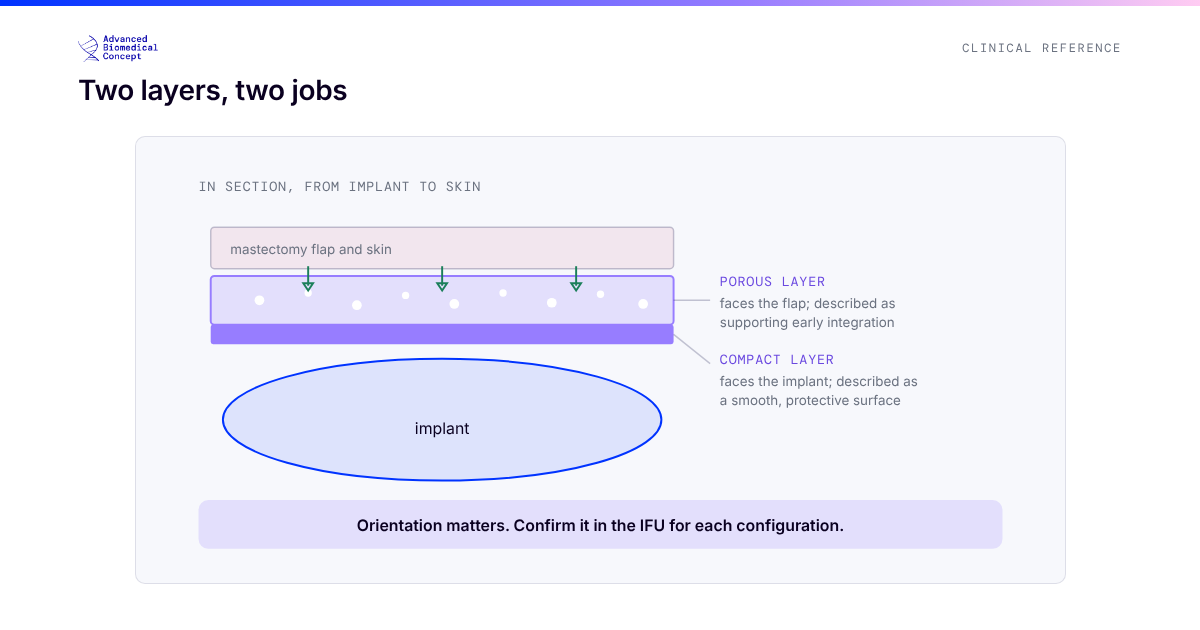
Seroma is the counterweight, and it is manageable. Lower biological mass, fenestration and attention to drainage all work in the right direction; in one dermal matrix series, changing how the matrix was fixed was associated with a fall in seroma from 13.9% to 2.3%.7 This is the design logic of ExaShape®: a bilayer bovine pericardium membrane with a lower biological mass than dermis, a compact layer facing the implant and a porous layer facing the flap to encourage integration, supplied in meshed and perforated configurations and as pre-shaped pockets for prepectoral use. Its multicentre published experience in direct-to-implant prepectoral reconstruction reported four minor and two major complications across 65 reconstructions.8 These are design choices aimed at the known weaknesses of biological matrices, not a claim that the class question has been resolved.
Whatever material is chosen, thin cover over a prepectoral implant often needs a further layer that only the patient can provide: fat. Staged grafting with a consistent, well-processed graft, such as one prepared with the EXAFAT® closed-loop system, is the common refinement whichever mesh lies beneath.
The short version
The two randomised head-to-heads favoured synthetic mesh on seroma and implant loss, and synthetics cost less. Pooled data show xenogeneic matrices and synthetic mesh with similar risk profiles, and no class superior for implant loss. Biological matrices offer something synthetics cannot, integration into the cover, which matters most under thin prepectoral flaps. The defensible choice is made patient by patient, and for biological matrices it comes with an obligation to manage seroma by design.
References
- Bernardini R, Varvaras D, D’Amico F, et al. Biological acellular pericardial mesh regulated tissue integration and remodeling in a rat model of breast prosthetic implantation. J Biomed Mater Res B Appl Biomater. 2020;108(2):577-590. doi:10.1002/jbm.b.34413
- Logan Ellis H, Asaolu O, Nebo V, Kasem A. Biological and synthetic mesh use in breast reconstructive surgery: a literature review. World J Surg Oncol. 2016;14:121. doi:10.1186/s12957-016-0874-9
- Hansson E, Edvinsson AC, Elander A, Kölby L, Hallberg H. First-year complications after immediate breast reconstruction with a biological and a synthetic mesh in the same patient: a randomized controlled study. J Surg Oncol. 2021;123(1):80-88. doi:10.1002/jso.26227
- Gschwantler-Kaulich D, Schrenk P, Bjelic-Radisic V, et al. Mesh versus acellular dermal matrix in immediate implant-based breast reconstruction: a prospective randomized trial. Eur J Surg Oncol. 2016;42(5):665-671. doi:10.1016/j.ejso.2016.02.007
- Murphy D, O’Donnell JP, Ryan ÉJ, et al. Immediate breast cancer reconstruction with or without dermal matrix or synthetic mesh support: a review and network meta-analysis. Plast Reconstr Surg. 2023;151(4):563e-574e. doi:10.1097/PRS.0000000000009984
- Casella D, Rocco N, Luridiana G, et al. Enhancing breast reconstruction with bovine pericardium: a preliminary STEP (Surgical Techniques and Efficacy in Pericardium use) towards improved outcomes. J Clin Med. 2025;14(17):6296. doi:10.3390/jcm14176296
- Tettamanzi M, Arrica G, Ziani F, et al. Prepectoral breast reconstruction with prosthesis and acellular dermal matrix: a new technique of ADM implantation and fixation. Plast Reconstr Surg Glob Open. 2024;12(6):e5895. doi:10.1097/GOX.0000000000005895
- De Vita R, Mangialardi ML, Pozzi M, et al. A pericardium bovine matrix pocket in DTI prepectoral breast reconstruction. Clin Breast Cancer. 2024;24(7):e613-e621. doi:10.1016/j.clbc.2024.06.004. Disclosure: the first author is a consultant for ExaShape.
This article is educational material for healthcare professionals. It does not claim clinical superiority for any material or product. Studies cited for bovine pericardium used several different commercial products. ExaShape® and EXAFAT® are CE marked per EU MDR 2017/745 and are for professional use only.
Important information This article is general education, not medical advice. Tap to read the full medical, regulatory & legal notice.
This article is provided by Advanced Biomedical Concept for general informational and educational purposes only. It does not constitute medical, surgical, diagnostic, or other professional healthcare advice, and it is not a substitute for consultation with a suitably qualified healthcare professional. Reading it creates no doctor–patient or other professional relationship. Nothing here should be used to diagnose, treat, cure, or prevent any disease or condition, or to make decisions about medical care. Always seek the advice of a physician or other qualified provider with any questions about a medical condition or treatment, and never disregard or delay professional advice because of something you have read here.
Any reference to Advanced Biomedical Concept products (including ExaShape and ExaFat) is provided for general information only. These are medical devices intended to be used by appropriately trained healthcare professionals strictly in accordance with their applicable, current Instructions for Use (IFU). Regulatory status (including CE marking and classification under the EU Medical Device Regulation), market availability, and approved indications differ between countries and may change over time; a device referred to here may not be available or approved in your country. This content is not intended as, and must not be relied upon as, a statement or claim of safety, clinical performance, or efficacy beyond what is set out in the applicable IFU and current regulatory approvals. Product-specific information is directed at healthcare professionals and is not intended to promote, advertise, or offer any medical device to the general public where such promotion is restricted or prohibited by law.
Statements reflect information believed to be accurate at the date of publication and may be updated or corrected without notice. Any statements regarding the future are expectations or general views, not guarantees. Clinical outcomes depend on many individual factors, results vary from person to person, and no particular result is promised or implied. Where third-party studies, sources, or external links are referenced, they are provided for convenience and information only and do not imply endorsement, and Advanced Biomedical Concept is not responsible for their content.
To the fullest extent permitted by applicable law, Advanced Biomedical Concept and its officers, employees, contributors, and representatives (each acting in that capacity and on behalf of Advanced Biomedical Concept) accept no liability for any loss, injury, or damage of any kind arising directly or indirectly from use of, or reliance on, this content. Nothing in this notice excludes or limits any liability that cannot lawfully be excluded or limited.
Questions about this material can be directed to us via our contact page.
Last reviewed: October 15, 2026.