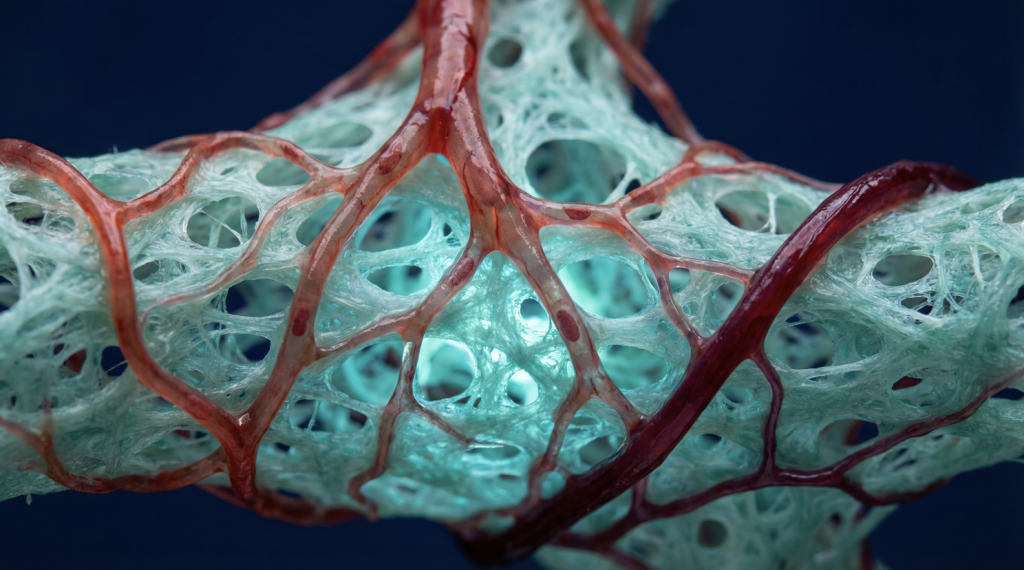
The defining question for any biological matrix is not just whether it holds an implant, but whether it becomes part of the patient’s own body. This article explains integration — revascularisation and remodelling — in general terms. It is educational, not medical advice.
Integration versus encapsulation
When any material is implanted, the body responds. The desired response for a biological matrix is constructive remodelling: host cells migrate in, new blood vessels form, and the scaffold is gradually turned into vascularised living tissue. The less desirable response is encapsulation, where the body walls the material off behind a fibrous capsule and it remains essentially inert.
The role of revascularisation
New blood-vessel formation (neovascularisation) is central. A scaffold that becomes vascularised is nourished, defended by the immune system and able to support ongoing tissue turnover. This is why matrix design increasingly targets revascularisation directly — for example the bilayer construction of ExaShape, engineered to encourage fibroblast activity and new vessels.
What influences integration
Several factors shape how well a matrix integrates: the preservation of collagen architecture during processing, the surface presented to host cells, contact with well-vascularised tissue, and the local environment — an irradiated field, for instance, is more challenging.
Why it matters for reconstruction
A well-integrated matrix contributes durable, living support for the reconstruction and can improve soft-tissue quality, especially in prepectoral reconstruction where the matrix carries more of the load. Integration is the difference between a scaffold that disappears into the body and one that merely sits within it.
The bottom line
Integration means the body repopulating and revascularising the scaffold so it becomes living tissue, rather than encapsulating it. It is the property that most distinguishes modern matrices. See our selection framework for how to weigh it against other factors.
This article is general educational information, not clinical guidance. Individual results vary; refer to device instructions for use and current evidence.
Important information This article is general education, not medical advice. Tap to read the full medical, regulatory & legal notice.
This article is provided by Advanced Biomedical Concept for general informational and educational purposes only. It does not constitute medical, surgical, diagnostic, or other professional healthcare advice, and it is not a substitute for consultation with a suitably qualified healthcare professional. Reading it creates no doctor–patient or other professional relationship. Nothing here should be used to diagnose, treat, cure, or prevent any disease or condition, or to make decisions about medical care. Always seek the advice of a physician or other qualified provider with any questions about a medical condition or treatment, and never disregard or delay professional advice because of something you have read here.
Any reference to Advanced Biomedical Concept products (including ExaShape and ExaFat) is provided for general information only. These are medical devices intended to be used by appropriately trained healthcare professionals strictly in accordance with their applicable, current Instructions for Use (IFU). Regulatory status (including CE marking and classification under the EU Medical Device Regulation), market availability, and approved indications differ between countries and may change over time; a device referred to here may not be available or approved in your country. This content is not intended as, and must not be relied upon as, a statement or claim of safety, clinical performance, or efficacy beyond what is set out in the applicable IFU and current regulatory approvals. Product-specific information is directed at healthcare professionals and is not intended to promote, advertise, or offer any medical device to the general public where such promotion is restricted or prohibited by law.
Statements reflect information believed to be accurate at the date of publication and may be updated or corrected without notice. Any statements regarding the future are expectations or general views, not guarantees. Clinical outcomes depend on many individual factors, results vary from person to person, and no particular result is promised or implied. Where third-party studies, sources, or external links are referenced, they are provided for convenience and information only and do not imply endorsement, and Advanced Biomedical Concept is not responsible for their content.
To the fullest extent permitted by applicable law, Advanced Biomedical Concept and its officers, employees, contributors, and representatives (each acting in that capacity and on behalf of Advanced Biomedical Concept) accept no liability for any loss, injury, or damage of any kind arising directly or indirectly from use of, or reliance on, this content. Nothing in this notice excludes or limits any liability that cannot lawfully be excluded or limited.
Questions about this material can be directed to us via our contact page.
Last reviewed: July 24, 2026.