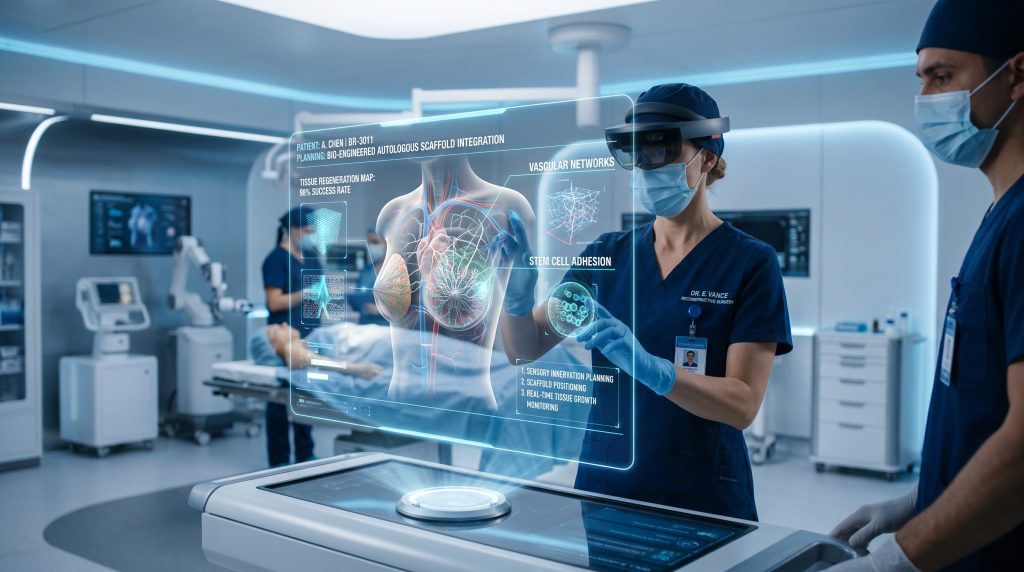
Breast reconstruction has changed more in the last fifteen years than in the previous fifty, and the pace is not slowing. This article looks at the directions the field is heading — and why med tech for breast reconstruction is central to almost all of them. It is a forward-looking overview, not a prediction or medical advice.
Muscle-sparing becomes the default
The shift toward prepectoral reconstruction — placing the implant above the muscle — is likely to continue as biological matrices and fat grafting mature. Leaving the chest wall undisturbed avoids animation deformity and muscle-related pain, and patients increasingly ask for it by name.
Smarter biomaterials
The next generation of the biological matrix is being designed around integration. Rather than acting as an inert sheet, surface-engineered and bilayer scaffolds such as ExaShape aim to actively encourage fibroblast activity and new blood-vessel formation, so the material becomes living, vascularised tissue. Expect continued work on shaping, consistency and evidence generation.
Better fat, better results
Autologous fat grafting is becoming a core finishing tool, and its reliability depends on fat quality. Processing systems like ExaFat that clean fat while preserving its regenerative fraction point toward more predictable grafting and softer, more natural contours.
Data, planning and personalisation
Three-dimensional imaging, surgical planning tools and better patient-reported outcome measurement are making reconstruction more personalised and more measurable. As registries grow, decisions can increasingly be guided by real-world evidence rather than habit.
The bottom line
The future of breast reconstruction is biology-led, muscle-sparing, data-informed and increasingly personalised — and med tech is the thread running through it. For how the field reached this point, see the history of breast reconstruction, or explore the ABC portfolio.
This article describes general trends and is not a prediction of individual outcomes or medical advice.
Important information This article is general education, not medical advice. Tap to read the full medical, regulatory & legal notice.
This article is provided by Advanced Biomedical Concept for general informational and educational purposes only. It does not constitute medical, surgical, diagnostic, or other professional healthcare advice, and it is not a substitute for consultation with a suitably qualified healthcare professional. Reading it creates no doctor–patient or other professional relationship. Nothing here should be used to diagnose, treat, cure, or prevent any disease or condition, or to make decisions about medical care. Always seek the advice of a physician or other qualified provider with any questions about a medical condition or treatment, and never disregard or delay professional advice because of something you have read here.
Any reference to Advanced Biomedical Concept products (including ExaShape and ExaFat) is provided for general information only. These are medical devices intended to be used by appropriately trained healthcare professionals strictly in accordance with their applicable, current Instructions for Use (IFU). Regulatory status (including CE marking and classification under the EU Medical Device Regulation), market availability, and approved indications differ between countries and may change over time; a device referred to here may not be available or approved in your country. This content is not intended as, and must not be relied upon as, a statement or claim of safety, clinical performance, or efficacy beyond what is set out in the applicable IFU and current regulatory approvals. Product-specific information is directed at healthcare professionals and is not intended to promote, advertise, or offer any medical device to the general public where such promotion is restricted or prohibited by law.
Statements reflect information believed to be accurate at the date of publication and may be updated or corrected without notice. Any statements regarding the future are expectations or general views, not guarantees. Clinical outcomes depend on many individual factors, results vary from person to person, and no particular result is promised or implied. Where third-party studies, sources, or external links are referenced, they are provided for convenience and information only and do not imply endorsement, and Advanced Biomedical Concept is not responsible for their content.
To the fullest extent permitted by applicable law, Advanced Biomedical Concept and its officers, employees, contributors, and representatives (each acting in that capacity and on behalf of Advanced Biomedical Concept) accept no liability for any loss, injury, or damage of any kind arising directly or indirectly from use of, or reliance on, this content. Nothing in this notice excludes or limits any liability that cannot lawfully be excluded or limited.
Questions about this material can be directed to us via our contact page.
Last reviewed: July 24, 2026.