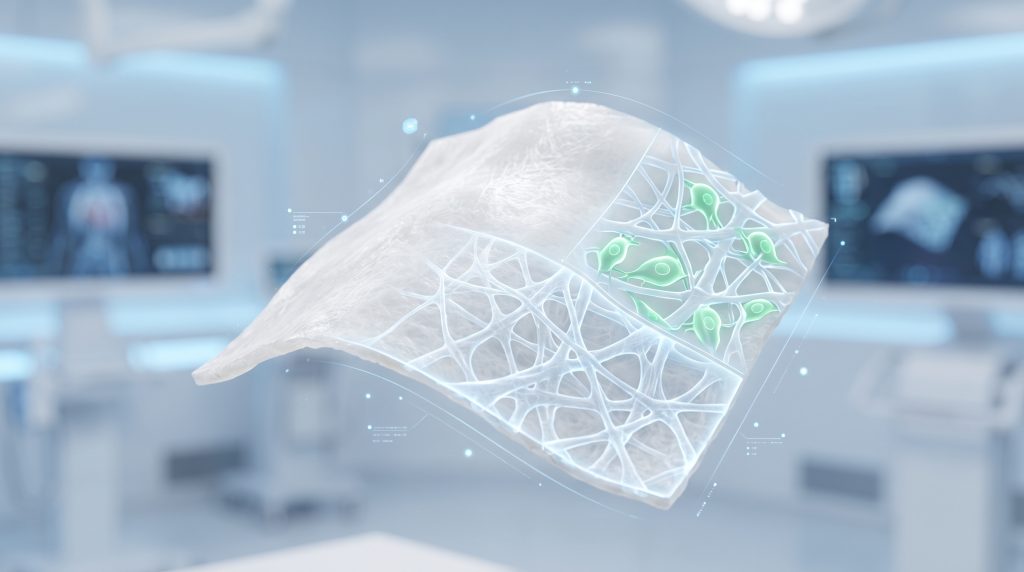
Among the materials used in modern breast reconstruction, bovine pericardium has become one of the most clinically interesting sources of a biological matrix. It is strong, well-organised, and can be manufactured to consistent specifications — a combination that makes it well suited to supporting a breast implant. This article explains what bovine pericardium is, why its structure matters, and how a pericardium-derived matrix supports implant-based reconstruction.
What is bovine pericardium?
The pericardium is the tough, fibrous sac that surrounds the heart. In cattle (bovine) this membrane is a dense sheet of type I collagen arranged in organised, multidirectional layers. That architecture is precisely what gives the pericardium its natural strength: it is built by nature to withstand constant mechanical stress.
Surgeons have used bovine pericardium for decades in cardiac and general surgery precisely because it is strong, workable, and biologically compatible once processed. Applying that same well-understood material to breast reconstruction is a natural extension of a long clinical track record in other specialties.
From raw tissue to biological matrix: how it is processed
Raw pericardium cannot be implanted as-is. To become a biological matrix it is decellularised — the living cells and cellular debris are removed — leaving behind the collagen and elastin scaffold. Good processing has two competing goals:
- Remove enough cellular material that the body does not mount a strong immune response to the graft.
- Preserve the scaffold’s natural structure so the patient’s own cells and blood vessels can move in and repopulate it.
The quality of this processing largely determines how the matrix behaves in the body. A scaffold that is cleaned but structurally intact can act as a biologically active template rather than an inert patch.
Why the collagen structure matters
Not all collagen scaffolds are equal. The organised, layered collagen of pericardium gives a matrix two properties that matter in reconstruction:
Mechanical strength
A breast implant needs stable support, especially at the lower pole where gravity and tissue weight act. The dense collagen of pericardium provides tensile strength and suture retention, so the matrix holds where the surgeon places it.
A template for regeneration
The same structure that provides strength also provides a route for the body to grow into. When cells and capillaries can migrate into an intact collagen framework, the graft becomes incorporated into living, vascularised tissue. This is the difference between a material the body integrates and one it merely tolerates.
ExaShape: a pericardium-derived bilayer membrane
Advanced Biomedical Concept’s ExaShape is a biological matrix engineered from bovine pericardium as a bilayer membrane. It is designed to do more than provide passive support: the intent is to actively encourage tissue regeneration — reactivating fibroblasts, supporting the release of growth factors, and initiating neovascularisation (new blood-vessel formation) as integration begins.
A bilayer design allows different surfaces to serve different roles — one oriented toward the implant, one toward the host tissue — so the membrane can support the implant while presenting a regeneration-friendly surface to the body. For the full technical description, see the ExaShape device page.
Where a pericardium matrix fits in reconstruction
Pericardium-derived matrices are used in implant-based reconstruction to reinforce and define the implant pocket. They are especially relevant to prepectoral reconstruction, where the implant sits above the chest muscle and therefore relies on the matrix — rather than muscle — for coverage and support. The strength of pericardium makes it a logical candidate for this more demanding, muscle-sparing role.
It is often used alongside fat grafting, which adds soft-tissue thickness and helps refine the final contour. Together, a robust matrix and healthy fat grafting form the backbone of many modern reconstructions.
Strength, thickness and handling in the operating room
The practical qualities of a matrix matter as much as its biology. A surgeon has to be able to handle the material easily, trim it to shape, suture it securely and position it precisely around the implant. Pericardium’s organised collagen gives it good suture retention and tear resistance, so it holds where it is placed and tolerates the tension of a well-defined pocket. A bilayer design, as used in ExaShape, adds a further dimension: the two surfaces can be optimised separately, so the membrane can present a supportive face toward the implant and a regeneration-friendly face toward the host tissue. These handling characteristics are part of why a matrix behaves well not only in the body but on the operating table.
Bovine pericardium vs. dermal matrices
Compared with acellular dermal matrix (ADM), a bovine pericardium matrix offers some practical advantages: it is derived from a consistent, well-characterised tissue and manufactured to specification rather than depending on donor tissue supply, which can make quality more uniform batch to batch. Dermal matrices remain widely used and well studied, so the right choice depends on the technique and the surgeon’s judgement. We compare the categories in depth in Biological Matrix vs. ADM vs. Synthetic Mesh.
How a pericardium matrix is manufactured and controlled
Turning raw tissue into an implantable device is a tightly regulated manufacturing process. Beyond decellularisation, production typically involves cleaning, sterilisation and quality testing to confirm the scaffold meets specification for strength, thickness and biological cleanliness. Because the starting tissue is a consistent, well-characterised material, manufacturers can hold each batch to defined standards — one of the practical reasons a xenograft matrix can offer more predictable, uniform quality than materials that depend on variable donor supply. In Europe these devices are regulated under the medical device framework, and manufacturing takes place under controlled, audited conditions.
Pericardium and the move to muscle-sparing surgery
The strength of pericardium is not just a technical detail — it is part of why the wider field has been able to move toward less invasive surgery. When a matrix can reliably support an implant on its own, the surgeon has less need to recruit the chest muscle for coverage. That is the enabling logic behind prepectoral reconstruction, and it is why the choice of matrix material has consequences well beyond the material itself. A weaker or less-integrating scaffold constrains what the surgeon can safely attempt; a robust, integrating one opens up options.
Safety and considerations
Bovine-derived surgical materials are manufactured under strict controls and have a long history of clinical use. As with any implanted material, there are risks, and suitability depends on the individual patient and surgical plan. A biological matrix is one component of a reconstruction, not a guarantee of a particular outcome; results depend on patient factors and technique. Any specific concerns — including questions about tissue sourcing or personal, cultural or dietary considerations relating to bovine-derived material — are best discussed directly with your surgical team.
The bottom line
Bovine pericardium brings together two properties that reconstruction demands: the mechanical strength to support an implant and an organised collagen scaffold the body can repopulate. Engineered into a device such as ExaShape, it is designed to support the implant while actively encouraging the tissue regeneration that makes a reconstruction feel like the patient’s own. Learn more on the products page or read the foundational biological matrix guide.
This article is for general education and is not medical advice. Speak with a qualified reconstructive surgeon about the options appropriate for you.
Important information This article is general education, not medical advice. Tap to read the full medical, regulatory & legal notice.
This article is provided by Advanced Biomedical Concept for general informational and educational purposes only. It does not constitute medical, surgical, diagnostic, or other professional healthcare advice, and it is not a substitute for consultation with a suitably qualified healthcare professional. Reading it creates no doctor–patient or other professional relationship. Nothing here should be used to diagnose, treat, cure, or prevent any disease or condition, or to make decisions about medical care. Always seek the advice of a physician or other qualified provider with any questions about a medical condition or treatment, and never disregard or delay professional advice because of something you have read here.
Any reference to Advanced Biomedical Concept products (including ExaShape and ExaFat) is provided for general information only. These are medical devices intended to be used by appropriately trained healthcare professionals strictly in accordance with their applicable, current Instructions for Use (IFU). Regulatory status (including CE marking and classification under the EU Medical Device Regulation), market availability, and approved indications differ between countries and may change over time; a device referred to here may not be available or approved in your country. This content is not intended as, and must not be relied upon as, a statement or claim of safety, clinical performance, or efficacy beyond what is set out in the applicable IFU and current regulatory approvals. Product-specific information is directed at healthcare professionals and is not intended to promote, advertise, or offer any medical device to the general public where such promotion is restricted or prohibited by law.
Statements reflect information believed to be accurate at the date of publication and may be updated or corrected without notice. Any statements regarding the future are expectations or general views, not guarantees. Clinical outcomes depend on many individual factors, results vary from person to person, and no particular result is promised or implied. Where third-party studies, sources, or external links are referenced, they are provided for convenience and information only and do not imply endorsement, and Advanced Biomedical Concept is not responsible for their content.
To the fullest extent permitted by applicable law, Advanced Biomedical Concept and its officers, employees, contributors, and representatives (each acting in that capacity and on behalf of Advanced Biomedical Concept) accept no liability for any loss, injury, or damage of any kind arising directly or indirectly from use of, or reliance on, this content. Nothing in this notice excludes or limits any liability that cannot lawfully be excluded or limited.
Questions about this material can be directed to us via our contact page.
Last reviewed: July 23, 2026.