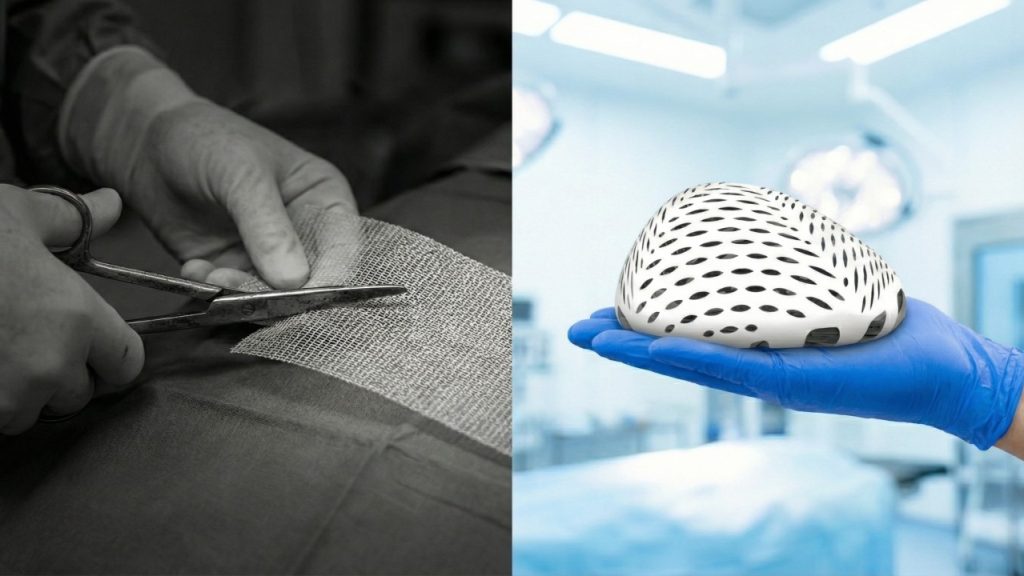
Over the past month, we have explored the clinical, biological, and economic evolution of prepectoral breast reconstruction. We have moved beyond traditional methods to analyze a new standard: shifting from the manual “craft” of shaping meshes to the strategic “positioning” of engineered solutions.
Through this campaign, we analyzed how standardized procedures, supported by the largest multicentric studies to date, confirming the clinical reliability of the ABPM pocket.
For years, the gold standard in implant-based breast reconstruction relied on the surgeon’s ability to “tailor” by meticulously cutting and shaping flat biological meshes to fit a three-dimensional need. While this craftsmanship is admirable, it introduces variables: increased operative time, prolonged handling of the matrix, and a lack of procedural standardization.

At Advanced Biomedical Concept, we believe the future of MedTech lies in shifting from manual craft to clinical strategy. The #Exashape Bioshield Pocket is a pre-shaped, bilayer bovine pericardium matrix designed to standardize the prepectoral pocket and allow surgeons to focus on what matters most: optimal positioning for symmetry and stability.
Traditional breast reconstruction often requires the surgeon to act as a tailor. With the Exashape Bioshield Pocket, the “craft” is already engineered into the device. This acellular bovine pericardium matrix (#ABPM) allows you to move directly to the most critical part of the procedure: optimal implant positioning for long-term stability and aesthetic symmetry (Mazzocchi et al., PRRS 2022).

A strategy is only as strong as the evidence behind it. The 2024 multicentric study by Roy de Vita et al. represents the largest clinical series to date on prepectoral breast reconstruction assisted by an ABPM pocket.
Following 65 reconstructions with a mean follow-up of 21.3 months, the data confirms:
- Predictable Outcomes: No significant cases of capsular contracture (Baker III-IV) were noted.
- Safety Profile: A low major complication rate of 4.3% in a real-world patient cohort.
- Efficiency: Average surgical time was recorded at 1.42 hours.
(Source: De Vita R, et al. A Pericardium Bovine Matrix Pocket in DTI Prepectoral Breast Reconstruction. Clinical Breast Cancer. 2024)

In the OR, time is a factor in patient safety. Clinical experience shows that once the prepectoral site is ready, the mean positioning time with the Exashape Bioshield Pocket is approximately 3 to 4 minutes.
- Reduced Exposure: Minimizes the window for accidental bacterial contamination.
- Implant Integrity: Avoids the use of cutting edges near the silicone shell during intraoperative tailoring.
- Standardization: Creates a predictable workflow for the entire surgical team.
(Source: Mazzocchi M, et al. 2022; De Vita R, et al. 2024)

Effective positioning requires a material that understands human biology. Exashape is engineered from non-crosslinked bilayer bovine pericardium, designed to act as a bioactive scaffold.
- Functional Integration: Progressive neovascularization within the matrix observed in a 12 month period.
- Regulated Response: Reduced inflammatory cell infiltration and minimized periprosthetic fibrosis compared to other matrices.
(Source: Varvaras D, et al. Use of Acellular Pericardial Biological Mesh for Prepectoral and Dual Plane. St. Gallen 2023; Bernardini R, et al. J. Biomed Mater Res. 2020)

The final measure of “positioning” is found in the patient’s quality of life. By preserving the pectoralis major and utilizing the biological support of Exashape, surgeons are achieving outcomes that patients value most.
According to BREAST-Q data:
- Aesthetic Satisfaction: High mean scores for breast shape (4.18/5) and symmetry (4.15/5).
- Psychosocial Well-being: Significant increases in patient-reported satisfaction scores.
(Source: De Vita R, et al. 2024; Mazzocchi M, et al. 2022)
Stop Tailoring. Start Positioning.
The transition to standardized, pre-shaped pockets is a commitment to OR efficiency, procedural safety, and reproducible aesthetic excellence.
Are you ready to redefine your surgical workflow?
Important information This article is general education, not medical advice. Tap to read the full medical, regulatory & legal notice.
This article is provided by Advanced Biomedical Concept for general informational and educational purposes only. It does not constitute medical, surgical, diagnostic, or other professional healthcare advice, and it is not a substitute for consultation with a suitably qualified healthcare professional. Reading it creates no doctor–patient or other professional relationship. Nothing here should be used to diagnose, treat, cure, or prevent any disease or condition, or to make decisions about medical care. Always seek the advice of a physician or other qualified provider with any questions about a medical condition or treatment, and never disregard or delay professional advice because of something you have read here.
Any reference to Advanced Biomedical Concept products (including ExaShape and ExaFat) is provided for general information only. These are medical devices intended to be used by appropriately trained healthcare professionals strictly in accordance with their applicable, current Instructions for Use (IFU). Regulatory status (including CE marking and classification under the EU Medical Device Regulation), market availability, and approved indications differ between countries and may change over time; a device referred to here may not be available or approved in your country. This content is not intended as, and must not be relied upon as, a statement or claim of safety, clinical performance, or efficacy beyond what is set out in the applicable IFU and current regulatory approvals. Product-specific information is directed at healthcare professionals and is not intended to promote, advertise, or offer any medical device to the general public where such promotion is restricted or prohibited by law.
Statements reflect information believed to be accurate at the date of publication and may be updated or corrected without notice. Any statements regarding the future are expectations or general views, not guarantees. Clinical outcomes depend on many individual factors, results vary from person to person, and no particular result is promised or implied. Where third-party studies, sources, or external links are referenced, they are provided for convenience and information only and do not imply endorsement, and Advanced Biomedical Concept is not responsible for their content.
To the fullest extent permitted by applicable law, Advanced Biomedical Concept and its officers, employees, contributors, and representatives (each acting in that capacity and on behalf of Advanced Biomedical Concept) accept no liability for any loss, injury, or damage of any kind arising directly or indirectly from use of, or reliance on, this content. Nothing in this notice excludes or limits any liability that cannot lawfully be excluded or limited.
Questions about this material can be directed to us via our contact page.
Last reviewed: June 16, 2026.