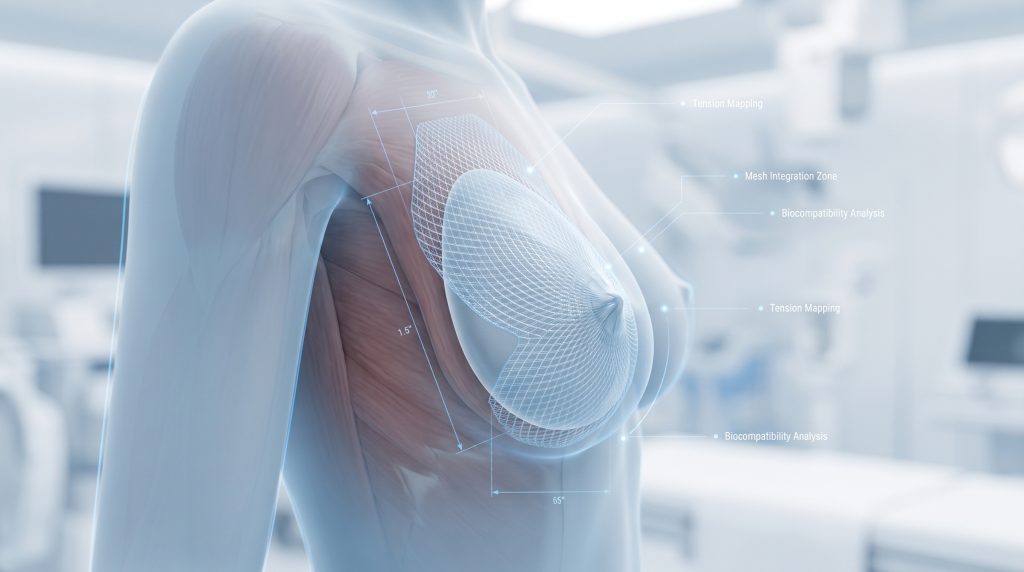
A 2026 multicenter cohort followed 501 immediate direct-to-implant reconstructions after nipple-sparing mastectomy for up to 10 years — comparing prepectoral placement with mesh against subpectoral techniques across clinical outcomes, quality of life and cost.
Where should the implant sit — and does mesh earn its cost?
Implant-based reconstruction can be performed above the muscle (prepectoral, supported by mesh) or beneath it (subpectoral, with or without mesh). Each path carries a different trade-off between upfront cost, early recovery and long-term revision burden. This study weighed all three, side by side.
Prepectoral + mesh
Implant placed anterior to the pectoralis, wrapped in supporting mesh. Preserves muscle function; no animation deformity. n = 215
Subpectoral (± mesh)
Dual-plane with mesh, or traditional submuscular without mesh. Longer-established, lower material cost. n = 286 pooled
Cumulative reoperations were roughly halved
Over the observed follow-up, prepectoral reconstruction with mesh carried the lowest reoperation rate of the three strategies — the study’s primary endpoint.
Versus pooled subpectoral, prepectoral + mesh gave an absolute risk reduction of ~10.5% in cumulative reoperation (NNT ≈ 10) and a markedly lower adjusted hazard of reoperation. (P = .008)
Two late complications separated the groups most
The long-term advantage of prepectoral placement was driven largely by dramatically lower clinically-significant capsular contracture and the complete absence of animation deformity.
Baker III–IV capsular contracture
Prepectoral + mesh — versus 31.5% dual-plane and 11.3% subpectoral no-mesh. (P < .001)
Animation deformity
None observed in prepectoral cases — versus 13.3% dual-plane and 7.8% subpectoral. (P < .001)
Adjusted hazard ratio
Cox model (age, BMI, smoking, radiotherapy) for reoperation vs pooled subpectoral over 10 years.
An honest trade-off: some mesh-containing techniques showed higher early seroma and infection — but this signal concentrated in the dual-plane arm. Prepectoral cases had among the lowest early seroma (2.8%) and surgical-site infection (1.9%) rates in the cohort.
Higher quality-adjusted life years
Using prospectively collected EQ-5D-5L utilities integrated over a 10-year horizon, prepectoral reconstruction delivered a meaningful quality-of-life advantage.
Discounted QALY advantage
Prepectoral vs pooled subpectoral over 10 years (3.5% annual discounting).
Mean EQ-5D-5L utility
Time-weighted, prepectoral group — versus ≈0.801 for pooled subpectoral.
Higher upfront cost, favorable value over time
From the hospital/provider perspective, fewer late reoperations and higher QALYs offset the greater initial outlay — landing the incremental cost-utility ratio comfortably within commonly used willingness-to-pay thresholds.
- €17,566Base-case incremental cost-utility ratio (ICUR) per QALY — prepectoral vs pooled subpectoral.
- ≈ 10Number needed to treat to prevent one cumulative reoperation.
- +0.26Discounted QALY gain per patient driving the value equation over 10 years.
The value case depends on mesh acquisition cost
The study’s own sensitivity analysis flags mesh unit price as a principal driver of cost-effectiveness — the lower the mesh cost, the stronger the value story. Among the extracellular-matrix (ECM) products the authors priced, ExaShape sits at the lean end of the range.
Because the prepectoral value proposition hinges on keeping index mesh cost in check while capturing the long-term reoperation savings, a competitively-priced ECM like ExaShape helps tilt the ICUR further in the surgeon’s — and the system’s — favour.
ExaShape is categorised in the study as an extracellular-matrix (APM/ECM) product, not a specific biologic ADM. The trial evaluated prepectoral placement with mesh as a strategy across several products; it did not compare individual mesh brands head-to-head. Prices shown are the study’s reported 2024 unit acquisition figures.
Deliver the prepectoral value proposition with ExaShape
Support your prepectoral, muscle-sparing reconstructions with a cost-effective extracellular matrix engineered for durable outcomes. Talk to the AdvancedBioConcept team about bringing ExaShape into your protocol.
Source study: Grieco F, Driutti M, Zanin E, et al. Long-Term Clinical Outcomes and Cost-Utility Analysis of Prepectoral Versus Subpectoral Implant-Based Breast Reconstruction Following Nipple-Sparing Mastectomy: A Multicenter Retrospective Cohort Study. Clinical Breast Cancer. 2026;26:82–89.
This page is an independent educational summary of selected quantitative findings and does not reproduce the article text. Figures are approximate as reported by the authors. It is intended for healthcare professionals and does not constitute medical advice or a treatment recommendation. Please consult the original publication for full methodology, context and limitations.
Important information This article is general education, not medical advice. Tap to read the full medical, regulatory & legal notice.
This article is provided by Advanced Biomedical Concept for general informational and educational purposes only. It does not constitute medical, surgical, diagnostic, or other professional healthcare advice, and it is not a substitute for consultation with a suitably qualified healthcare professional. Reading it creates no doctor–patient or other professional relationship. Nothing here should be used to diagnose, treat, cure, or prevent any disease or condition, or to make decisions about medical care. Always seek the advice of a physician or other qualified provider with any questions about a medical condition or treatment, and never disregard or delay professional advice because of something you have read here.
Any reference to Advanced Biomedical Concept products (including ExaShape and ExaFat) is provided for general information only. These are medical devices intended to be used by appropriately trained healthcare professionals strictly in accordance with their applicable, current Instructions for Use (IFU). Regulatory status (including CE marking and classification under the EU Medical Device Regulation), market availability, and approved indications differ between countries and may change over time; a device referred to here may not be available or approved in your country. This content is not intended as, and must not be relied upon as, a statement or claim of safety, clinical performance, or efficacy beyond what is set out in the applicable IFU and current regulatory approvals. Product-specific information is directed at healthcare professionals and is not intended to promote, advertise, or offer any medical device to the general public where such promotion is restricted or prohibited by law.
Statements reflect information believed to be accurate at the date of publication and may be updated or corrected without notice. Any statements regarding the future are expectations or general views, not guarantees. Clinical outcomes depend on many individual factors, results vary from person to person, and no particular result is promised or implied. Where third-party studies, sources, or external links are referenced, they are provided for convenience and information only and do not imply endorsement, and Advanced Biomedical Concept is not responsible for their content.
To the fullest extent permitted by applicable law, Advanced Biomedical Concept and its officers, employees, contributors, and representatives (each acting in that capacity and on behalf of Advanced Biomedical Concept) accept no liability for any loss, injury, or damage of any kind arising directly or indirectly from use of, or reliance on, this content. Nothing in this notice excludes or limits any liability that cannot lawfully be excluded or limited.
Questions about this material can be directed to us via our contact page.
Last reviewed: July 23, 2026.