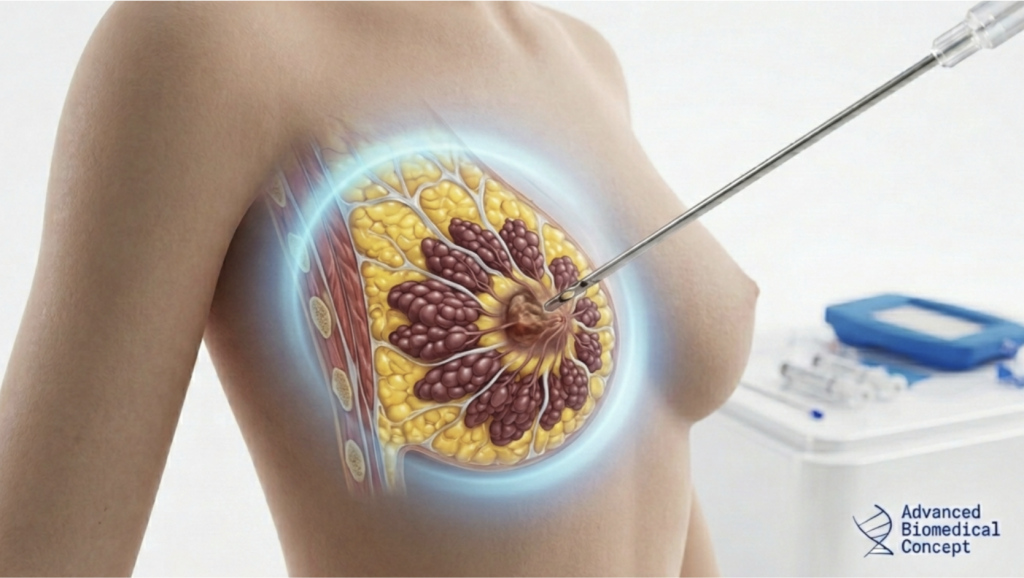
Advanced Biomedical Concept | Clinical Overview | June 2026
Fat grafting in breast surgery has long operated under an unspoken constraint: the outcome depends heavily on what happens between harvest and injection. The procedure itself — the technique, the anatomy, the surgeon’s skill — matters enormously. But upstream of all of that, the quality of the graft material sets a ceiling on what’s achievable.
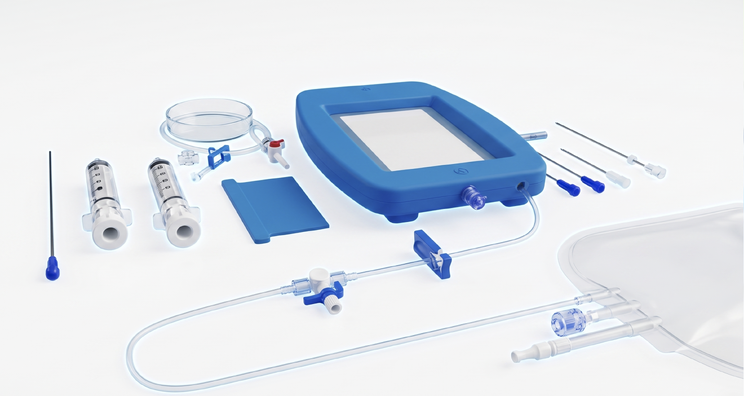
EXAFAT® was designed to address that ceiling.
Developed by Advanced Biomedical Concept , EXAFAT is an all-in-one fat grafting system engineered exclusively for breast surgery — covering every step of the fat grafting workflow, from harvest to purification to transfer, within a single closed-loop system. Its central innovation, Fat Dialysing, is a continuous, active, gentle washing-filtration process designed to produce a uniform, contaminant-free graft, with the same methodology applied in every case.
The Problem EXAFAT Was Designed to Address
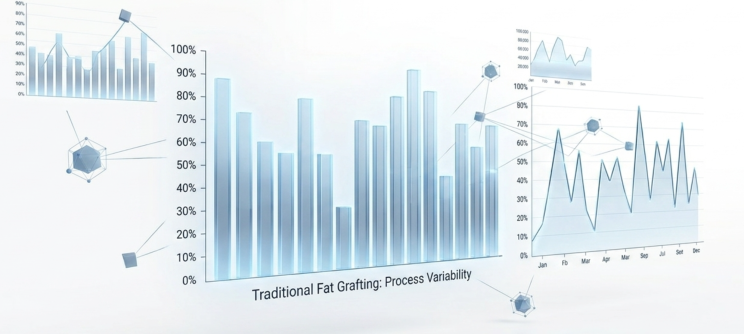
The clinical literature on fat grafting is consistent on one point: process variability is a significant driver of outcome variability. Volume retention rates in autologous breast fat grafting range from 30% to 80% across published studies, with an average of approximately 58%.¹ Fat necrosis -driven by ischaemia, inflammatory contamination, and damaged adipocytes – accounts for 43.7% of all complications documented in breast fat grafting literature.² In reconstructive contexts, published data indicates patients undergo an average of 3.4 procedures.²
These figures reflect the procedure category as documented across multiple published studies – not outcomes attributable to any specific device or processing system. They are cited here to frame the clinical problem that process standardisation is designed to address.
EXAFAT was engineered with this problem in mind. Every component in the system reflects a design intent to reduce the process-driven variables that the published literature identifies as contributors to poor fat graft outcomes.
The Complete System: What’s in the Kit
EXAFAT is supplied as a sterile, single-use, all-in-one kit. Every component is designed to work together within a standardised workflow — reducing procedural steps, minimising unnecessary fat handling, and limiting the points at which graft integrity can be compromised between harvest and transfer.
01 — Harvesting Cannula
250 mm × 3 mm Ø | 12-port tri-lateral
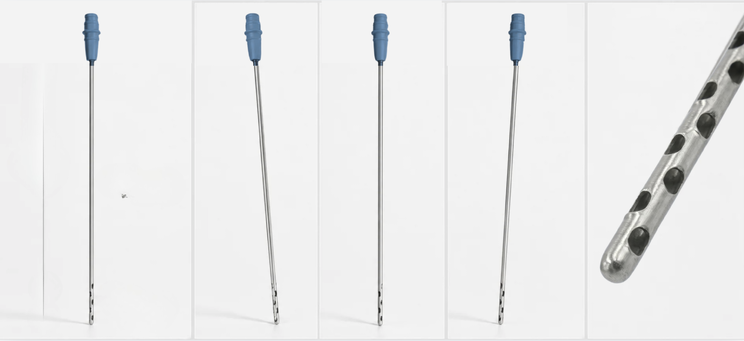
The harvesting cannula features 12 ports distributed across three sides, with one side intentionally kept port-free to enable controlled, directional harvesting. The port geometry is a deliberate design choice informed by published evidence on cannula size and adipocyte survival.
Independent research has demonstrated that smaller-bore cannulas result in meaningfully less mechanical trauma to adipose tissue during harvest compared to larger diameters.³ The 3 mm harvesting cannula sits within the range supported by this evidence. The 12-port tri-lateral configuration, combined with the recommended vacuum protocol, is designed to enable consistent harvesting of fat lobules under 3 mm in diameter — a parameter with clinical relevance: published research on particle size and fat graft retention indicates that smaller lobule size is associated with improved retention outcomes, attributed to the increased surface-area-to-volume ratio available for diffusion-based nutrition during the avascular window prior to revascularisation.⁴
02 — Vacuum Locking Syringe
20 mL | Automatic 300 mmHg negative pressure
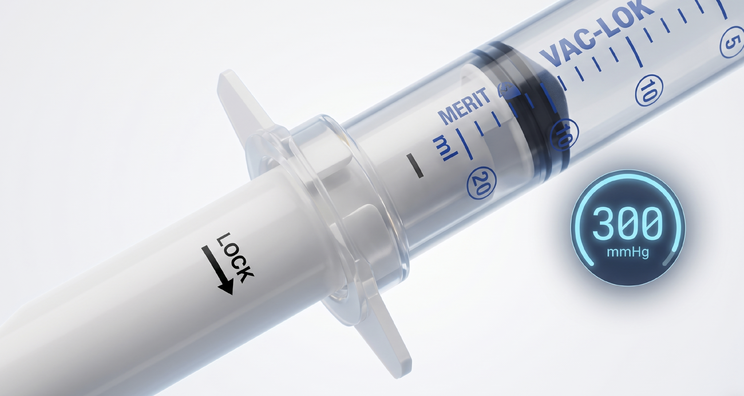
Vacuum pressure during fat harvest is a modifiable variable with documented impact on adipocyte viability. Published evidence indicates that excessive negative pressure increases shear stress on adipocyte membranes, with viability outcomes declining at higher vacuum levels.⁵
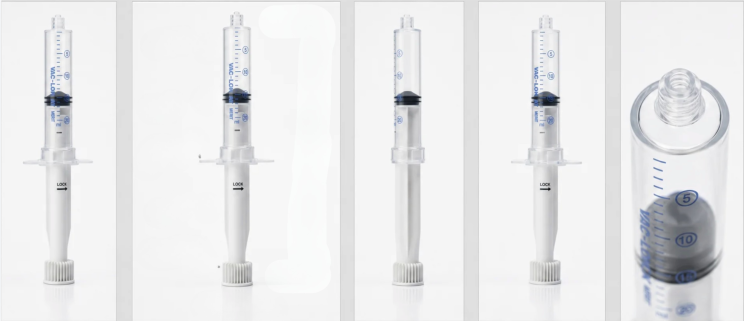
EXAFAT’s Vacuum Locking Syringe is designed to maintain harvest vacuum at an automatic ceiling of 300 mmHg — consistent with the pressure threshold referenced in the literature as the level at which adipocyte damage is minimised. The locking mechanism is designed to hold this pressure consistently throughout harvest, limiting one of the commonly cited sources of variability in manual fat grafting workflows.
03 — Fat Dialysing Station
Closed-loop | Up to 200 mL/cycle
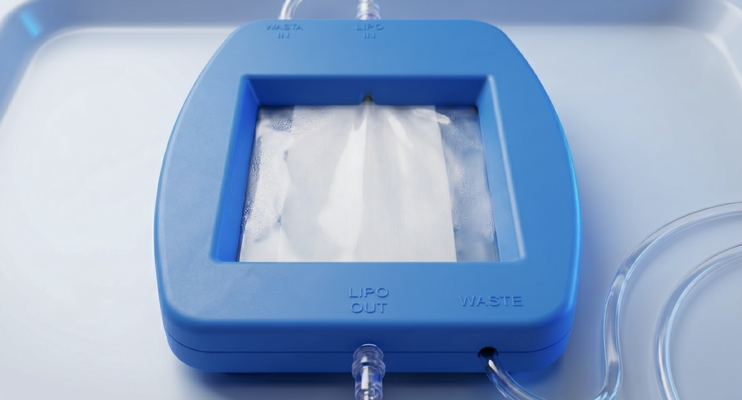
The Fat Dialysing Station is the core of the EXAFAT system. It uses a semi-permeable microfiltration barrier to purify the harvested lipoaspirate through a continuous, active washing process. Liquid waste — oil, red blood cells, aqueous contaminants, inflammatory mediators — is designed to pass through the membrane under controlled hydrostatic pressure, while adipose tissue is retained and gently washed across processing cycles.
The intended output is a graft of uniform composition: oil-free, RBC-free, with structural integrity maintained. In technical evaluation, EXAFAT-dialysed fat retained 20% (±5%) of clean fluid, compared to 33% (±6%) of non-purified fluid observed with traditional decantation — a measurable difference in the composition of the processed material prior to transfer.⁶
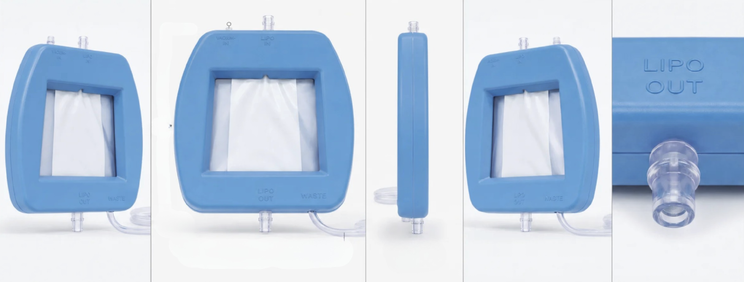
The closed-loop design processes up to 200 mL per cycle, making the system applicable across procedure volumes from subtle contouring and defect correction through to large-volume grafting — with the same methodology applied throughout.
For context on why purification methodology matters: independent comparative research on fat processing techniques has shown that centrifugation — currently the most widely used purification method — is associated with greater cell structure damage and viability decline compared to filtration-based approaches.⁷ This published evidence relates to processing techniques as a category; EXAFAT’s Fat Dialysing Station is designed around the filtration principle that this body of research supports.
04 — Injection Cannulas × 2
Blunt tips | 150 mm × 2.1 mm Ø
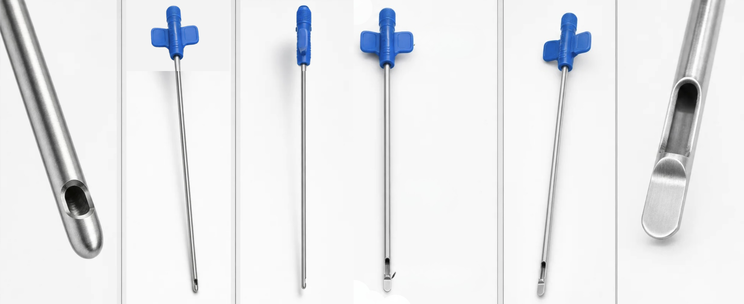
Two blunt-tip injection cannulas are included for the transfer phase. Blunt-tip design is intended to reduce the risk of inadvertent intravascular injection — a documented safety consideration in breast fat grafting procedures. The 2.1 mm diameter is consistent with ranges used in published breast fat grafting protocols.
05 — Subcision Needle
16G | 150 mm ultra-sharp
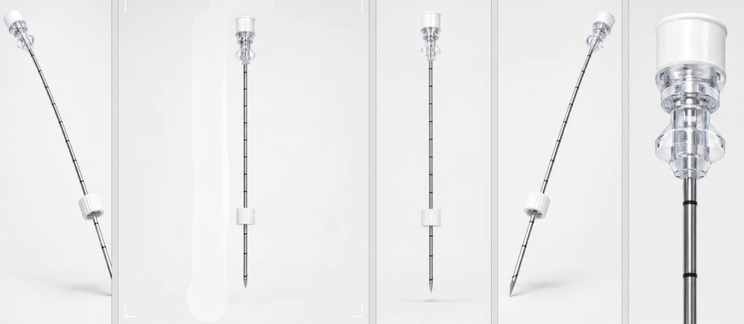
The subcision needle supports recipient site preparation prior to fat transfer. Subcision is used to release fibrotic tissue — particularly relevant in post-mastectomy reconstruction cases involving radiation-induced fibrosis, where the mechanical environment of the recipient site can limit graft contact with vascularised tissue.
Additional components: 16G × 90 mm Needle · FLL-FLL Connector · Sterile / Single Use
Clinical Applications
EXAFAT is indicated for use across the following breast surgery contexts:
Reconstruction — Post-mastectomy fat grafting, as a standalone approach or as an adjunct to implant-based or autologous flap reconstruction. The system’s scalable processing capacity is designed to accommodate the volume range encountered in reconstructive procedures.
Augmentation — Primary breast volume enhancement with autologous fat. The standardised workflow is designed to produce consistent graft material across augmentation cases.
Explantation — Autologous fat grafting in the context of implant removal, where volume replacement with the patient’s own tissue is indicated. EXAFAT’s capacity accommodates the variable volumes required across explantation cases.
Reshaping — Correction of contour irregularities, asymmetry, and post-surgical defects in both reconstructive and aesthetic settings. The blunt-tip injection cannulas are designed to support targeted, precise placement in reshaping applications.
The Design Rationale: Evidence-Informed Engineering
Each component of EXAFAT reflects a design decision informed by published clinical science. The intent is not to replace the surgeon’s skill or clinical judgement, but to provide a standardised system that addresses the process-level variables the literature identifies as contributing to variability in fat graft outcomes.
The key published evidence informing EXAFAT’s design:
Cannula size and adipocyte survival: Research on the impact of cannula diameter on adipocyte viability supports the use of smaller-bore harvesting instruments.³
Fat lobule size and graft retention: Studies on particle size in lipofilling demonstrate that harvesting technique affects lobule size, and that smaller lobules are associated with improved retention in published series.⁴
Vacuum pressure and cellular damage: Published evidence identifies excessive negative pressure during harvest as a source of avoidable adipocyte damage, with 300 mmHg referenced as a threshold in the literature.⁵
Filtration versus centrifugation: Independent comparative studies on fat processing techniques provide published support for filtration-based approaches over centrifugation in terms of cellular integrity and viability.⁷
These citations describe published findings about fat grafting techniques and processing methods as categories. They form the evidence base that informed EXAFAT’s engineering — they do not represent claims about EXAFAT’s own clinical outcomes, which are subject to the device’s clinical evaluation documentation.
Where EXAFAT Is Used
EXAFAT is in clinical use across breast surgery programmes in Europe, the Middle East, and Latin America, including in the United Kingdom, Italy, Spain, France, Belgium, Switzerland, Austria, the Netherlands, Luxembourg, Portugal, Ireland, Israel, Saudi Arabia, the UAE (Dubai), Qatar, Oman, Bahrain, Kuwait, and Chile.
The system is used in both hospital-based breast surgery departments and specialist private practice settings across reconstructive, oncoplastic, and aesthetic breast surgery contexts.
A Single System. Every Step.
“The same tools, methodology, and techniques are applied in every case — designed to ensure a reproducible process and more consistent results.” — Advanced Biomedical Concept
EXAFAT was designed so that the workflow from harvest to purification to transfer follows the same standardised path in every procedure. The aim is to reduce the process-driven variability that the published literature links to inconsistent fat graft outcomes — leaving the clinical result as a function of the biology and the surgeon’s skill, not the processing step.
For clinical documentation, step-by-step procedural video, or to request a demonstration, visit advancedbioconcept.com/exafat or contact your Advanced Biomedical Concept clinical representative.
References
- Volume retention rate after breast autogenous fat grafting and related influencing factors: A systematic review and meta-analysis. Journal of Plastic, Reconstructive & Aesthetic Surgery, 2023. https://www.sciencedirect.com/science/article/abs/pii/S1748681523007829
- Immediate Oncoplastic Breast Reconstruction with Fat Grafting: Preliminary Radiological, Aesthetic, and Patient Satisfaction Outcomes. PMC, 2025. https://www.ncbi.nlm.nih.gov/pmc/articles/PMC12423156/
- The impact of liposuction cannula size on adipocyte viability. PubMed, 2012. https://pubmed.ncbi.nlm.nih.gov/22964677/
- Particle size in fat graft retention: A review on the impact of harvesting technique in lipofilling surgical outcomes. PMC, 2015. https://www.ncbi.nlm.nih.gov/pmc/articles/PMC4550681/
- The effects of the size of liposuction cannula on adipocyte survival and the optimum temperature for fat graft storage. ScienceDirect, 2008. https://www.sciencedirect.com/science/article/abs/pii/S1748681508003562
- EXAFAT Fat Dialysing System — Technical Data. Advanced Biomedical Concept. https://advancedbioconcept.com/exafat/
- Comparative Analysis of a New Automatic System and Four Existing Techniques for Autologous Fat Grafting. PRS Global Open, 2023. https://pmc.ncbi.nlm.nih.gov/articles/PMC10578716/
© Advanced Biomedical Concept 2026. Intended for healthcare professionals. Statistics cited from published literature describe fat grafting procedures as a category and are not attributable to EXAFAT-specific clinical outcomes unless otherwise noted. All promotional use of this content is subject to regulatory review in accordance with EU MDR 2017/745.
Important information This article is general education, not medical advice. Tap to read the full medical, regulatory & legal notice.
This article is provided by Advanced Biomedical Concept for general informational and educational purposes only. It does not constitute medical, surgical, diagnostic, or other professional healthcare advice, and it is not a substitute for consultation with a suitably qualified healthcare professional. Reading it creates no doctor–patient or other professional relationship. Nothing here should be used to diagnose, treat, cure, or prevent any disease or condition, or to make decisions about medical care. Always seek the advice of a physician or other qualified provider with any questions about a medical condition or treatment, and never disregard or delay professional advice because of something you have read here.
Any reference to Advanced Biomedical Concept products (including ExaShape and ExaFat) is provided for general information only. These are medical devices intended to be used by appropriately trained healthcare professionals strictly in accordance with their applicable, current Instructions for Use (IFU). Regulatory status (including CE marking and classification under the EU Medical Device Regulation), market availability, and approved indications differ between countries and may change over time; a device referred to here may not be available or approved in your country. This content is not intended as, and must not be relied upon as, a statement or claim of safety, clinical performance, or efficacy beyond what is set out in the applicable IFU and current regulatory approvals. Product-specific information is directed at healthcare professionals and is not intended to promote, advertise, or offer any medical device to the general public where such promotion is restricted or prohibited by law.
Statements reflect information believed to be accurate at the date of publication and may be updated or corrected without notice. Any statements regarding the future are expectations or general views, not guarantees. Clinical outcomes depend on many individual factors, results vary from person to person, and no particular result is promised or implied. Where third-party studies, sources, or external links are referenced, they are provided for convenience and information only and do not imply endorsement, and Advanced Biomedical Concept is not responsible for their content.
To the fullest extent permitted by applicable law, Advanced Biomedical Concept and its officers, employees, contributors, and representatives (each acting in that capacity and on behalf of Advanced Biomedical Concept) accept no liability for any loss, injury, or damage of any kind arising directly or indirectly from use of, or reliance on, this content. Nothing in this notice excludes or limits any liability that cannot lawfully be excluded or limited.
Questions about this material can be directed to us via our contact page.
Last reviewed: July 21, 2026.