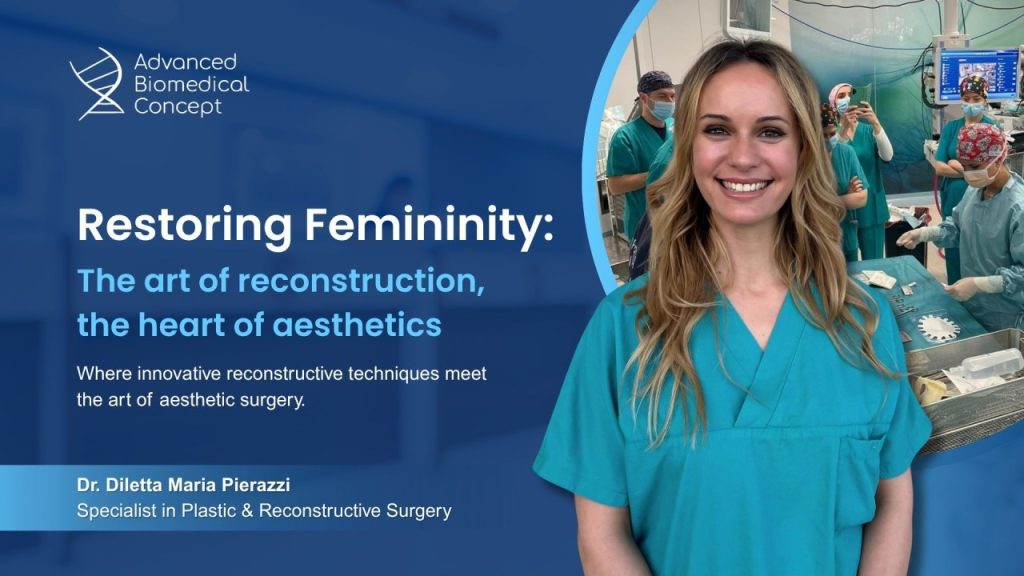
It’s not often you meet a surgeon who speaks about ‘magic’ and ‘vocation’ in the same breath as ‘biological matrices’ and ‘pre-pectoral planes.’ We spent time with Dr. Diletta Maria Pierazzi to learn about her unique journey through the world of plastic surgery. As the sole plastic surgeon for the Breast Units in Arezzo and Grosseto, Diletta is redefining the patient experience by blending top-tier aesthetic precision with a woman-to-woman empathy that turns clinical care into a path of true personal recovery.
Q1. Your career has taken you from the lecture halls of Siena and Pisa to Stockholm for a prestigious specialization in aesthetic surgery. It was there that your 360-degree vision of plastic surgery matured. Was there a specific moment when you realized that breast reconstruction would be your vocation – a way to perfectly bridge the aesthetic and reconstructive souls of your craft?
During my residency, I tried to learn as much as possible across all fields of plastic surgery. I had a real “hunger” for the operating room. I aimed to be as autonomous as possible by the end of those five years, which proved fundamental; I’ve been a specialist for three years now, and I immediately began working in the Breast Units of Arezzo and later Grosseto as the sole plastic surgeon for those facilities. My passion for breast reconstruction matured gradually, but as time passed, I realized it would become my primary focus. In my work within breast units, I strive to merge reconstructive and aesthetic techniques to perform increasingly innovative and functional procedures.
My passion for breast reconstruction matured gradually, but I soon realized it was my true vocation – the perfect bridge between reconstructive surgery and aesthetic art.
Q2. You specialized at the University of Siena, but your path led you to collaborate with various hospital and university structures for your scientific work. How has engaging with such diverse environments shaped your multidisciplinary approach?
Engaging with colleagues has been vital to my training and growth. Collaboration with other institutions is essential in all specialties, but particularly in plastic surgery. it makes the surgeon more well-rounded, providing a better “big picture” view and the preparation needed to tackle the diverse clinical cases we encounter.

Q3. Just a few days ago, nine surgeons from Breast Units across Tuscany and Emilia-Romagna came to Arezzo to learn your pre-pectoral technique. For those not in the field, could you explain the “philosophy” behind using implants and biological matrices that allow you to leave the pectoral muscle untouched?
Many surgical techniques can be used during reconstruction. The technique I presented involves a type of breast reconstruction that happens simultaneously with the oncological mastectomy. It involves using an implant covered by a biological matrix, positioned in the pre-pectoral plane – meaning there is no need to lift the pectoralis major muscle. It requires great technical precision, but when executed correctly, we achieve results that are highly satisfying for both the patient and the surgeon, both aesthetically and functionally. I have been performing this technique for some time in the Breast Units where I work. The philosophy is to reconstruct the patient immediately (oncological situation permitting) in the most definitive way possible.
The goal is to reconstruct immediately. I want my patients to feel well emotionally from the start, bypassing intermediate steps and returning to their lives with confidence.
Q4. You perform reconstruction at the same time as the removal, eliminating the need for tissue expanders. What does this “single-stage” approach mean for the patient—not just clinically, but in terms of emotional well-being?
I always try to reconstruct immediately after the oncological removal of the tumor using a single-stage approach. For me, it is essential to give the patient a reconstruction that is as definitive as possible, avoiding the need for multiple surgeries to reach a satisfying result—such as the intermediate step of an expander. Obviously, this isn’t possible in every case, but my goal is always to reconstruct. I want the patient to feel well emotionally right from the start. In my view, this is only possible if they can regain a self-image they recognize as soon as possible, ensuring their femininity isn’t altered by the tumor removal surgery.
Q5. Your work is based on a very close synergy with breast surgeons, particularly Dr. Gjondedaj. How do you build the harmony necessary for that perfect “passing of the baton” in the operating room?
Working in a multidisciplinary team is always the winning strategy. We have perfect synergy in the OR: Dr. Ulpjana Gjondedaj handles the removal and I handle the reconstruction. We work side-by-side to guarantee the patient the best possible treatment. We study the cases together and define the best technique, because a good reconstruction always starts with a good removal in terms of tissue preservation. We are colleagues who share deep professional respect, but we are also friends, which makes everything even more rewarding.

Q6. Regarding complications, capsular contracture is a major concern. Based on your experience and research, how has the approach to preventing this issue changed in modern implant reconstruction?
Capsular contracture – a thickening or hardening of the periprosthetic capsule – is a complication that can occur following implant placement for both aesthetic and reconstructive purposes. The formation of a capsule around an implant is a physiological process; it becomes pathological when that process is altered (even long after surgery), leading to a hard, thick capsule that causes pain and breast deformity. While we cannot completely prevent this complication due to unknown and unpredictable factors, using latest-generation implants, preventing infections, and employing the correct surgical technique are decisive in reducing the risk.
Q7. We know you are finalizing a study on immediate breast reconstruction using Exashape biological matrix, a technique you use in both Arezzo and Grosseto. What is emerging from this analysis regarding patient outcomes?
I am currently finishing the publication of my case studies on the breast reconstruction technique using the Exashape matrix to coat the implants. Preliminary results are very encouraging regarding short- and long-term complications, aesthetic outcomes, and functional recovery post-surgery. However, careful patient selection is essential for this type of reconstruction.

Q8. You practice across several locations: Arezzo, Grosseto, and Florence. When you close the OR doors, what does Diletta do to decompress and recharge?
Working as a plastic surgeon, both in the hospital and the clinic, requires a lot of time and energy, so there is little room for much else. However, I love traveling and I use my few free hours to “see the world.” But if I’m being completely honest, the best way to regenerate is a classical dance class. Ballet has been my great passion since I was a child; it allows me to recharge my batteries and, above all, it transports me to another dimension that I can only describe as magical.
Q9. In your work, the relationship with your patients is a cornerstone of the healing journey. In a surgical field often perceived as cold, how vital is it for you to build a synergy based on empathy and a deep understanding of each patient’s emotional needs?
The bond created with patients is very strong, partly because I am the sole plastic surgeon at these facilities; they meet me at the pre-op visit, see me in the OR, and return to me for all post-op checkups. I always try to empathize with them to understand their fears, doubts, and desires, seeking to reassure them and offer emotional support. A deep bond is almost always formed; they trust me completely, which gives me an enormous sense of responsibility. I believe the woman-to-woman connection helps patients feel more understood and welcomed. Patients often tell me at the end of their journey that they consider me a family member, which is a beautiful thing.
A deep bond is almost always formed; my patients trust me completely, and that gives me an enormous sense of responsibility
Q10. You maintain that it is wonderful to unite the concepts of aesthetic and reconstructive surgery. Why do you believe these two “souls” of plastic surgery must feed into each other?
My training covered both aesthetic and reconstructive surgery. Today, I deal mainly with breast reconstruction, but I prefer to call it “aesthetic breast reconstruction.” This is because, in my view, the purely reconstructive aspect after oncology must be completed by the aesthetic side. I try to adopt aesthetic surgery techniques in reconstructive cases to achieve a result that is satisfying both aesthetically and functionally. My goal is for patients to feel good, look good, feel feminine, and recognize themselves in a body that is different from before, yet still harmonious and beautiful.

Q11. If you could go back in time and give the Diletta who was just starting her residency one tool or technology you use today, what would you choose?
I probably would have liked to have the Artificial Intelligence tools we have now – not as a replacement for the human element, but as an aid for study and for resolving doubts more quickly and efficiently.
Q12. Today, colleagues travel to Arezzo to observe your work. If the roles were reversed, which operating room in the world would you like to spend a day in to continue innovating your technique?
There isn’t a single place I want to go; rather, I always want to see my colleagues operate so I can discuss the practical and technical aspects of our work with each of them. I believe you can learn from everyone. To improve, we must always be willing to put ourselves out there and think critically about our own work. Therefore, the best thing is always the dialogue with others.
A woman should look in the mirror after surgery and not just see a result, but recognize herself – harmonious, feminine, and beautiful.
A heartfelt thank you to Dr. Diletta Maria Pierazzi for her time and for the passion she brings to the operating room every day. Her success in immediate, single-stage reconstruction is driven by a unique blend of technical skill and the use of cutting-edge materials like Exashape.
Together, they represent the new standard in care -where innovation meets the heart to redefine what is possible in modern reconstruction.
Important information This article is general education, not medical advice. Tap to read the full medical, regulatory & legal notice.
This article is provided by Advanced Biomedical Concept for general informational and educational purposes only. It does not constitute medical, surgical, diagnostic, or other professional healthcare advice, and it is not a substitute for consultation with a suitably qualified healthcare professional. Reading it creates no doctor–patient or other professional relationship. Nothing here should be used to diagnose, treat, cure, or prevent any disease or condition, or to make decisions about medical care. Always seek the advice of a physician or other qualified provider with any questions about a medical condition or treatment, and never disregard or delay professional advice because of something you have read here.
Any reference to Advanced Biomedical Concept products (including ExaShape and ExaFat) is provided for general information only. These are medical devices intended to be used by appropriately trained healthcare professionals strictly in accordance with their applicable, current Instructions for Use (IFU). Regulatory status (including CE marking and classification under the EU Medical Device Regulation), market availability, and approved indications differ between countries and may change over time; a device referred to here may not be available or approved in your country. This content is not intended as, and must not be relied upon as, a statement or claim of safety, clinical performance, or efficacy beyond what is set out in the applicable IFU and current regulatory approvals. Product-specific information is directed at healthcare professionals and is not intended to promote, advertise, or offer any medical device to the general public where such promotion is restricted or prohibited by law.
Statements reflect information believed to be accurate at the date of publication and may be updated or corrected without notice. Any statements regarding the future are expectations or general views, not guarantees. Clinical outcomes depend on many individual factors, results vary from person to person, and no particular result is promised or implied. Where third-party studies, sources, or external links are referenced, they are provided for convenience and information only and do not imply endorsement, and Advanced Biomedical Concept is not responsible for their content.
To the fullest extent permitted by applicable law, Advanced Biomedical Concept and its officers, employees, contributors, and representatives (each acting in that capacity and on behalf of Advanced Biomedical Concept) accept no liability for any loss, injury, or damage of any kind arising directly or indirectly from use of, or reliance on, this content. Nothing in this notice excludes or limits any liability that cannot lawfully be excluded or limited.
Questions about this material can be directed to us via our contact page.
Last reviewed: June 16, 2026.