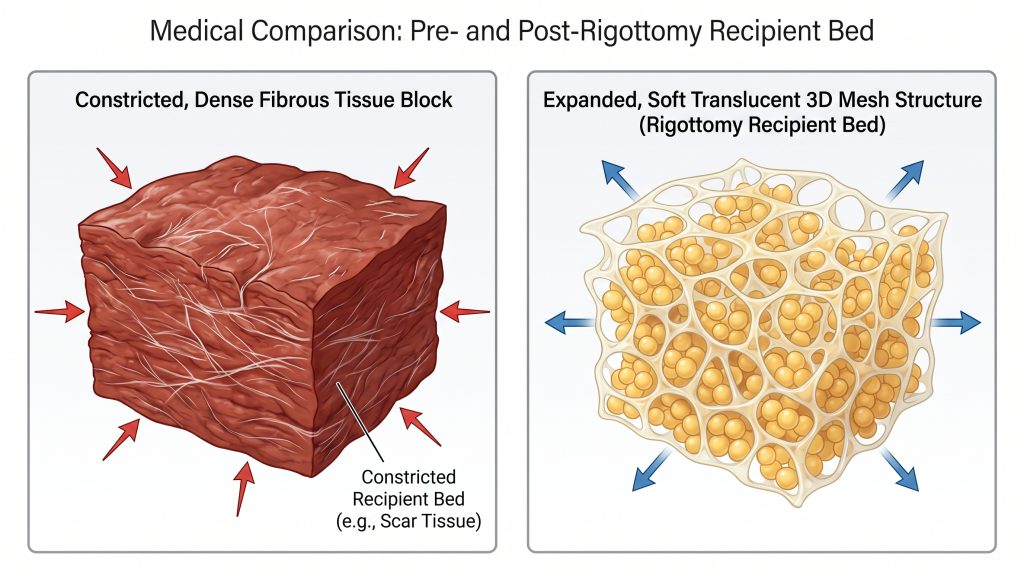
In autologous fat grafting, graft survival is decided less by how the fat is injected than by the tissue it is injected into. Rigottomia (rigottomy) is the percutaneous manoeuvre that reconditions that recipient site — releasing fibrosis, expanding volume and increasing vascular access — so the seeded graft has somewhere to live. This is a professional overview of how rigottomia prepares the recipient bed and why it complements clean fat grafting technique.
The recipient site is the rate-limiting factor
Grafted adipocytes survive by diffusion until neovascularisation reaches them, typically within the first days. Anything that increases the distance between a fat parcel and a perfused surface — large boluses, high injection pressure, or a stiff, hypovascular bed — pushes graft centres beyond the reach of diffusion and drives resorption and, in the worst case, oil cysts and fat necrosis. In fibrotic, irradiated or scarred tissue the bed itself is the constraint: it is non-compliant, offers little interstitial space, and is poorly vascularised.
What rigottomia does mechanically
Passing a fine needle or blade percutaneously, the surgeon performs multiple small releases (classically around 2 mm) through the restrictive fibrous septa and subdermal aponeurosis. The effect is threefold:
- Release. Contracted bands that tether and restrict the tissue are divided, so the site becomes compliant and can accommodate graft volume without high pressure.
- Expansion. The many micro-releases open a lattice of small cavities, increasing the three-dimensional volume of the recipient matrix while avoiding the macrocavities that lead to pooling and graft failure.
- Vascular access. The controlled micro-injury and released architecture present more perfused surface area to each seeded fat parcel — the essential requirement for early graft nutrition.
The goal is a vascularised, compliant scaffold of micro-cavities to be seeded with micrografts — not an empty pocket to be filled.
Rigottomia within a recipient-site conditioning strategy
Percutaneous release is most powerful as one element of a wider conditioning approach, popularised by Rigotti and Khouri. External tissue expansion applied before grafting increases recipient-site vascularity and interstitial volume; percutaneous rigottomia releases the aponeurotic restraint that limits that expansion; and structural, low-pressure micrografting distributes the graft as fine parcels through the prepared bed. Percutaneous aponeurotomy plus lipofilling has been described in the literature as a regenerative alternative to flap reconstruction in selected defects for precisely this reason.
Graft quality still matters
A well-prepared bed cannot rescue a poorly processed graft. Gentle, low-negative-pressure harvest and processing that removes blood, oil and cellular debris while preserving adipocyte integrity and the regenerative stromal vascular fraction give the seeded parcels their best chance. Closed-system washing and concentration — the principle behind fat dialysis and systems such as EXAFAT — is aimed at exactly this: cleaner, better-preserved fat to seed into the released matrix. Recipient-site preparation and graft quality are complementary levers, not alternatives.
Patient selection and judgement
Rigottomia is most valuable where the recipient bed is the problem: mature scars, burn contractures, irradiated skin, tethered reconstruction sites and congenital fibrous constriction. It is technique-dependent — too aggressive and confluent a release risks macrocavities and vascular compromise; too timid and the fibrosis is not meaningfully released. As with all grafting, staged sessions are often more predictable than attempting excessive volume in a single pass, and outcomes depend on tissue quality, technique and patient factors.
The bottom line
Rigottomia reconditions the recipient site — releasing fibrosis, expanding volume and improving vascular access — so that structural fat grafting can succeed in tissue that would otherwise reject it. Paired with clean, well-preserved fat, it is a core tool for grafting into scarred, irradiated and constricted beds. For the processing side, see our overview of fat processing quality and fat dialysis.
This is a general professional overview of a surgical technique, not clinical guidance or a treatment protocol. Follow current evidence, device instructions for use and local governance.
Important information This article is general education, not medical advice. Tap to read the full medical, regulatory & legal notice.
This article is provided by Advanced Biomedical Concept for general informational and educational purposes only. It does not constitute medical, surgical, diagnostic, or other professional healthcare advice, and it is not a substitute for consultation with a suitably qualified healthcare professional. Reading it creates no doctor–patient or other professional relationship. Nothing here should be used to diagnose, treat, cure, or prevent any disease or condition, or to make decisions about medical care. Always seek the advice of a physician or other qualified provider with any questions about a medical condition or treatment, and never disregard or delay professional advice because of something you have read here.
Any reference to Advanced Biomedical Concept products (including ExaShape and ExaFat) is provided for general information only. These are medical devices intended to be used by appropriately trained healthcare professionals strictly in accordance with their applicable, current Instructions for Use (IFU). Regulatory status (including CE marking and classification under the EU Medical Device Regulation), market availability, and approved indications differ between countries and may change over time; a device referred to here may not be available or approved in your country. This content is not intended as, and must not be relied upon as, a statement or claim of safety, clinical performance, or efficacy beyond what is set out in the applicable IFU and current regulatory approvals. Product-specific information is directed at healthcare professionals and is not intended to promote, advertise, or offer any medical device to the general public where such promotion is restricted or prohibited by law.
Statements reflect information believed to be accurate at the date of publication and may be updated or corrected without notice. Any statements regarding the future are expectations or general views, not guarantees. Clinical outcomes depend on many individual factors, results vary from person to person, and no particular result is promised or implied. Where third-party studies, sources, or external links are referenced, they are provided for convenience and information only and do not imply endorsement, and Advanced Biomedical Concept is not responsible for their content.
To the fullest extent permitted by applicable law, Advanced Biomedical Concept and its officers, employees, contributors, and representatives (each acting in that capacity and on behalf of Advanced Biomedical Concept) accept no liability for any loss, injury, or damage of any kind arising directly or indirectly from use of, or reliance on, this content. Nothing in this notice excludes or limits any liability that cannot lawfully be excluded or limited.
Questions about this material can be directed to us via our contact page.
Last reviewed: July 28, 2026.