When one breast is rebuilt, it is judged next to the other one. A patient who sees two different breasts in the mirror will not feel her reconstruction is finished. Surgery on the other breast to make the two match is called symmetrisation. This article explains how often it is needed, when to do it, and what it adds.
In short
- Many patients need surgery on the other breast, especially when the breasts are large.
- Doing it in the same operation is as safe as doing it later.
- It makes patients more satisfied only when it gives a better match.
- Breasts drift apart over the years, so a later touch-up is normal.
How often it is needed
In the largest of these studies, 249 women with cancer in one breast, 63% had the other breast adjusted and the rest had it removed and rebuilt as well.1 In large, drooping breasts it is close to routine.2
The need can also appear later. A natural breast changes with age and weight. An implant changes much less.4
Same operation, or later?
Surgeons used to wait until the rebuilt breast had settled. Newer evidence shows that doing both together is at least as safe.
A 2025 pooled analysis of 11 studies and 1,263 patients found no significant difference in complications, bleeding, skin loss or return operations between the two timings.5 Most of those patients had reconstruction with their own tissue, not implants. A 2024 review reached a similar result, and found patients were more satisfied with their breasts when both were done together.6
In one series of 48 patients, the matching surgery had to be redone in 2 of 31 patients who had it at the same time and 6 of 17 who had it later.7
Does it make patients more satisfied?
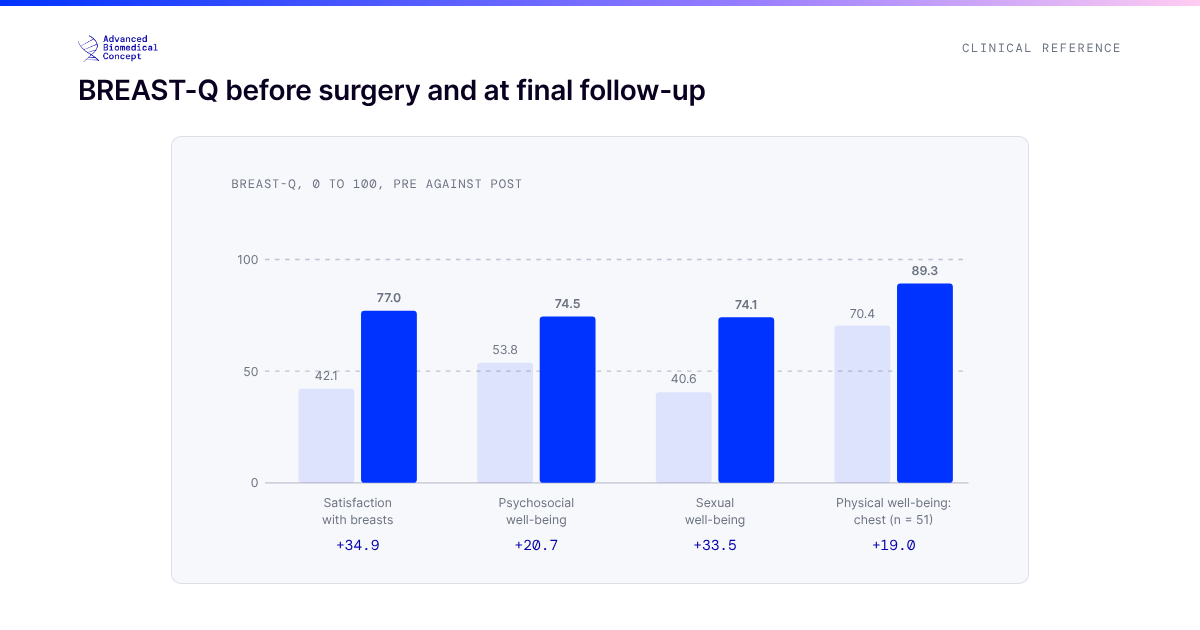
Only when it improves the result. In the Riccio 2026 study of 56 women, satisfaction followed the look of the final result very closely. Once that was taken into account, having had surgery on the other breast made no separate difference.3 Most of those women had ExaShape® as the matrix on the rebuilt side. The paper does not credit the results to it.
Patients are satisfied by two breasts that look as if they belong together, not by the extra operation itself.
One more finding helps with counselling. Compared with removing and rebuilding the healthy breast, adjusting it gave similar satisfaction at 12 months. But chest comfort fell by about 6 points after an adjustment and rose by about 3 after removal and rebuilding.1 It is a smaller operation, but it is still an operation.
Which procedure
The other half of the plan is often fat grafting to the rebuilt side, to add volume where it is missing. See hybrid reconstruction with implant and fat grafting.
What it means in practice
Talk about the other breast at the first visit. Plan both sides together. Offer surgery in the same operation when the result is predictable and radiotherapy is not expected. Wait when either is uncertain. And tell patients that breasts drift apart with time, so a later adjustment is normal care.
References
- Bitoiu B, Grigor E, Hardy J, et al. Symmetric breast surgery: balancing procedures versus prophylactic mastectomy and immediate reconstruction. Plast Reconstr Surg. 2024;153(4):777-784. doi:10.1097/PRS.0000000000010713
- Bonomi S, Sala L, Gennaro M, Ricci C, Cortinovis U. Skin-reducing mastectomy and direct-to-implant breast reconstruction with submuscular-dermal-mesh pocket. Ann Plast Surg. 2019;82(1):19-27. doi:10.1097/SAP.0000000000001614
- Riccio M, Zingaretti N, Aquinati A, et al. Oncoaesthetic breast reconstruction after mastectomy improves patient satisfaction and aesthetic outcomes. Clin Breast Cancer. 2026;26(10):134-146. doi:10.1016/j.clbc.2026.08.025
- Nahabedian MY. What are the long-term aesthetic issues in prepectoral breast reconstruction? Aesthet Surg J. 2020;40(Suppl 2):S29-S37. doi:10.1093/asj/sjaa164
- Wang CY, Montalmant KE, Peng T, et al. The safety of simultaneous versus delayed contralateral breast symmetrization: systematic review and meta-analysis. J Plast Reconstr Aesthet Surg. 2025;105:348-358. doi:10.1016/j.bjps.2025.04.023
- AlQhtani A. Immediate symmetrization of the contralateral breast in breast reconstruction: revision, complications, and satisfaction. A systematic review. Plast Reconstr Surg Glob Open. 2024;12(2):e5586. doi:10.1097/GOX.0000000000005586
- Laporta R, Longo B, Sorotos M, Pagnoni M, Santanelli Di Pompeo F. One-stage DIEP flap breast reconstruction: algorithm for immediate contralateral symmetrization. Microsurgery. 2016;36(1):7-19. doi:10.1002/micr.22390
Important information This article is general education, not medical advice. Tap to read the full medical, regulatory & legal notice.
This article is provided by Advanced Biomedical Concept for general informational and educational purposes only. It does not constitute medical, surgical, diagnostic, or other professional healthcare advice, and it is not a substitute for consultation with a suitably qualified healthcare professional. Reading it creates no doctor–patient or other professional relationship. Nothing here should be used to diagnose, treat, cure, or prevent any disease or condition, or to make decisions about medical care. Always seek the advice of a physician or other qualified provider with any questions about a medical condition or treatment, and never disregard or delay professional advice because of something you have read here.
Any reference to Advanced Biomedical Concept products (including ExaShape and ExaFat) is provided for general information only. These are medical devices intended to be used by appropriately trained healthcare professionals strictly in accordance with their applicable, current Instructions for Use (IFU). Regulatory status (including CE marking and classification under the EU Medical Device Regulation), market availability, and approved indications differ between countries and may change over time; a device referred to here may not be available or approved in your country. This content is not intended as, and must not be relied upon as, a statement or claim of safety, clinical performance, or efficacy beyond what is set out in the applicable IFU and current regulatory approvals. Product-specific information is directed at healthcare professionals and is not intended to promote, advertise, or offer any medical device to the general public where such promotion is restricted or prohibited by law.
Statements reflect information believed to be accurate at the date of publication and may be updated or corrected without notice. Any statements regarding the future are expectations or general views, not guarantees. Clinical outcomes depend on many individual factors, results vary from person to person, and no particular result is promised or implied. Where third-party studies, sources, or external links are referenced, they are provided for convenience and information only and do not imply endorsement, and Advanced Biomedical Concept is not responsible for their content.
To the fullest extent permitted by applicable law, Advanced Biomedical Concept and its officers, employees, contributors, and representatives (each acting in that capacity and on behalf of Advanced Biomedical Concept) accept no liability for any loss, injury, or damage of any kind arising directly or indirectly from use of, or reliance on, this content. Nothing in this notice excludes or limits any liability that cannot lawfully be excluded or limited.
Questions about this material can be directed to us via our contact page.
Last reviewed: November 16, 2026.