Two biological matrices can look identical on the back table and behave nothing alike. The reason is written into the tissue they came from.
In implant-based breast reconstruction, the biological matrix has become a familiar tool. So familiar, in fact, that many surgeons file every option under a single mental heading: ADM. It is a useful shorthand. It is also a flattening one, because it treats origin tissue as a detail rather than as the variable that shapes everything downstream.
ExaShape is not a dermal matrix. It is acellular bovine pericardium (ABPM), and that is not a marketing distinction. It is a biological one.
Source tissue is not a footnote
Dermis and pericardium do different jobs in the body, and they are built differently to do them. Pericardium is the membrane that surrounds and protects the heart. It is engineered by nature to be a barrier on one face and a biologically active surface on the other. That native duality is the starting point for everything ExaShape does in the reconstructive pocket.
When a matrix is chosen, the surgeon is not only selecting a thickness or a shape. They are inheriting the biological behaviour of the source tissue: how it integrates, how it vascularises, how it remodels, and how the surrounding tissue responds to it. Origin is not the fine print. It is the specification.
What “gently processed” actually protects
ExaShape is obtained by processing the pericardium of cattle through a multiphasic process. The purpose of that process is twofold: it ensures pathogen inactivation, and it does so while maintaining the three-dimensional structure of the collagen and its biomechanical properties.
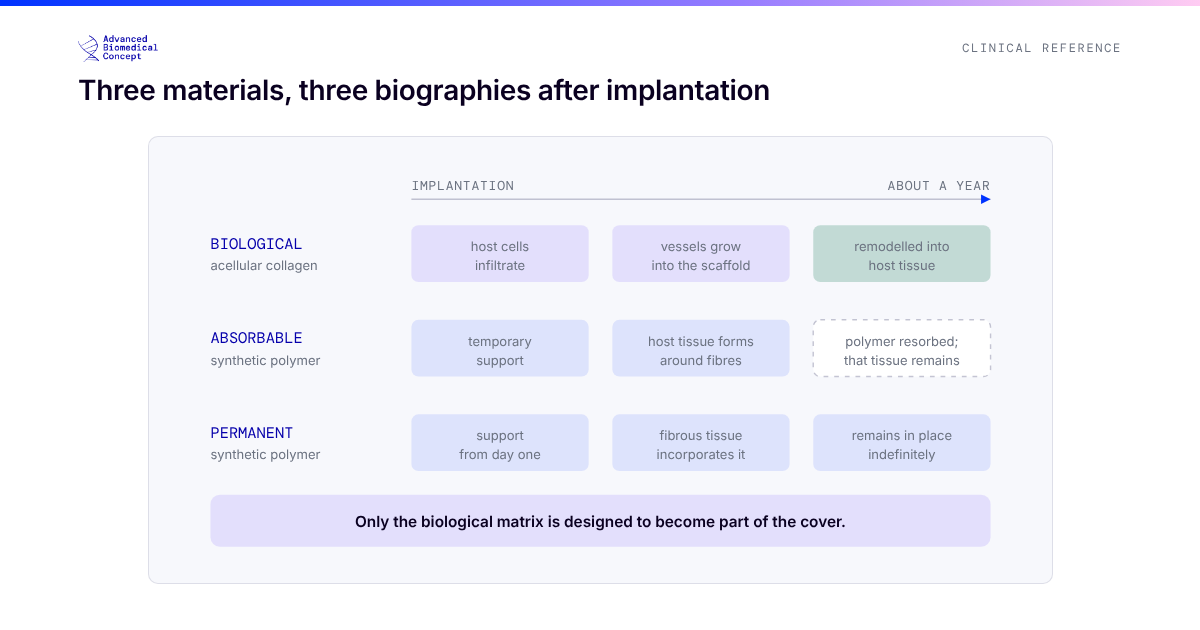
This matters because processing is where many biological matrices lose the very properties that made the source tissue useful. ExaShape is non-crosslinked, which leaves the native collagen architecture available for the body to recognise, populate, and remodel on its own terms. The device arrives as a scaffold the tissue can read, not as an inert sheet the tissue must work around.
A membrane built in two layers
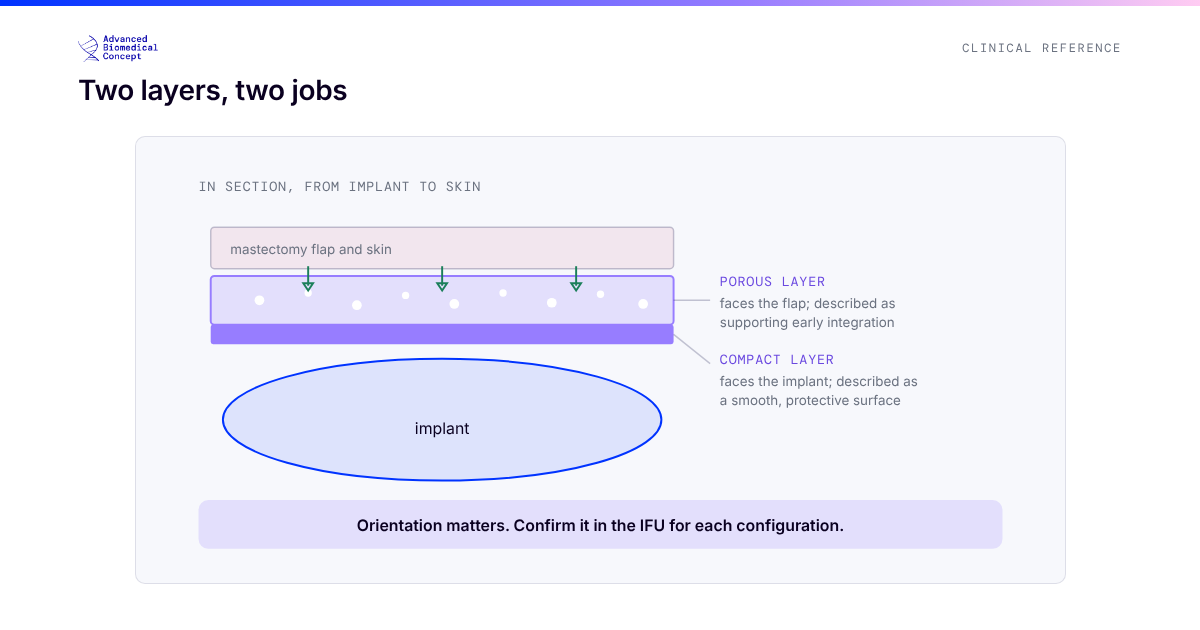
Because ExaShape preserves the original structure of the bovine pericardium, it arrives as a genuine bilayer, and each layer has a distinct role.
The compact layer faces the implant. Its smooth surface reduces friction against the device, protects it from external factors, and provides structural support.
The porous layer faces the tissue. Its open structure allows an early start to integration, with progressive neovascularization, fibroblast colonization, and collagen formation. That same porosity supports tissue adherence and implant stability.
Most matrices ask the surgeon to accept a single-character material and hope it does two jobs. ExaShape carries both a barrier surface and an integration surface, because that is how the native tissue is built.
Architecture you can see in the clinical record
Architecture is only interesting if it shows up in outcomes. In the largest series to date on prepectoral reconstruction assisted by an ABPM pocket, De Vita and colleagues followed 65 reconstructions with a mean follow-up of 21.3 months. The real-world clinical data recorded no significant cases of Baker III to IV capsular contracture, a 4.3% major complication rate, and a mean surgical time of 1.42 hours (De Vita R, et al. Clinical Breast Cancer. 2024).
The integration story is documented too. Progressive neovascularization within the matrix has been observed across a 12-month period (Varvaras D, et al. St. Gallen 2023), alongside a regulated inflammatory response and controlled periprosthetic remodelling (Bernardini R, et al. J Biomed Mater Res. 2020). These are not properties bolted onto the device. They are the predictable consequence of starting with the right tissue and preserving it.
The material is the strategy
Surgical strategy usually gets framed as technique: the plane, the pocket, the positioning. But the material sets the ceiling on what technique can achieve. A matrix that integrates predictably, vascularises early, and remodels into living, patient-specific collagen is not a passive consumable. It is part of the plan.
So the next time a biological matrix is reached for, the useful question is not “which ADM,” but “which biography.” ExaShape brings the biography of bovine pericardium: bilayer by nature, non-crosslinked, and designed to be read by the tissue it joins.
Not all matrices share a biography. Choose the one built for the job.
Explore the real-world clinical data behind ExaShape in the Evidence Library, or request a demo.
Scientific references
- De Vita R, et al. A Pericardium Bovine Matrix Pocket in DTI Prepectoral Breast Reconstruction. Clinical Breast Cancer. 2024.
- Varvaras D, et al. Use of Acellular Pericardial Biological Mesh for Prepectoral and Dual Plane. St. Gallen 2023.
- Bernardini R, et al. J Biomed Mater Res. 2020.
- Mazzocchi M, et al. PRRS 2022.
Images for illustrative purposes only. For Healthcare Professionals Only. ExaShape is CE marked per EU MDR 2017/745.
Important information This article is general education, not medical advice. Tap to read the full medical, regulatory & legal notice.
This article is provided by Advanced Biomedical Concept for general informational and educational purposes only. It does not constitute medical, surgical, diagnostic, or other professional healthcare advice, and it is not a substitute for consultation with a suitably qualified healthcare professional. Reading it creates no doctor–patient or other professional relationship. Nothing here should be used to diagnose, treat, cure, or prevent any disease or condition, or to make decisions about medical care. Always seek the advice of a physician or other qualified provider with any questions about a medical condition or treatment, and never disregard or delay professional advice because of something you have read here.
Any reference to Advanced Biomedical Concept products (including ExaShape and ExaFat) is provided for general information only. These are medical devices intended to be used by appropriately trained healthcare professionals strictly in accordance with their applicable, current Instructions for Use (IFU). Regulatory status (including CE marking and classification under the EU Medical Device Regulation), market availability, and approved indications differ between countries and may change over time; a device referred to here may not be available or approved in your country. This content is not intended as, and must not be relied upon as, a statement or claim of safety, clinical performance, or efficacy beyond what is set out in the applicable IFU and current regulatory approvals. Product-specific information is directed at healthcare professionals and is not intended to promote, advertise, or offer any medical device to the general public where such promotion is restricted or prohibited by law.
Statements reflect information believed to be accurate at the date of publication and may be updated or corrected without notice. Any statements regarding the future are expectations or general views, not guarantees. Clinical outcomes depend on many individual factors, results vary from person to person, and no particular result is promised or implied. Where third-party studies, sources, or external links are referenced, they are provided for convenience and information only and do not imply endorsement, and Advanced Biomedical Concept is not responsible for their content.
To the fullest extent permitted by applicable law, Advanced Biomedical Concept and its officers, employees, contributors, and representatives (each acting in that capacity and on behalf of Advanced Biomedical Concept) accept no liability for any loss, injury, or damage of any kind arising directly or indirectly from use of, or reliance on, this content. Nothing in this notice excludes or limits any liability that cannot lawfully be excluded or limited.
Questions about this material can be directed to us via our contact page.
Last reviewed: July 1, 2026.