
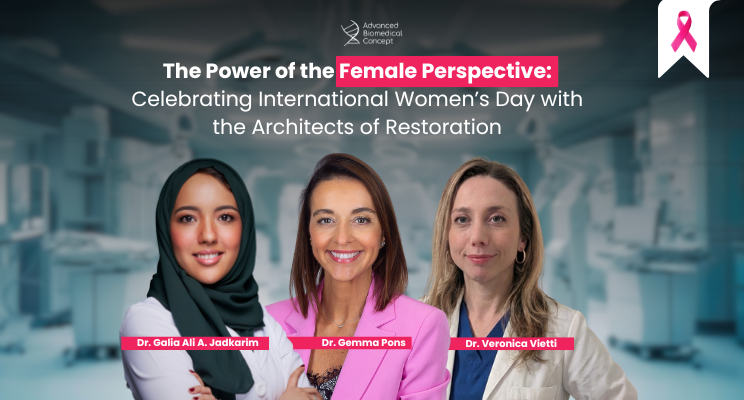
International Women’s Day 2026 marks a pivotal moment in the surgical world. In the specialized field of breast reconstruction, the “human touch” has evolved from a soft skill into a clinical powerhouse. To understand this shift, we sat down with three pioneers: Dr. Veronica Vietti Michelina from Italy, Dr. Gemma Pons MD, PhD from Spain, and Dr. Galia Jadkarim from Saudi Arabia, to discuss the fusion of advanced technology and radical empathy.
When asked about the most significant hurdles they overcame to become leaders in their specialty, the responses revealed a global journey of breaking through cultural glass ceilings. Dr. Vietti recalls her start at the National Cancer Institute in Rome, where the entire staff was male, requiring her to actively value diversity to change the status quo. Dr. Galia shares a similar narrative from Saudi Arabia, noting she was the only female in her batch. She highlights a poignant irony: while some supervisors were obstacles, it was mentors with a different mentality who helped her bypass those hurdles to become Program Director. For Dr. Pons, the challenge was less about gender and more about the relentless dedication required to listen. She believes leadership isn’t planned; it happens naturally when you treat every patient as if you were facing yourself in the mirror.

We then explored the unique empathetic bond between a female surgeon and her patient, and how this influences clinical choices, specifically the move toward “biological texturization” like Exashape. Dr. Vietti describes this bond as a journey toward new self-acceptance, where patients feel free to share dreams and vulnerabilities. Dr. Pons, noting that she is now at an age where the risk of breast cancer is a reality for her peers, uses this sensitivity to advocate for the shortest possible recovery times. Dr. Galia brings this home with a striking comparison to the past. Earlier in her training reconstruction was not an option nowadays she views the procedure as a “gift.” She emphasizes that even if a complex reconstruction takes six hours, the happiness of the patient upon waking makes every minute worth the effort.
In discussing the regional challenges and patient expectations they face today, the surgeons highlighted a shift in public awareness. In Spain, Dr. Pons notes that while patients are well-educated on their rights, the psychological weight of prophylactic mastectomies for young women remains a challenge. She views these women as the “pillars” of their homes and strives to minimize the impact on their bodies. In Saudi Arabia, Dr. Galia navigates a “one-and-done” mentality, where patients expect a single surgery to be a permanent fix despite the biological complexities of healing. Meanwhile, in Italy, Dr. Vietti is focused on the logistics of care, advocating for single-stage reconstructions to reduce waiting lists and prevent the psychological distress of mutilation.

As the conversation turned toward “inspiring inclusion” and advice for the next generation of women in medical school, the message was one of balance and bravery. Dr. Pons urges young women to be brave enough to fail, reminding them that surgery is a human profession involving complications. Dr. Vietti stresses the importance of mentorship to prove that job satisfaction and raising a family are not mutually exclusive. Dr. Galia offers a grounded perspective on the “work-life balance” myth, suggesting that women can indeed have it all, but often in phases. During residency, the focus is the craft; as a consultant, the stability allows for roles as a wife, teacher, and surgeon simultaneously.
Finally, when looking toward the future of technology and the “growth gaps” in the field, the vision is clear: the future is regenerative. Dr. Vietti sees 3D bioprinting -breasts grown in a lab to mimic the patient’s own anatomy- as the ultimate goal. Dr. Galia envisions biological scaffolds that eliminate the “dents” left by lumpectomies, while Dr. Pons dreams of a world where regenerative tissue engineering makes our current invasive methods look ancient.

It was a true privilege to provide a spotlight for these three extraordinary women. Their voices represent a shift in the very soul of medicine, ensuring that the future of breast reconstruction is not just about survival, but about thriving.
We want to thank Dr. Vietti, Dr. Pons, and Dr. Galia for their time and their tireless commitment to their patients. Because their insights were so profound, we want to give them the dedicated space they deserve. Over the next few weeks, we will be sharing each of their interviews singularly, allowing you to dive deeper into their individual stories and surgical philosophies.


